
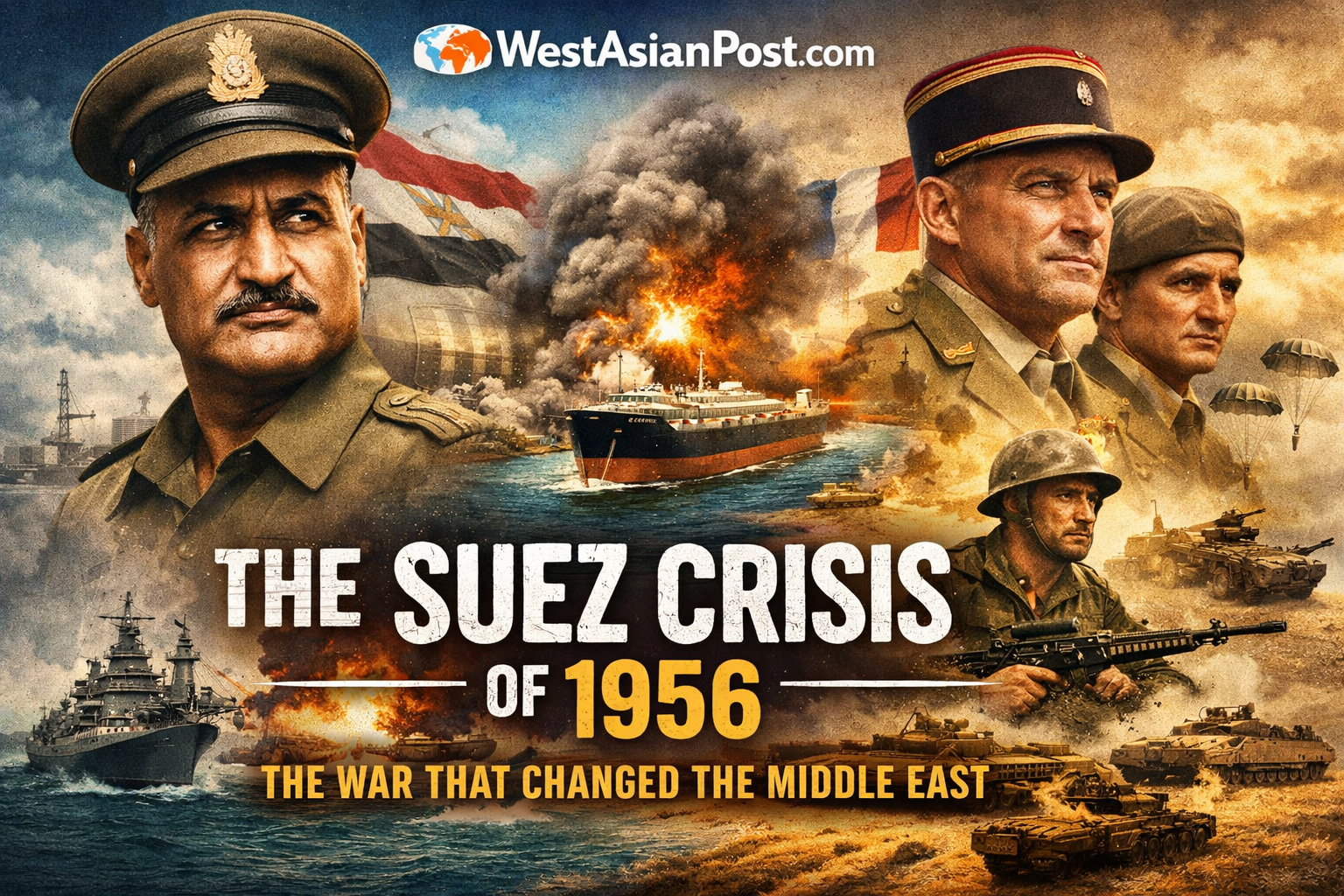
Suez Crisis 1956: The War That Reshaped the Middle East and Marked the End of European Empire.
A comprehensive analysis of the 1956 Suez Canal Crisis, its causes, military conflict, global reactions, and lasting impact on Middle East geopolitics and the decline of British and French imperial power.
Introduction: A Canal That Changed the Course of History
In 1956, a narrow artificial waterway connecting the Mediterranean Sea to the Red Sea became the epicenter of a geopolitical earthquake. The Suez Canal Crisis, also known as the Second Arab-Israeli War or the Tripartite Aggression, was far more than a regional military confrontation—it was a defining moment that signaled the collapse of old imperial powers and the rise of a new global order dominated by the United States and the Soviet Union.
At the heart of the crisis stood a bold and defiant leader—Gamal Abdel Nasser—whose decision to nationalize the Suez Canal ignited a chain reaction involving Britain, France, Israel, and the superpowers of the Cold War.
This conflict not only reshaped Middle Eastern geopolitics but also marked the beginning of the end for European colonial dominance in the region.
The Strategic Importance of the Suez Canal
Constructed in the 19th century, the Suez Canal is one of the world’s most vital maritime chokepoints. It provides the shortest sea route between Europe and Asia, dramatically reducing travel time compared to navigating around the Cape of Good Hope.
By the mid-20th century:
- Nearly two-thirds of Europe’s oil supplies passed through the canal
- It served as a lifeline for trade between Europe, Asia, and East Africa
- It was controlled largely by British and French interests via the Suez Canal Company
For Britain, the canal was the artery of its remaining empire, particularly its links to India and Southeast Asia. For France, it was tied to its colonial and economic ambitions in North Africa. For Egypt, however, it was a symbol of foreign domination and a source of national humiliation.
Background: Rise of Arab Nationalism
The roots of the crisis lie in the wave of post-colonial nationalism sweeping across the Middle East after World War II. Egypt, though formally independent, remained heavily influenced by British military presence.
When Gamal Abdel Nasser rose to power following the 1952 revolution, he became the face of Arab nationalism. His goals were clear:
- End Western dominance in Egypt
- Modernize the economy
- Assert Arab unity and independence
One of his most ambitious projects was the construction of the Aswan High Dam, a massive infrastructure initiative intended to control the Nile River and boost Egypt’s agricultural and industrial capacity.
Initially, both the United States and Britain offered financial support. However, due to Cold War tensions and Egypt’s growing ties with the Soviet bloc, the funding was abruptly withdrawn in 1956.
Nasser’s response would shock the world.
Nationalization of the Suez Canal
On July 26, 1956, Nasser announced the nationalization of the Suez Canal, declaring that its revenues would fund the Aswan Dam.
The move was electrifying:
- Egyptians celebrated it as a reclaiming of sovereignty
- Britain and France viewed it as a direct threat to their economic and strategic interests
- The global shipping industry feared disruption
For London and Paris, this was not merely about a canal, it was about prestige, influence, and control.
The Secret Plot: Britain, France, and Israel
Unwilling to accept the nationalization, Britain and France began secretly planning a military response. They found an unexpected partner in Israel.
At the time, Israel had its own grievances against Egypt:
- Blockade of Israeli shipping through the Straits of Tiran
- Support for Palestinian fedayeen attacks
- Rising military tensions along the border
In October 1956, representatives from Britain, France, and Israel met in secrecy in Sèvres, France. The result was a covert agreement:
- Israel would invade Egypt’s Sinai Peninsula
- Britain and France would issue an ultimatum to both sides to cease hostilities
- When Egypt refused, Anglo-French forces would intervene, ostensibly to “separate” the combatants and secure the canal
This plan aimed to justify military intervention while masking its true objective—regime change in Egypt and regaining control of the canal.
The War Begins: Operation Kadesh
On October 29, 1956, Israel launched its offensive into Sinai.
The Israeli Defense Forces, under the leadership of David Ben-Gurion, executed a rapid and highly coordinated campaign:
- Paratroopers were dropped near the Mitla Pass
- Armored units advanced swiftly across the desert
- Egyptian defenses were quickly overwhelmed
Within days, Israeli forces were advancing toward the Suez Canal.
As planned, Britain and France issued their ultimatum. Egypt rejected it.
Anglo-French Intervention
On October 31, Britain and France launched airstrikes against Egyptian airfields, followed by amphibious landings near Port Said.
Their objectives were:
- Secure control of the Suez Canal
- Topple Nasser’s government
- Reassert Western dominance in the region
Militarily, the operation was initially successful:
- Egyptian air force was largely destroyed
- Anglo-French troops captured key canal zones
- Israeli forces controlled most of Sinai
However, the real battlefield was not just in Egypt, it was in global diplomacy.
Superpower Showdown: US vs USSR
The Suez Crisis unfolded at the height of the Cold War, and both superpowers reacted swiftly.
United States Reaction
Despite being a close ally of Britain and France, the United States—under Dwight D. Eisenhower—strongly opposed the invasion.
Reasons included:
- Fear of escalating tensions with the Soviet Union
- Concern that Arab nations would turn toward communism
- Desire to present the U.S. as an anti-colonial power
Washington applied intense economic and diplomatic pressure:
- Threatened to sell British currency reserves
- Forced a ceasefire through the United Nations
- Refused to support its European allies
Soviet Union Reaction
The Soviet Union, led by Nikita Khrushchev, issued strong warnings:
- Threatened military intervention
- Positioned itself as a defender of Egypt and Arab nationalism
Though the Soviet threats were partly rhetorical, they added immense pressure on the invading powers.
The Role of the United Nations
The crisis marked a turning point in the role of the United Nations.
- The UN General Assembly called for an immediate ceasefire
- The first-ever United Nations Emergency Force (UNEF) was deployed
- Peacekeeping operations became a permanent feature of global conflict management
Under mounting pressure, Britain, France, and Israel agreed to withdraw their forces.
Outcome: A Political Defeat for the West
Despite military gains, the invasion ended in political humiliation for Britain and France.
Key Outcomes
- Egypt retained control of the Suez Canal
- Nasser emerged as a hero of the Arab world
- Britain and France suffered a dramatic loss of global influence
- Israel withdrew but gained temporary strategic assurances
The Fall of European Imperial Power
The Suez Crisis exposed the declining power of traditional colonial empires.
For Britain:
- It marked the end of its role as a global superpower
- Accelerated decolonization across its territories
For France:
- Reinforced its struggles in Algeria
- Led to shifts in foreign policy and military strategy
The real winners were the United States and the Soviet Union, which solidified their dominance in global affairs.
Impact on the Middle East
The crisis had profound and lasting effects:
Rise of Arab Nationalism
Nasser became the symbol of resistance against Western intervention.
Strengthening of Israel
Though forced to withdraw, Israel demonstrated military capability and strategic effectiveness.
Cold War Expansion
The Middle East became a major theater of US-Soviet rivalry.
Economic and Strategic Implications
The temporary closure of the canal disrupted global trade:
- Oil shipments to Europe were severely affected
- Shipping costs surged
- Alternative routes increased transit times
The crisis underscored the vulnerability of global supply chains—a lesson that remains relevant today.
Legacy of the Suez Crisis
The Suez Crisis continues to influence global geopolitics in several ways:
- It redefined international norms regarding sovereignty
- Strengthened the role of international institutions
- Highlighted the limits of military power without diplomatic backing
It also cemented the strategic importance of the Suez Canal as a global chokepoint.
Conclusion: A Turning Point in Modern History
The Suez Crisis of 1956 was not just a war over a canal—it was a clash between old empires and emerging nations, between colonialism and nationalism, and between regional ambition and global power politics.
For Gamal Abdel Nasser, it was a defining victory that reshaped the Arab world. For Britain and France, it marked the end of imperial dominance. For the United States and Soviet Union, it was an opportunity to assert global leadership.
In many ways, the echoes of Suez can still be heard today, in the geopolitics of the Middle East, in debates over strategic waterways, and in the ongoing struggle between national sovereignty and global power.
Team: WestAsianPost.com
More Featured Articles:
India’s Strategic Depth in West Asia: Why Pakistan’s Iran Diplomacy Narrative Doesn’t Hold.
Why Kjøller Is an Important Venture Capital Investor for Startups Globally.
Ultimate Guide to Early Stage Startup Funding in MENA (2026): Top Investors & Strategies
Trump’s “Board of Peace”: How Real Estate, Crypto, and Pakistan Are Shaping U.S.–Iran Diplomacy.
Company Registration in Dubai 2026: Complete Guide to Setup, Costs, Benefits & Compliance.
Why Saudi Arabia Is Opening Its Doors to Global Tourism: Vision, Economy, and a New Cultural Era.