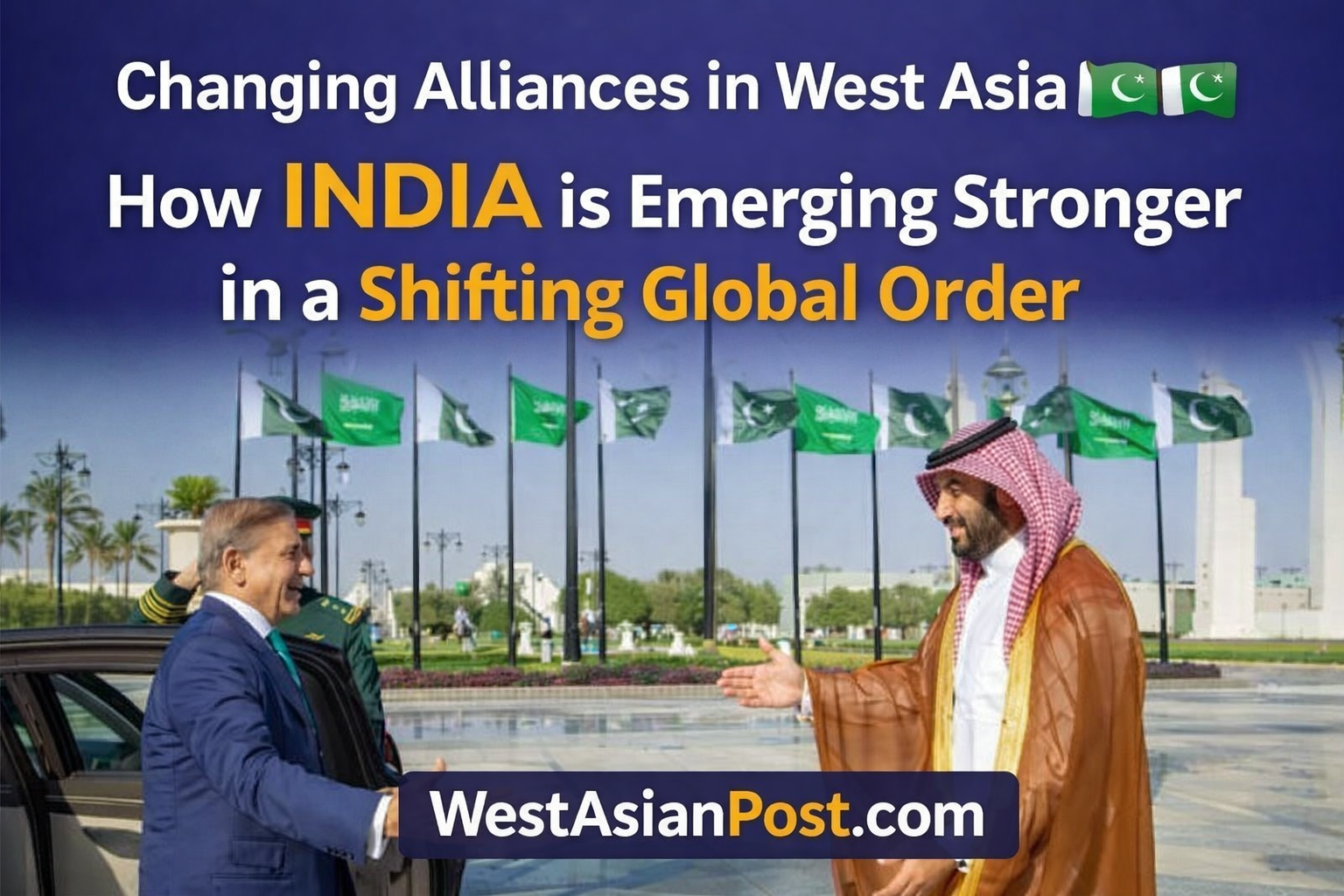
Saudi Arabia–Pakistan Rift Signals Shift in West Asia: Why India Is Emerging Stronger in a Changing Global Order.
Saudi Arabia’s concerns over Pakistan’s absence in regional conflicts highlight shifting alliances in West Asia.
Discover how India is leveraging stability, diplomacy, and economic growth to emerge stronger globally.
Changing Equations in West Asia: A Reality Check for Old Alliances.
Recent developments in West Asia have sparked fresh debate over the strength and reliability of long-standing geopolitical alliances. Reports suggesting that Saudi Arabia is dissatisfied with Pakistan’s cautious stance during regional tensions point toward a deeper structural shift in global diplomacy.
Historically, Saudi Arabia and Pakistan have shared close military and strategic ties, often described as a “brotherhood alliance.” However, Pakistan’s recent decision to avoid direct involvement in regional conflicts reflects a pragmatic recalibration of its foreign policy, balancing its relationships with both Saudi Arabia and Iran.
This evolving dynamic raises a critical question: Are traditional alliances becoming more transactional and less dependable?
Strategic Neutrality: Pakistan’s Calculated Move.
Pakistan’s approach can be viewed as a strategic balancing act. With economic vulnerabilities and regional sensitivities, Islamabad appears to be prioritizing internal stability over external commitments.
However, this neutrality may come at a diplomatic cost. Saudi Arabia, which has historically supported Pakistan economically and politically, may begin to reassess the depth and reliability of this partnership.
This shift is not just about two countries, it reflects a broader global trend where national interest outweighs legacy alliances.
India’s Moment: Stability in an Uncertain World.
Amid these shifting sands, India stands out as a beacon of stability, growth, and strategic clarity.
Unlike many nations grappling with conflicting alliances, India has successfully maintained strong relations across diverse geopolitical blocs, including the Gulf nations, the West, and emerging economies.
1. Strong Diplomatic Positioning
India has built robust ties with both Saudi Arabia and Iran—something very few countries have managed effectively. This balanced diplomacy allows India to act as a credible and neutral partner in global affairs.
2. Economic Growth Story
India continues to be one of the fastest-growing major economies in the world. With large-scale infrastructure development, digital transformation, and manufacturing expansion, the country is attracting global investors at an unprecedented pace.
Initiatives like:
- Make in India
- Digital India
- Production-Linked Incentive (PLI) schemes
are positioning India as a global manufacturing and innovation hub.
India–Saudi Arabia Relations: A Rising Partnership.
Despite tensions in the region, India’s relationship with Saudi Arabia is strengthening steadily.
Key highlights include:
- Increasing energy cooperation
- Investments in infrastructure and technology
- Collaboration in defense and security
Saudi Arabia views India not just as an energy customer, but as a long-term strategic partner.
India’s Advantage: Strategic Autonomy.
One of India’s biggest strengths is its policy of strategic autonomy, the ability to make independent decisions without being tied to rigid alliances.
This approach allows India to:
- Engage with multiple power centers simultaneously
- Avoid entanglement in conflicts
- Focus on economic and technological growth
In contrast to alliance-dependent nations, India’s flexibility is becoming a major geopolitical advantage.
Domestic Strength: The Real Engine of Global Influence.
India’s rise is not just about foreign policy, it is deeply rooted in its domestic progress.
Key Positive Developments in India:
1. Infrastructure Boom
Massive investments in highways, railways, ports, and airports are transforming connectivity and boosting economic activity.
2. Digital Revolution
India’s digital ecosystem—UPI, Aadhaar, and fintech innovation—is setting global benchmarks for financial inclusion.
3. Startup Ecosystem
India is now one of the world’s largest startup hubs, producing unicorns across sectors like fintech, edtech, and AI.
4. Energy Transition
India is aggressively expanding renewable energy capacity, positioning itself as a leader in sustainability.
5. Skilled Workforce
With a young and dynamic population, India is becoming a global talent hub for technology, finance, and services.
Global Investors Are Taking Notice.
As geopolitical uncertainties rise, global investors are increasingly looking toward India as a safe and promising destination.
- Factors driving this trend include:
- Political stability
- Large domestic market
- Reform-oriented policies
- Improved ease of doing business
India is not just an alternative, it is becoming a preferred choice.
Conclusion: A New World Order Emerging.
The reported friction between Saudi Arabia and Pakistan is more than a bilateral issue, it is a signal of a transforming global order where adaptability, economic strength, and strategic independence matter more than ever.
In this evolving landscape, India is uniquely positioned to lead not through confrontation, but through cooperation, growth, and stability.
As old alliances are tested and new ones emerge, India’s consistent and balanced approach may well define the next chapter of global geopolitics.
Team: West Asian post.com
Featured Posts:
Why Saudi Arabia Is Opening Its Doors to Global Tourism: Vision, Economy, and a New Cultural Era.
Ultimate Guide to Early Stage Startup Funding in MENA (2026): Top Investors & Strategies
Why Kjøller Is an Important Venture Capital Investor for Startups Globally.