

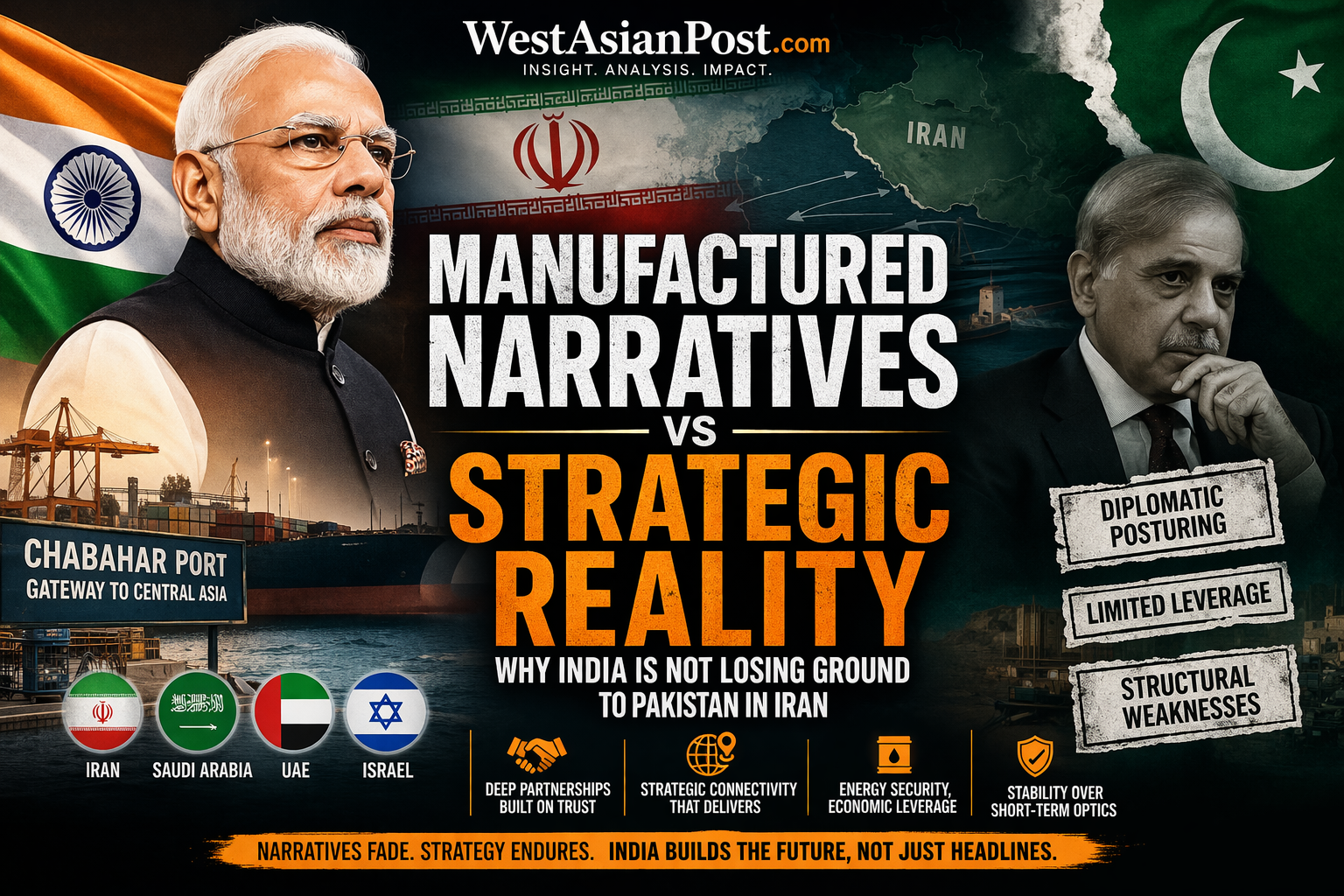
India’s Strategic Depth in West Asia: Why Pakistan’s Iran Diplomacy Narrative Doesn’t Hold.
Manufactured Narratives vs Strategic Reality: Why India Is Not Losing Ground to Pakistan in Iran
An analysis debunking claims that India is being sidelined in Iran diplomacy. Why Pakistan’s narrative is overstated and India’s strategic influence in West Asia remains dominant.
At a time when geopolitical tensions in West Asia demand serious, fact-based analysis, sections of global media appear to be pushing a simplistic and misleading narrative: that Pakistan is emerging as a key diplomatic player in Iran, while India is somehow being “sidelined.”
Let’s be clear, this narrative is not just flawed. It is intellectually dishonest.
Diplomacy Is Not a Photo Opportunity
Pakistan’s recent outreach towards Iran is being portrayed as a breakthrough moment. But diplomacy is not measured by last-minute visibility or crisis-driven engagement. It is built on consistency, credibility, and capability.
India has spent decades building trust across West Asia not through reactive diplomacy, but through sustained engagement, economic investment, and strategic restraint.
Pakistan, on the other hand, has historically oscillated between dependency and irrelevance in the region.
The Chabahar Reality That Can’t Be Ignored
If one needs a reality check, look no further than the Chabahar Port.
This is not a symbolic project. It is a strategic corridor that:
- Bypasses Pakistan entirely
- Connects India to Afghanistan and Central Asia
- Strengthens Iran’s economic resilience
And most importantly it exists because Iran trusts India.
No amount of diplomatic posturing by Pakistan can replicate this level of strategic depth.
Pakistan’s Structural Limitations
Let’s address the elephant in the room.
Pakistan simply does not have the economic strength, geopolitical autonomy, or institutional credibility to shape outcomes in West Asia in any meaningful way.
Its foreign policy has long been constrained by:
- Economic fragility
- Overdependence on external patrons
- Security-centric decision-making
In contrast, India’s rise is backed by economic scale, technological capability, and strategic independence.
India’s Multi-Alignment Strategy: A Masterclass
India’s engagement in West Asia is not transactional—it is transformational.
New Delhi maintains strong, simultaneous relationships with:
- Iran
- Saudi Arabia
- United Arab Emirates
- Israel
This is not easy. In fact, it is one of the most complex diplomatic balancing acts in modern geopolitics.
And India is executing it with precision.
While others choose sides, India builds bridges.
Neutrality Is Strength—Not Weakness
Critics often misinterpret India’s calibrated silence during regional conflicts as disengagement.
This is a fundamental misunderstanding.
India’s approach is deliberate:
- Avoid escalation
- Maintain strategic flexibility
- Protect long-term interests
This is what mature powers do.
Noise is not influence. Stability is.
The Media Bias Problem
The bigger concern is not Pakistan’s actions—it is how they are being framed.
When global platforms amplify limited diplomatic gestures while ignoring decades of strategic engagement, they distort reality.
The question must be asked:
Why is sustained influence being overshadowed by episodic visibility?
Because narratives are easier to sell than nuance.
India’s Real Leverage: Economics, Energy, and Diaspora
India’s influence in West Asia is deeply embedded in:
- Energy partnerships
- Trade relationships
- A massive Indian diaspora contributing to regional economies
These are structural advantages—not temporary headlines.
Pakistan cannot match this scale. Not today. Not in the foreseeable future.
Leadership That Commands Respect
Under Narendra Modi, India has elevated its global diplomatic profile significantly.
From high-level summits to strategic alliances like I2U2, India is no longer a passive player—it is shaping conversations.
Leaders across West Asia engage with India not out of courtesy, but out of necessity.
The Truth: India Is Not Being Sidelined—It Is Being Underestimated
The idea that India is losing relevance in West Asia is not just inaccurate—it is dangerously misleading.
India is:
- Deepening its economic footprint
- Expanding strategic connectivity
- Strengthening political trust
While Pakistan seeks visibility, India is building permanence.
Conclusion: Reality Will Outlast Narratives
Media narratives come and go. Strategic realities endure.
India’s position in West Asia is not defined by headlines—it is defined by hard power, economic integration, and diplomatic credibility.
Those suggesting otherwise are not analyzing geopolitics—they are manufacturing perception.
And perception, unlike strategy, has a short shelf life.
Team: West Asian Post
More Featured Articles:
Company Registration in Dubai 2026: Complete Guide to Setup, Costs, Benefits & Compliance.
Trump’s “Board of Peace”: How Real Estate, Crypto, and Pakistan Are Shaping U.S.–Iran Diplomacy.
BSE Main Board Listed Company (Mumbai) Available for Strategic Acquisition.
Venture Capital and Private Equity Funding in India: A Complete Founder’s Guide (2025)
Why Kjøller Is an Important Venture Capital Investor for Startups Globally.

2 thoughts on “India’s Strategic Depth in West Asia: Why Pakistan’s Iran Diplomacy Narrative Doesn’t Hold.”