

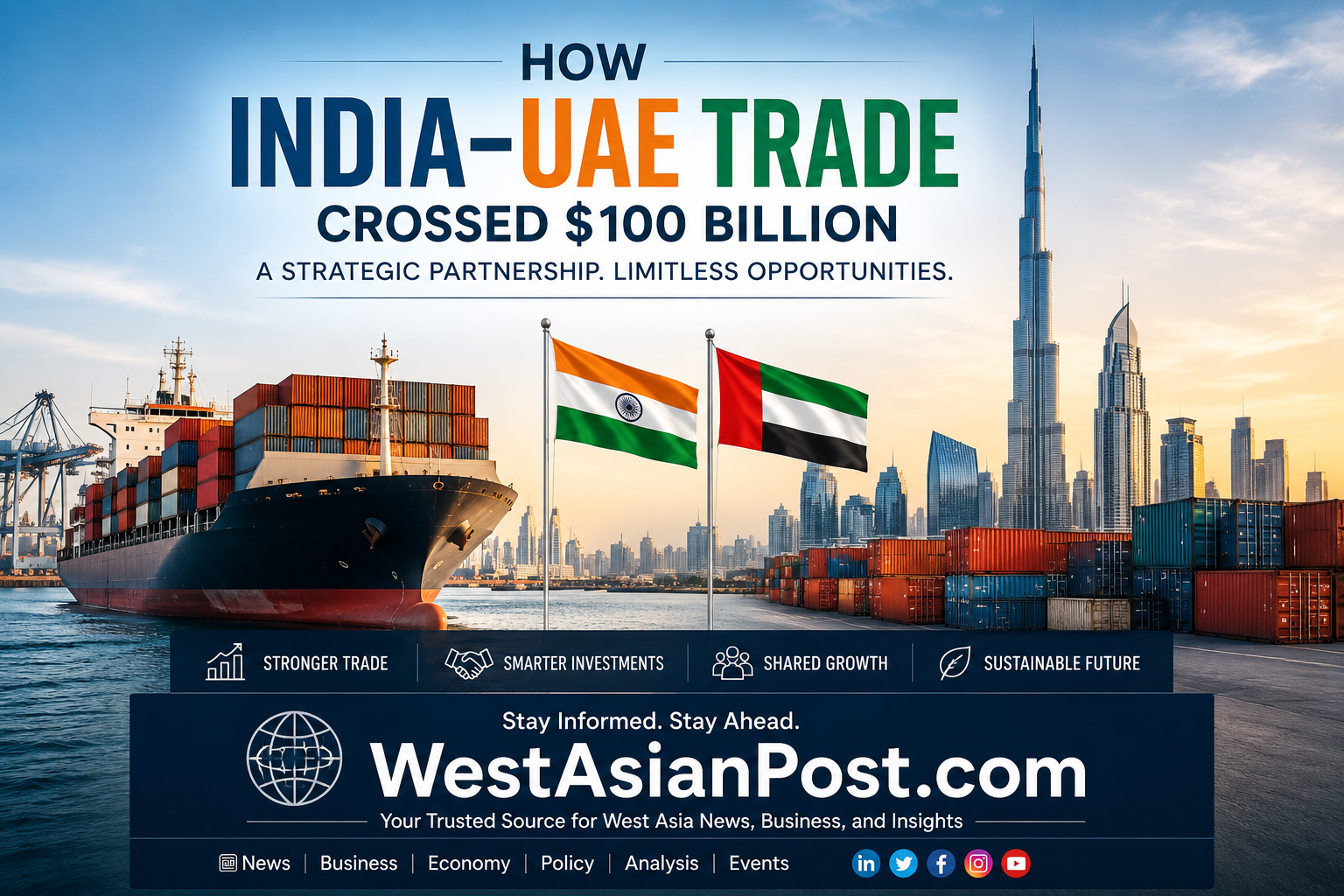
How India-UAE Trade Crossed $100 Billion: The Economic Partnership Reshaping West Asia and South Asia.
Discover how India–UAE trade crossed $100 billion, the role of CEPA, key sectors driving growth, investment opportunities, and what this milestone means for the future of India-West Asia economic relations.
The economic relationship between India and the United Arab Emirates (UAE) has evolved into one of the most dynamic and strategically important partnerships in the world. What was once largely driven by energy imports and a strong expatriate workforce has transformed into a comprehensive economic alliance spanning trade, investments, technology, logistics, manufacturing, infrastructure, fintech, renewable energy, and digital commerce.
A landmark moment in this journey came when bilateral trade between India and the UAE crossed the remarkable $100 billion mark, highlighting the growing interdependence between the world’s fastest-growing major economy and one of the Middle East’s most influential business hubs.
This achievement is not merely a trade statistic—it reflects a broader transformation in regional economics, geopolitics, and global supply chains. It also signals the emergence of a new economic corridor connecting South Asia with West Asia and beyond.
A Historic Relationship Built on Commerce
The relationship between India and the UAE dates back centuries. Long before modern nation-states emerged, merchants from India’s western coast traded spices, textiles, pearls, and precious metals with traders in the Arabian Gulf.
Today, that historic trading relationship has evolved into a strategic partnership supported by:
- Strong diplomatic ties
- Deep cultural connections
- A large Indian diaspora
- Extensive business networks
- Robust transportation links
- Shared economic ambitions
More than 3.5 million Indians live and work in the UAE, making them one of the largest expatriate communities in the country. Their contribution has played a significant role in strengthening economic and social bonds between the two nations.
The CEPA Effect: A Game-Changing Trade Agreement
One of the biggest catalysts behind the surge in bilateral trade has been the Comprehensive Economic Partnership Agreement (CEPA), signed in 2022.
The agreement significantly reduced tariffs and trade barriers across a wide range of products and services, creating new opportunities for businesses on both sides.
CEPA has delivered several advantages:
Improved Market Access
Indian exporters gained easier access to UAE markets for:
- Gems and jewellery
- Textiles
- Engineering goods
- Pharmaceuticals
- Agricultural products
- Food processing products
Faster Customs Procedures
Streamlined trade processes reduced transaction costs and improved supply-chain efficiency.
Services Expansion
The agreement opened opportunities in:
- Information technology
- Financial services
- Professional consulting
- Healthcare
- Education
Investment Promotion
CEPA strengthened investor confidence and encouraged long-term capital flows between the two countries.
The result was an immediate boost in bilateral trade volumes, helping accelerate progress toward the $100 billion milestone.
What Makes the UAE So Important for India?
The UAE occupies a unique position in India’s international trade strategy.
Gateway to Global Markets
Dubai serves as a major re-export hub connecting businesses to:
- Africa
- Europe
- Central Asia
- The Middle East
Many Indian companies use the UAE as their regional headquarters to access international markets.
Strategic Geographic Location
Located at the crossroads of Asia, Europe, and Africa, the UAE provides unparalleled connectivity through world-class ports and airports.
Business-Friendly Environment
The UAE offers:
- Low taxation
- Efficient regulations
- Free zones
- Modern infrastructure
- Investor-friendly policies
These advantages make it an attractive destination for Indian companies seeking international expansion.
Key Sectors Driving the $100 Billion Milestone
1. Energy Trade
Energy remains a cornerstone of the India-UAE relationship.
The UAE is among India’s key suppliers of:
- Crude oil
- Petroleum products
- Liquefied petroleum gas
As India’s energy demand continues to rise, energy cooperation remains crucial for both nations.
2. Gems and Jewellery
India’s jewellery industry has strong trade links with Dubai, one of the world’s largest gold trading centers.
The UAE serves as a major destination and transit hub for:
- Gold
- Diamonds
- Precious stones
- Finished jewellery
This sector contributes billions of dollars annually to bilateral trade.
3. Engineering and Manufacturing
Indian engineering exports to the UAE have witnessed substantial growth.
Products include:
- Machinery
- Industrial equipment
- Automotive components
- Electrical goods
- Construction materials
The UAE’s infrastructure expansion has created significant demand for these products.
4. Agriculture and Food Security
Food security is a national priority for the UAE, creating opportunities for Indian exporters.
India supplies:
- Rice
- Sugar
- Fruits
- Vegetables
- Processed foods
- Meat products
The UAE’s dependence on food imports makes India a reliable strategic supplier.
5. Digital Economy and Technology
The technology sector is emerging as a major growth engine.
Areas of collaboration include:
- Artificial Intelligence
- Fintech
- E-commerce
- Cloud computing
- Cybersecurity
- Digital payments
Indian technology companies are increasingly establishing operations across the UAE.
UAE Investments in India
Trade growth has been accompanied by rising investment flows.
UAE sovereign wealth funds and corporations have invested heavily in India across sectors such as:
Infrastructure
Investment in roads, logistics, ports, airports, and industrial corridors has increased significantly.
Renewable Energy
Both countries are collaborating on clean energy initiatives, including:
- Solar power
- Green hydrogen
- Sustainable infrastructure
Real Estate
UAE investors continue to participate in major commercial and residential projects across India.
Technology Startups
Indian startups have attracted growing interest from UAE-based investors looking to diversify their portfolios.
The Rise of Dubai as India’s Business Gateway
Dubai has emerged as the preferred destination for Indian entrepreneurs seeking international growth.
Several factors explain this trend:
Ease of Doing Business
Company formation processes are streamlined and efficient.
Access to Capital
Businesses gain exposure to regional and international investors.
Global Connectivity
Dubai provides direct access to key global markets.
Talent Availability
Companies can recruit skilled professionals from around the world.
As a result, thousands of Indian businesses have established a presence in Dubai and other UAE emirates.
Emerging Opportunities Beyond Trade
The India-UAE partnership is increasingly moving beyond traditional trade.
Green Hydrogen
Both countries are investing in clean energy solutions that could shape future global energy markets.
Supply Chain Cooperation
Global supply-chain diversification is creating opportunities for deeper collaboration.
Financial Services
Cross-border digital payments and financial technology partnerships are expanding rapidly.
Space Technology
India and the UAE are exploring cooperation in advanced technology and innovation sectors.
Smart Cities
Urban development and smart infrastructure projects offer significant collaboration opportunities.
The Geopolitical Significance
The India-UAE partnership has strategic implications that extend beyond economics.
It contributes to:
- Regional stability
- Energy security
- Trade diversification
- Investment cooperation
- Technological advancement
The relationship also aligns with broader efforts to strengthen economic integration between South Asia and West Asia.
As global supply chains evolve and new economic corridors emerge, the India-UAE partnership is becoming increasingly important for international commerce.
Challenges Ahead
Despite remarkable progress, some challenges remain:
Global Economic Uncertainty
Fluctuations in global markets can impact trade volumes.
Energy Transition
Both nations must adapt to a future increasingly focused on renewable energy.
Regulatory Alignment
Continued harmonization of standards and procedures will be important.
Competition
Businesses must remain competitive in rapidly changing global markets.
Addressing these challenges effectively will determine how quickly trade can move beyond the current milestone.
Looking Toward the Future
Crossing $100 billion in bilateral trade represents far more than a numerical achievement. It symbolizes the success of a strategic partnership built on trust, mutual benefit, and long-term vision.
Experts believe that trade volumes could continue expanding significantly over the coming decade as both countries deepen cooperation in:
- Technology
- Manufacturing
- Renewable energy
- Infrastructure
- Logistics
- Financial services
- Artificial Intelligence
The India-UAE relationship is increasingly being viewed as a model for modern economic diplomacy—one that combines trade, investment, innovation, and people-to-people connections.
Conclusion
The journey of India-UAE trade surpassing $100 billion reflects the extraordinary transformation of a historic commercial relationship into a strategic economic alliance. Driven by CEPA, growing investments, energy cooperation, technological innovation, and strong business ties, both nations have laid the foundation for sustained long-term growth.
As India strengthens its position as a global economic powerhouse and the UAE continues its evolution as a leading international business hub, their partnership is expected to play a pivotal role in shaping the future economic landscape of West Asia, South Asia, and the broader global economy.
The $100 billion milestone is not the destination—it is merely the beginning of a new era of economic cooperation between two of the world’s most ambitious and forward-looking nations.
WestAsianPost.com



One thought on “How India-UAE Trade Crossed $100 Billion: The Economic Partnership Reshaping West Asia and South Asia.”