

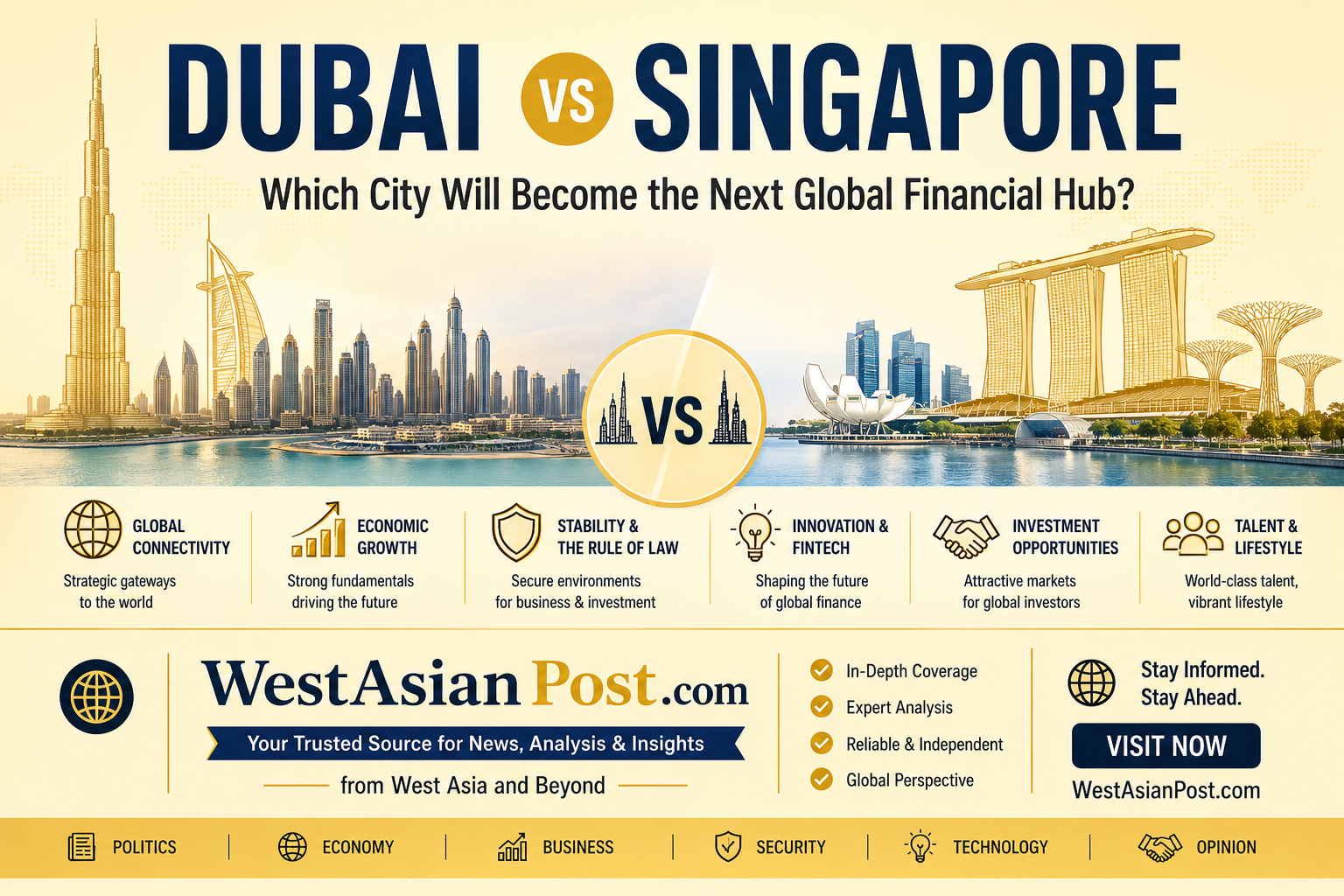
Dubai vs Singapore: Which City Will Become the Next Global Financial Hub?
Dubai and Singapore are emerging as the world’s leading financial centers. Explore the advantages, challenges, investment opportunities, and future outlook of both cities in this detailed comparison.
For decades, cities such as New York, London, Hong Kong, and Tokyo have dominated global finance. However, shifting geopolitical realities, technological transformation, changing tax policies, and the migration of global wealth are creating opportunities for new financial centers to emerge.
Two cities stand out prominently in this race: Dubai and Singapore.
Both have established themselves as world-class business destinations, attracting multinational corporations, banks, investment funds, family offices, entrepreneurs, and high-net-worth individuals. Each city offers a unique value proposition and enjoys strategic advantages that position it as a contender for becoming the world’s next major financial hub.
The question is no longer whether Dubai and Singapore are global financial centers—it is which one has the stronger potential to dominate the future of international finance.
Why Financial Hubs Matter
Global financial hubs play a critical role in the world economy. They facilitate:
- International banking
- Capital markets
- Wealth management
- Foreign direct investment
- Corporate headquarters operations
- Fintech innovation
- International trade finance
- Asset management
The city that attracts the greatest concentration of capital, talent, and innovation often becomes a key driver of regional and global economic growth.
Today, Dubai and Singapore are competing aggressively to attract exactly these resources.
Dubai: The Rising Financial Capital of the Middle East
Located at the crossroads of Europe, Asia, and Africa, Dubai has transformed itself from a regional trading port into a global business powerhouse.
The city’s rapid rise has been supported by visionary leadership, world-class infrastructure, favorable tax policies, and a business-friendly regulatory environment.
Key Advantages of Dubai
1. Strategic Geographic Location
Dubai sits within an eight-hour flight radius of nearly two-thirds of the world’s population.
This strategic position allows businesses to serve:
- Middle East markets
- African economies
- South Asia
- Central Asia
- European clients
Few cities enjoy such broad geographic connectivity.
2. Attractive Tax Environment
One of Dubai’s strongest advantages remains its low-tax regime.
Benefits include:
- No personal income tax
- No capital gains tax for individuals
- Competitive corporate taxation
- Investor-friendly regulations
For wealthy individuals and entrepreneurs, these advantages are highly attractive.
3. Massive Wealth Migration
In recent years, Dubai has witnessed an influx of:
- Millionaires
- Billionaires
- Family offices
- Investment firms
Political uncertainty in several regions has accelerated wealth migration into the UAE.
Dubai is increasingly becoming a preferred destination for global wealth preservation and investment management.
4. Dubai International Financial Centre (DIFC)
The DIFC has emerged as one of the world’s most sophisticated financial districts.
It hosts:
- International banks
- Asset managers
- Insurance companies
- Venture capital firms
- Fintech startups
The legal framework is based on international common law principles, providing confidence to global investors.
5. Strong Government Support
The UAE government actively promotes:
- Innovation
- Digital transformation
- Artificial intelligence
- Financial technology
- Foreign investment
Long-term economic diversification plans continue to strengthen Dubai’s global position.
6. Lifestyle and Quality of Life
Dubai offers:
- Modern infrastructure
- Luxury housing
- High safety standards
- Excellent healthcare
- International schools
These factors help attract global talent.
Challenges Facing Dubai
Despite its strengths, Dubai faces several challenges.
1. Smaller Domestic Market
Unlike some major economies, the UAE has a relatively small population.
As a result, much of Dubai’s success depends on attracting international business rather than domestic demand.
2. Regional Geopolitical Risks
Although the UAE remains highly stable, the broader Middle East can experience geopolitical tensions.
Global investors sometimes factor these risks into long-term planning decisions.
3. Dependence on Foreign Talent
A significant portion of Dubai’s workforce consists of expatriates.
Maintaining competitiveness requires continuous attraction and retention of international talent.
4. Emerging Regulatory Evolution
As Dubai grows into a larger financial center, regulatory standards must continuously evolve to meet global expectations.
Singapore: Asia’s Established Financial Powerhouse
Singapore has spent decades building its reputation as one of the most trusted financial centers in the world.
Often referred to as the “Switzerland of Asia,” Singapore combines political stability, strong governance, advanced infrastructure, and highly sophisticated financial markets.
Key Advantages of Singapore
1. Exceptional Regulatory Reputation
Singapore enjoys one of the strongest regulatory frameworks globally.
Investors value:
- Transparency
- Rule of law
- Predictable governance
- Strong investor protections
This reputation has been built over many decades.
2. Gateway to Asia-Pacific
Singapore serves as a central hub for:
- Southeast Asia
- China-related investments
- Australia
- Japan
- South Korea
The city is strategically positioned within one of the world’s fastest-growing economic regions.
3. Mature Banking Ecosystem
Singapore hosts many of the world’s leading:
- Commercial banks
- Investment banks
- Private banks
- Asset management firms
Its financial ecosystem is deep, sophisticated, and highly integrated.
4. Wealth Management Leadership
Singapore has become one of the world’s premier wealth management centers.
Ultra-high-net-worth individuals increasingly establish:
- Family offices
- Investment vehicles
- Trust structures
in Singapore to manage international assets.
5. Political Stability
Political predictability remains one of Singapore’s strongest advantages.
Businesses can make long-term plans with confidence due to consistent governance and economic policies.
6. Highly Skilled Workforce
Singapore consistently ranks among the world’s leaders in:
- Education
- Professional skills
- Financial expertise
- Technology talent
This creates a strong talent pipeline for financial institutions.
Challenges Facing Singapore
Singapore’s strengths are substantial, but it also faces certain limitations.
1. Higher Operating Costs
Office space, housing, and labor costs are significantly higher than many competing financial centers.
These expenses can impact business profitability.
2. Increasing Competition
Singapore faces growing competition from:
- Dubai
- Hong Kong
- Shanghai
- Abu Dhabi
- Riyadh
Maintaining leadership will require continued innovation.
3. Limited Land Availability
As a city-state, Singapore faces physical expansion constraints.
Infrastructure development must be carefully managed within limited space.
4. Tax Advantages Less Dramatic
While Singapore offers attractive tax policies, they are generally less aggressive than Dubai’s tax environment.
For many wealthy individuals, Dubai’s tax structure may appear more compelling.
Dubai vs Singapore: Head-to-Head Comparison
| Factor | Dubai | Singapore |
|---|---|---|
| Geographic Reach | Middle East, Africa, Europe, South Asia | Asia-Pacific |
| Personal Income Tax | None | Applicable under tax system |
| Wealth Migration | Extremely Strong | Strong |
| Banking Ecosystem | Rapidly Growing | Highly Mature |
| Regulatory Reputation | Improving Rapidly | World-Class |
| Political Stability | High | Very High |
| Cost of Living | High | Very High |
| Family Offices Growth | Explosive | Established Leader |
| Fintech Development | Rapid Expansion | Advanced Ecosystem |
| Global Connectivity | Excellent | Excellent |
The Future of Finance: Why Both May Win
The debate may ultimately be based on a false assumption.
The future financial system may not be dominated by a single city.
Instead, regional specialization could emerge:
Dubai may dominate:
- Middle East finance
- Africa-focused investments
- Islamic finance
- Wealth migration
- Energy-sector financing
Singapore may dominate:
- Asian capital markets
- Private banking
- Asset management
- Technology financing
- Southeast Asian investments
Rather than replacing each other, the two cities could become complementary pillars of global finance.
Which City Has the Edge?
If the focus is on regulatory maturity, institutional credibility, and deep financial markets, Singapore currently maintains an advantage.
However, if the focus is on future growth, tax competitiveness, wealth migration, and geographic positioning between East and West, Dubai may have greater upside potential.
Many analysts believe Dubai is currently experiencing a growth trajectory similar to Singapore’s rise several decades ago.
As global capital becomes increasingly mobile, Dubai’s unique combination of low taxes, strategic location, and ambitious economic policies could make it one of the most influential financial centers of the coming decades.
Conclusion
The competition between Dubai and Singapore reflects broader shifts in the global economy. As investors seek stability, efficiency, innovation, and access to new markets, both cities are uniquely positioned to benefit.
Singapore remains the benchmark for institutional excellence and financial sophistication. Dubai, meanwhile, represents one of the most dynamic and rapidly evolving financial ecosystems in the world.
Rather than asking which city will completely replace existing financial centers, a more realistic question may be this:
How will Dubai and Singapore together reshape the future of global finance?
The answer could define the next era of international investment, wealth management, and economic influence.
WestAsianPost.com
More Featured Articles:
Why Global Entrepreneurs Are Moving to Dubai: The Ultimate Business Hub of the 21st Century.
How Businesses in the UAE Can Stay Ahead of Compliance Demands in 2026.
CFO Services for Startups: Why Virtual CFOs Are Transforming Business Scalability in India
How Startups in the Middle East Can Successfully Raise Series A Funding: A Complete Strategic Guide.
How Startups Can Raise Funding in Dubai: A Comprehensive Guide for Founders and Entrepreneurs.
The Complete Guide to Startup Funding in West Asia (2026 Edition).
Venture Capital and Private Equity Funding in India: A Complete Founder’s Guide (2025)
Why Kjøller Is an Important Venture Capital Investor for Startups Globally.


3 thoughts on “Dubai vs Singapore: Which City Will Become the Next Global Financial Hub?”