

Launch Your Own Skincare, Haircare & Personal Care Brand Through White-Label Manufacturing
Explore how startups and entrepreneurs can launch skincare, haircare and personal care brands through white-label manufacturing. Discover products, private-label opportunities, investment considerations and how Intellex Strategic Consulting can help.
Launch Your Own Beauty & Personal Care Brand Without Building Your Own Manufacturing Facility
The beauty, skincare, haircare and personal care industry has become one of the most attractive sectors for entrepreneurs, startups, distributors and aspiring brand owners.
Growing consumer awareness, increasing online shopping, social-media-driven purchasing and the expansion of D2C brands have created significant opportunities for entrepreneurs who want to build their own brands.
However, starting a cosmetic brand traditionally required substantial investment in manufacturing infrastructure, formulation laboratories, production equipment, regulatory systems, quality-control facilities, packaging and inventory.
White-label and private-label manufacturing has changed that equation.
Today, an entrepreneur can work with an experienced third-party manufacturer, select suitable products, develop a brand identity, customise packaging and launch products under their own brand name—without establishing a manufacturing plant.
This model can be particularly attractive for startups, distributors, franchise operators, retailers, e-commerce entrepreneurs, influencers, existing FMCG businesses and investors looking to create a new consumer brand.
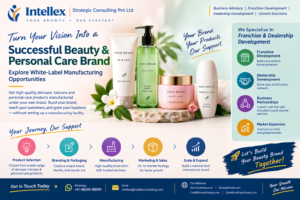
What Is White-Label Cosmetic Manufacturing?
White-label manufacturing is a business model in which an established manufacturer produces products that are subsequently marketed and sold under another company’s or entrepreneur’s brand.
For example, an entrepreneur may decide to create a new skincare brand.
Instead of investing immediately in:
- A manufacturing facility
- Production machinery
- Cosmetic formulation infrastructure
- Raw-material procurement systems
- Quality-control laboratories
- Production personnel
- Manufacturing processes
- Warehousing infrastructure
the entrepreneur can partner with a third-party manufacturer.
The manufacturer produces the selected products, while the brand owner focuses on:
Brand → Packaging → Marketing → Distribution → Sales → Customer Acquisition → Business Development
This allows entrepreneurs to concentrate on building the commercial side of the business.
Why White-Label Cosmetics Are Attractive for Startups
The biggest advantage of the model is that it allows an entrepreneur to enter the beauty and personal-care industry without taking on the entire manufacturing burden.
1. Lower Initial Infrastructure Requirement
A startup doesn’t necessarily need to build its own factory.
Instead, manufacturing can be outsourced to an experienced third-party manufacturing partner.
This can substantially reduce the infrastructure requirement compared with establishing a manufacturing operation from scratch.
2. Faster Market Entry
Building a manufacturing facility can take considerable time.
White-label manufacturing can potentially allow a brand to move from product selection to commercial launch much faster, subject to product development, packaging, regulatory and manufacturing requirements.
3. Product Portfolio Flexibility
Entrepreneurs can potentially create a portfolio covering multiple categories, such as:
- Face care
- Skin moisturisers
- Cleansers
- Serums
- Sunscreen products
- Hair oils
- Shampoos
- Conditioners
- Hair masks
- Body-care products
- Personal hygiene products
- Bath products
- Grooming products
The exact products available will depend on the manufacturing partner and applicable regulatory requirements.
4. Focus on Branding
The entrepreneur can focus resources on creating a differentiated brand.
In today’s market, branding can be as important as the product itself.
A strong brand requires attention to:
- Brand name
- Logo
- Packaging
- Product positioning
- Target customer
- Pricing
- Communication
- Digital presence
- Social media
- Influencer marketing
- Distribution strategy
An Opportunity for Entrepreneurs to Build a Complete Product Portfolio
One of the most interesting aspects of private-label manufacturing is the ability to build a multi-product consumer brand.
Rather than launching one product, an entrepreneur can gradually develop a complete portfolio.
For example:
Skincare
A new brand could potentially develop products such as:
- Face cleansers
- Moisturisers
- Face serums
- Face masks
- Sunscreen
- Toners
- Scrubs
- Body lotions
- Under-eye products
Haircare
Potential categories may include:
- Shampoo
- Conditioner
- Hair oil
- Hair serum
- Hair mask
- Scalp-care products
- Styling products
Personal Care
This could include:
- Body wash
- Hand wash
- Bath products
- Body care
- Deodorising products
- Grooming products
- Other personal-care formulations
The objective is not necessarily to launch everything simultaneously.
A more disciplined strategy is often to begin with a small number of strategically selected products, test market acceptance and subsequently expand the portfolio.
From Startup Idea to Your Own Brand
A typical white-label brand development journey may look like this:
Step 1: Identify the Market
Determine who the target customer is.
For example:
- Men
- Women
- Teenagers
- Premium consumers
- Mass-market consumers
- Wellness-focused consumers
- Professional users
- Salon customers
- E-commerce customers
Step 2: Select the Product Category
Choose the initial product category based on market demand, competition, pricing and business objectives.
Step 3: Select Manufacturing Partner
Evaluate third-party manufacturers based on:
- Product range
- Manufacturing capabilities
- Quality systems
- Regulatory compliance
- Production capacity
- Minimum order quantities
- Packaging options
- Lead times
- Documentation
- Track record
Step 4: Develop the Brand
Create:
- Brand identity
- Logo
- Packaging
- Product positioning
- Brand story
- Marketing strategy
Step 5: Determine Commercial Model
The business could potentially sell through:
- Website
- Marketplaces
- Social commerce
- Retail stores
- Distributors
- Dealers
- Salons
- Beauty stores
- Pharmacies, where appropriate
- Franchise networks
- Corporate/institutional channels
Step 6: Launch
Begin with a focused product range and establish customer feedback, sales data and repeat-purchase patterns.
Step 7: Scale
Once the initial products demonstrate market acceptance, the company can expand:
Products → Geography → Distribution → Dealers → Franchisees → Digital Sales → Exports
White-Label vs Building Your Own Manufacturing Facility
For many startups, the comparison is straightforward.
| Factor | Own Manufacturing | White-Label / Third-Party |
|---|---|---|
| Factory investment | High | Lower |
| Equipment requirement | High | Limited |
| Manufacturing team | Required | Usually handled by partner |
| Product development | In-house | Manufacturer-supported |
| Time to market | Generally longer | Potentially faster |
| Operational complexity | High | Lower |
| Brand ownership | Yes | Yes |
| Marketing control | Yes | Yes |
| Scalability | Requires infrastructure | Can leverage manufacturing capacity |
White-label manufacturing therefore allows the entrepreneur to become primarily a brand owner and business developer rather than a manufacturer.
The Opportunity for Distributors and Dealership Entrepreneurs
This model isn’t limited to conventional startups.
It can also create opportunities for existing distributors and dealership operators.
An established distributor could potentially move up the value chain by developing an exclusive or proprietary brand rather than distributing only third-party brands.
This can potentially create:
- Better brand ownership
- Greater control over pricing
- Long-term customer relationships
- Higher business valuation potential
- Greater differentiation
- Opportunities for geographic expansion
Instead of simply asking:
“Which brand should I distribute?”
the entrepreneur can potentially ask:
“Can I build my own brand and create my own distribution network?”
That is a significantly different business proposition.
Opportunity for Franchise Development
Beauty and personal-care products can also be integrated into a broader franchise strategy.
For example, an entrepreneur could develop a business around:
Own Brand + Product Portfolio + Distribution Network + Franchise Network
Potential franchise formats could include:
- Beauty stores
- Personal-care stores
- Cosmetic retail outlets
- Beauty & wellness centres
- Specialty stores
- E-commerce-led franchise models
- Regional distribution franchises
The exact structure should be developed based on product economics, territory potential, regulatory requirements and the operating model.
Why the Manufacturing Partner Matters
Selecting the right manufacturing partner is one of the most important decisions in building a private-label brand.
A manufacturer may be able to provide access to an existing product development and production ecosystem.
A manufacturer with a broad portfolio and experience working with multiple brands can potentially offer an entrepreneur a more efficient starting point.
The prospective brand owner should nevertheless conduct appropriate due diligence before entering into any commercial arrangement.
Important questions include:
- What products are currently manufactured?
- What are the minimum order quantities?
- What formulations are available?
- Can formulations be customised?
- What packaging options are available?
- What documentation is provided?
- What are the production timelines?
- What quality-control processes are followed?
- What regulatory responsibilities fall on the manufacturer and brand owner?
- What are the payment terms?
- What is the replacement/returns policy?
- What happens if demand increases substantially?
Building a Brand Is More Important Than Simply Buying Products
One common mistake among new entrepreneurs is treating white-label manufacturing as a product-buying exercise.
It is not.
The manufacturer creates the product.
The entrepreneur creates the brand.
The long-term value comes from developing:
- Brand recognition
- Customer trust
- Repeat purchases
- Distribution
- Customer data
- Marketing assets
- Product portfolio
- Retail presence
- Digital presence
- Intellectual property
- Business relationships
Therefore, entrepreneurs should think beyond their first production order.
The objective should be to build a scalable consumer business.
E-Commerce Has Changed the Beauty Brand Opportunity
Digital commerce has dramatically lowered the barriers to reaching customers.
A new brand can potentially sell through its own website and multiple online channels while simultaneously developing offline distribution.
Social media can also play an important role in product discovery.
Beauty and personal-care categories are particularly suited to visual marketing through:
- YouTube
- Short-form video
- Influencer marketing
- Educational content
- Product demonstrations
- Customer testimonials
- Creator collaborations
However, sustainable growth requires more than social-media visibility.
Product quality, customer experience, pricing, distribution and repeat purchases ultimately determine whether a brand can become a sustainable business.
Important Considerations Before Launching a Cosmetic Brand
Entrepreneurs should not assume that simply putting a logo on a product is enough.
A proper business plan should consider:
Regulatory Compliance
Cosmetic and personal-care products are subject to applicable laws and regulations. Product claims, labelling, manufacturing arrangements and marketing communications should be reviewed appropriately.
Product Claims
Claims such as “clinically proven,” “dermatologically tested,” “chemical-free,” “organic,” “natural” or treatment-related claims should not be used casually.
Claims should be supportable and compliant with applicable requirements.
Packaging & Labelling
The brand owner should ensure that required information is appropriately displayed on the packaging and that responsibilities between the manufacturer and brand owner are clearly established.
Minimum Order Quantity
MOQ can have a significant impact on startup capital.
An entrepreneur should avoid ordering excessive inventory before understanding actual market demand.
Unit Economics
Calculate:
Manufacturing Cost + Packaging + Logistics + Taxes + Marketplace Fees + Marketing + Discounts + Returns = Real Cost
Only after understanding the complete cost structure should the entrepreneur determine the selling price.
How Much Investment Is Required?
There is no single investment figure applicable to every white-label cosmetics business.
Investment depends on:
- Number of products
- Minimum order quantity
- Packaging
- Formulation
- Branding
- Product development
- Inventory
- Warehousing
- Website
- Marketing
- Influencer campaigns
- Distribution
- Team
- Geography
A sensible startup strategy is generally to begin with a focused portfolio, validate demand and then reinvest into additional products and markets.
This can help reduce the risk of locking too much capital into slow-moving inventory.
Who Can Consider This Business Opportunity?
White-label cosmetics can be considered by:
Startups
Entrepreneurs looking to create their first consumer brand.
Existing FMCG Companies
Businesses wanting to add beauty and personal-care products.
Distributors
Distributors looking to develop proprietary brands.
Retailers
Retail businesses seeking differentiated products.
E-Commerce Entrepreneurs
Founders building D2C brands.
Influencers & Content Creators
Individuals with an established audience who want to develop consumer products.
Salon & Beauty Businesses
Businesses that want to offer products under their own brand.
Franchise Entrepreneurs
Investors interested in building a retail or distribution network.
International Entrepreneurs
Businesses looking for manufacturing partners for brands targeting international markets, subject to applicable export and destination-country requirements.
Turning a Product Portfolio Into a Business Opportunity
The real opportunity lies in combining manufacturing with brand development and distribution.
A potentially scalable structure could be:
Manufacturer
↓
Private/White-Label Brand
↓
Marketing & Digital Sales
↓
Distributor
↓
Dealer / Retailer
↓
Franchise Network
↓
End Consumer
This creates multiple potential channels for revenue generation.
How Intellex Strategic Consulting Pvt Ltd Can Help
Intellex Strategic Consulting Pvt Ltd can assist entrepreneurs, startups, investors, distributors and business owners across India and international markets with franchise development, dealership development, business structuring and growth advisory.
For entrepreneurs interested in launching a white-label skincare, haircare or personal-care brand, Intellex can help evaluate the opportunity and support the commercial development process.
Our Business Development Support Can Include:
1. Franchise Development
Designing and developing franchise models for scalable businesses.
2. Dealership Development
Helping businesses structure dealership and distribution opportunities.
3. White-Label Business Development
Supporting entrepreneurs in evaluating private-label product opportunities and developing a commercial go-to-market strategy.
4. Distributor Network Development
Assisting businesses in creating structured distribution networks across different territories.
5. Startup Advisory
Helping founders evaluate business models, market positioning, commercial strategy and growth opportunities.
6. Fundraising Support
For eligible startups and growth-stage businesses, Intellex can also assist with fundraising strategy, investor preparation, financial modelling and related advisory.
7. Financial Modelling & Pitch Deck Support
Developing investor-ready financial models, business plans and pitch materials.
8. Strategic Partnerships
Helping identify and structure potential manufacturing, distribution, franchise and business partnerships.
From One Product to a National Brand
The biggest opportunity for an entrepreneur is not simply to launch another cosmetic product.
It is to build a recognisable, trusted and scalable consumer brand.
A small initial product portfolio can potentially evolve into:
5 Products → 20 Products → 50+ Products → Regional Distribution → National Distribution → Franchise Network → International Markets
The journey requires careful planning, appropriate manufacturing partners, strong branding, disciplined inventory management and effective distribution.
Final Takeaway
The emergence of white-label and third-party manufacturing has created a powerful entry route into the skincare, haircare and personal-care industry.
Entrepreneurs no longer necessarily need to own a manufacturing facility to build a consumer brand.
They can focus on what they do best:
Brand Building + Marketing + Sales + Distribution + Customer Relationships
while an experienced manufacturing partner handles the production side.
For startups and entrepreneurs looking at franchise, dealership, distribution or proprietary-brand opportunities, this can be an interesting business model to evaluate.
The key, however, is to approach it as a long-term brand-building exercise rather than simply a private-label product purchase.
🚀 Explore Franchise, Dealership & White-Label Business Opportunities
Intellex Strategic Consulting Pvt Ltd provides business advisory and development services across India and globally.
📱 WhatsApp: +91-98200-88394
📧 Email: intellex@intellexconsulting.com
🌐 Our Platforms:
VentureStreets.com
StartupStreets.com
CreditMoneyFinance.com
GrowMoreFranchisees.com
If you are an entrepreneur, investor, manufacturer, distributor or business owner looking to launch, franchise, distribute or scale a consumer brand, Intellex Strategic Consulting Pvt Ltd can help you evaluate and develop the opportunity.
More Featured Posts:
Why Global Entrepreneurs Are Moving to Dubai: The Ultimate Business Hub of the 21st Century.
Dubai vs Singapore: Which City Will Become the Next Global Financial Hub?
Strategic Finance Options for Medical and Hospital Businesses in India (2026)
How Startups in the Middle East Can Successfully Raise Series A Funding: A Complete Strategic Guide.