


Private Equity and Venture Capital Can Help Write MENA Region’s Next Growth Chapter.
Why Strategic Capital Matters for Startups, Businesses and Investors
Discover how private equity and venture capital can help shape MENA’s next growth chapter by funding startups, scaling businesses, creating jobs, supporting innovation and attracting global investment.
Private Equity and Venture Capital Can Help Write MENA’s Next Growth Chapter
The Middle East and North Africa are entering a defining period in their economic development.
Across the region, governments are pursuing economic diversification, entrepreneurs are building technology-enabled businesses, established companies are expanding into new markets, and investors are increasingly looking beyond traditional asset classes for opportunities to deploy capital.
At the centre of this transformation is a fundamental question:
How can MENA create enough productive businesses, investment opportunities and high-quality jobs to support the next generation of its population?
The scale of the challenge is enormous.
The World Bank estimates that nearly 300 million young people in MENA will be seeking employment by 2050. It argues that the region needs a more dynamic private sector capable of generating productive employment, investment and innovation.
Government policy will remain important.
Infrastructure will remain important.
Education and skills will remain important.
But there is another critical ingredient:
Private capital.
Private equity and venture capital can help channel capital toward companies capable of creating jobs, developing technology, expanding across borders, increasing productivity and building the next generation of regional businesses.
This makes private capital more than an investment mechanism.
It can become an important component of MENA’s economic growth architecture.
MENA’s Investment Story Is Changing
For many years, the MENA investment narrative was strongly associated with oil, gas, sovereign wealth, real estate, infrastructure and large government-led projects.
Those sectors remain important.
But the investment landscape is becoming considerably broader.
Technology companies, fintech businesses, SaaS platforms, healthcare companies, consumer brands, logistics businesses, artificial-intelligence ventures, e-commerce platforms, manufacturing companies and other growth businesses are attracting increasing attention.
The region’s startup investment figures illustrate this transformation.
According to Wamda’s 2025 investment review, MENA startups raised $7.5 billion across 647 companies in 2025, representing a 225% year-on-year increase in total funding. Even after excluding debt financing, equity investment increased 77% year over year. Saudi Arabia was the leading source of capital, with approximately $5 billion deployed across 211 deals.
The numbers should be interpreted carefully because mega-deals and debt transactions can significantly influence headline totals.
Nevertheless, the broader direction is important.
Capital is increasingly flowing toward businesses that can scale.
And that creates an opportunity for the region’s entrepreneurs, investors and financial institutions.
Why Private Equity Matters to MENA
Private equity can play a particularly important role as companies move beyond the startup phase.
A successful business may reach a point where it requires substantially more capital than traditional financing can comfortably provide.
It may need funding for:
- Geographic expansion
- Acquisitions
- New manufacturing capacity
- Technology transformation
- Working capital
- Management expansion
- Internationalisation
- Product development
- Brand building
- Corporate restructuring
- Succession
- Pre-IPO growth
- Balance-sheet strengthening
Private equity can potentially provide that capital while also bringing strategic expertise.
The PE model is therefore not simply about writing a cheque.
A sophisticated private equity investor may work with management to improve:
- Corporate governance
- Financial reporting
- Operational efficiency
- Capital allocation
- Management systems
- Risk management
- Technology adoption
- Strategic planning
- M&A capabilities
For many established businesses, these changes can be as important as the capital itself.
Venture Capital Can Build MENA’s Next Generation of Companies
While private equity often focuses on established or growth-stage businesses, venture capital plays a different but equally important role.
Many of tomorrow’s major companies will begin as relatively small businesses with limited historical financial performance.
They may have:
- An innovative product
- A technology platform
- A strong founding team
- An attractive market
- Early customers
- High growth potential
But they may not yet have the profitability or collateral required for conventional financing.
Venture capital allows investors to participate in the growth potential of such companies.
VC funding can support:
Product Development
Building and improving technology and products.
Talent Acquisition
Hiring engineers, executives, sales professionals and specialist teams.
Market Expansion
Entering additional cities, countries or customer segments.
Customer Acquisition
Building distribution and marketing capabilities.
Technology Infrastructure
Developing scalable platforms and data infrastructure.
International Expansion
Supporting companies that want to become regional or global businesses.
This is particularly relevant to MENA because the region contains multiple markets with different consumer demographics, regulatory systems and economic structures.
A company capable of successfully navigating these markets can potentially build significant regional value.
From Startup Ecosystem to Scale-Up Ecosystem
One of the most important changes that MENA needs is a transition from simply creating startups to building large, durable companies.
Creating thousands of startups is not sufficient.
The ecosystem needs companies that can:
- Survive economic cycles
- Reach profitability
- Employ thousands of people
- Export products and services
- Attract international capital
- Acquire other companies
- Develop intellectual property
- Create new industries
- Become regional champions
This is where growth capital becomes particularly important.
The journey can be viewed as:
Idea → Startup → Early Growth → Scale-Up → Regional Company → Global Company
Different forms of capital may be required at different stages.
Early Stage
Angel investors, seed funds and early-stage VC.
Growth Stage
Series A/B/C investors and growth funds.
Scale-Up Stage
Growth equity and larger institutional investors.
Mature Stage
Private equity, strategic investors, M&A capital and potentially public markets.
A healthy capital ecosystem needs financing options across this entire journey.
Saudi Arabia Could Be a Major Capital Engine
Saudi Arabia has emerged as one of the most important investment centres in the region.
Its role extends beyond being a destination for capital.
It is increasingly becoming a source of capital, a market for startups, a base for technology companies and a platform for broader economic transformation.
Wamda reported Saudi Arabia as the leading source of MENA startup capital in 2025, with $5 billion deployed across 211 deals.
This development is significant because the scale of Saudi capital can potentially influence investment activity across the wider MENA ecosystem.
For founders, this creates opportunities to access:
- Institutional capital
- Family-office capital
- Corporate investment
- Venture funds
- Growth funds
- Private equity
- Strategic investors
For investors, it creates opportunities to identify companies that can benefit from Saudi Arabia’s large domestic market and broader regional ambitions.
The GCC Can Become a Bridge Between MENA and Global Capital
The GCC’s role in the regional investment ecosystem is also evolving.
Countries such as Saudi Arabia and the UAE have substantial pools of institutional and private capital.
This gives them the potential to serve as bridges between:
MENA entrepreneurs ↔ GCC capital ↔ Global investors
That bridge can become increasingly important.
A promising company from North Africa, Levant markets or another emerging MENA economy may seek expansion capital from GCC investors.
Likewise, a Gulf-based business may seek opportunities to acquire companies or enter new markets across MENA.
This creates the potential for a more interconnected regional capital market.
Private Equity Can Help Transform Family Businesses
An important part of the MENA economy consists of family-owned and privately held businesses.
Many of these companies have strong brands, customer relationships and operating histories.
However, the next generation of growth may require institutionalisation.
Private equity can potentially help family businesses address issues such as:
- Succession planning
- Professional management
- Corporate governance
- Expansion
- Technology adoption
- Internationalisation
- M&A
- Capital restructuring
- Minority shareholder liquidity
A PE investment does not necessarily mean that a founding family must completely exit.
Depending on the transaction structure, the family can potentially retain a significant stake while bringing in an institutional partner.
This can create an alignment between:
Family legacy + institutional capital + professional management + future growth
The Rise of Secondary Transactions
Another important part of the evolving private capital ecosystem is the secondary market.
A secondary transaction allows existing shareholders to sell some or all of their shares to another investor.
This can be useful for:
- Early-stage investors seeking liquidity
- Founders seeking partial liquidity
- Employees holding shares
- Family shareholders
- Institutional investors
- Existing PE or VC investors
Secondary transactions can provide liquidity without necessarily requiring the company to conduct a full exit or IPO.
As MENA’s startup ecosystem matures, secondary transactions could become increasingly relevant.
They can help create liquidity in private markets while giving new investors access to established companies.
Private Capital Can Help Address the Jobs Challenge
The most important argument for private capital in MENA may ultimately be economic rather than financial.
Businesses create jobs.
Growing businesses create more jobs.
Productive businesses create higher-quality jobs.
The World Bank has highlighted the scale of the employment challenge facing MENA, noting that nearly 300 million young people could be looking for work by 2050. It has also emphasised the importance of a stronger private sector in creating productive employment.
This creates a direct connection between:
Capital → Companies → Investment → Expansion → Jobs → Productivity → Economic Growth
VC and PE cannot solve the region’s employment challenge by themselves.
But they can help fund companies that become engines of job creation.
Capital Alone Is Not Enough
One of the biggest misconceptions about venture capital and private equity is that the investment process is simply about raising money.
It is not.
Institutional investors increasingly evaluate the quality of the underlying business.
They may examine:
Market
How large is the addressable market?
Management
Can the founders and executives execute the growth strategy?
Financials
Is revenue sustainable? Are margins improving? What is the cash-burn profile?
Governance
Are financial, legal and corporate records properly maintained?
Technology
Is the technology scalable and defensible?
Competition
What prevents another company from replicating the business?
Customer Economics
Are acquisition costs reasonable relative to customer lifetime value?
Exit Potential
Who could potentially acquire the business or invest in it at a later stage?
This means entrepreneurs need to prepare their businesses for institutional investment long before they actually approach an investor.
Due Diligence Will Become Increasingly Important
As MENA’s private capital market matures, due diligence will become even more important.
Investors may conduct:
Financial Due Diligence
Revenue, expenses, EBITDA, cash flows, debt, working capital and financial controls.
Legal Due Diligence
Corporate documents, contracts, litigation, licences and ownership.
Tax Due Diligence
Tax filings, assessments and potential liabilities.
Commercial Due Diligence
Customers, competitors, market opportunity and business sustainability.
Technology Due Diligence
Intellectual property, cybersecurity, architecture and scalability.
Management Due Diligence
Leadership capability, background and organisational structure.
Companies that maintain institutional-quality records can potentially move through investment processes more efficiently.
The Valuation Question
Valuation is often the most sensitive part of a VC or PE transaction.
Founders want to maximise value.
Investors want sufficient upside to compensate for risk.
The challenge is finding an appropriate balance.
Valuation may consider:
- Revenue
- EBITDA
- Growth rate
- Market size
- Comparable companies
- Comparable transactions
- Customer quality
- Recurring revenue
- Technology
- Intellectual property
- Competitive advantage
- Capital requirements
- Future growth potential
A high valuation may look attractive initially.
However, an unrealistic valuation can create difficulties during subsequent funding rounds.
The best transaction is therefore not necessarily the one with the highest headline valuation.
It is the transaction that provides:
Appropriate capital + aligned investors + realistic valuation + sustainable growth + a credible future exit.
Primary Capital and Secondary Capital Serve Different Purposes
Investors and entrepreneurs should also understand the distinction between primary and secondary investment.
Primary Investment
New shares are issued and the capital enters the company.
The company can use the money for growth.
Secondary Investment
An investor purchases existing shares from an existing shareholder.
The proceeds generally go to the selling shareholder rather than the company.
Combination Transaction
A transaction can also contain both primary and secondary components.
For example, a PE investor might invest fresh capital into the company while simultaneously purchasing a portion of the promoter’s existing shares.
This can provide both:
Growth capital for the business + partial liquidity for existing shareholders.
What Startups Should Do Before Raising Capital
Founders considering VC investment should prepare well before beginning investor discussions.
A professional fundraising package may include:
Corporate Documentation
- Incorporation documents
- Shareholding structure
- Cap table
- Board records
- Shareholder agreements
Financial Documentation
- Historical financial statements
- Management accounts
- Financial projections
- Cash-flow forecasts
- Debt details
- Working-capital requirements
Business Information
- Investor presentation
- Business model
- Market analysis
- Competitor analysis
- Customer metrics
- Growth strategy
Legal and Compliance Information
- Material contracts
- Intellectual property documentation
- Regulatory approvals
- Tax records
- Litigation details
Investment Proposal
- Capital requirement
- Primary/secondary requirement
- Proposed use of funds
- Valuation expectations
- Investor profile
- Ownership structure
- Potential exit strategy
Being investment-ready can significantly improve the quality of investor conversations.
What Investors Should Look for
The responsibility is not only on entrepreneurs.
Investors also need disciplined processes.
Potential investors should consider:
- Quality of management
- Market size
- Competitive advantage
- Financial sustainability
- Regulatory environment
- Customer concentration
- Technology risks
- Capital requirements
- Governance
- Valuation
- Exit opportunities
The objective should be to identify companies that can create long-term enterprise value, rather than simply chasing short-term investment trends.
Beyond FinTech: The Next MENA Investment Opportunities
Fintech has been one of the strongest sectors in the MENA startup ecosystem.
Wamda’s 2025 data showed fintech attracting approximately $4.4 billion, or 58% of total startup funding, while B2B startups raised $2.8 billion.
But the next growth chapter could be considerably broader.
Potential areas include:
- Artificial Intelligence
- Enterprise Software
- SaaS
- FinTech
- HealthTech
- Logistics
- E-commerce
- PropTech
- ClimateTech
- Renewable Energy
- Manufacturing
- FoodTech
- AgriTech
- Cybersecurity
- Digital infrastructure
- Healthcare
- Education technology
- Consumer brands
- Mobility
- Defence technology
- Industrial technology
The opportunity is not limited to pure technology startups.
Traditional businesses adopting technology can also become attractive investment opportunities.
MENA Needs More Growth Capital, Not Just More Startups
The next stage of ecosystem development should focus on scale.
The region needs more businesses capable of progressing from:
$1 million → $10 million → $100 million → $1 billion+ enterprise value
That requires capital.
It also requires management talent, technology, governance, market access and strategic partnerships.
This is precisely where growth equity and private equity can complement venture capital.
VC can help build the company.
Growth capital can help scale it.
Private equity can help institutionalise and expand it.
Strategic investors can help connect it to markets.
Public markets can eventually provide liquidity.
The ecosystem works best when all these components are connected.
The Importance of M&A and Consolidation
M&A could become another important driver of MENA’s next growth chapter.
Many industries remain fragmented.
A well-capitalised company can potentially use acquisitions to:
- Enter new markets
- Acquire customers
- Obtain technology
- Expand distribution
- Consolidate fragmented industries
- Acquire talent
- Improve economies of scale
Private equity can play an important role in building such platforms.
Instead of investing in a company merely as a standalone business, an investor may support a buy-and-build strategy in which a core company acquires smaller businesses.
This can potentially accelerate scale.
Global Investors Are Watching MENA
MENA is no longer an isolated investment ecosystem.
International investors are increasingly participating in regional opportunities.
Wamda reported that US-based investors backed 144 MENA startups in 2025, while regional investors remained highly active.
This creates an increasingly interconnected capital environment.
For MENA businesses, international capital can provide:
- Larger funding pools
- Global networks
- International expertise
- Technology partnerships
- Access to international markets
For global investors, MENA can offer exposure to:
- Young populations
- Large consumer markets
- Economic diversification
- Rapid digital adoption
- Government-backed transformation programmes
- High-growth companies
The Future Will Belong to Capital-Ready Businesses
The companies most likely to benefit from the next phase of MENA’s investment cycle may not simply be the companies with the best ideas.
They may be the companies that are investment-ready.
That means:
- Clean financials
- Strong governance
- Clear ownership
- Defensible intellectual property
- Transparent reporting
- Strong management
- Realistic valuations
- Scalable business models
- Measurable growth
- A credible capital strategy
Founders should therefore think about institutional readiness before they need institutional capital.
The Role of Professional Intermediaries
The VC and PE ecosystem involves multiple stakeholders.
A transaction may involve:
Promoters → Advisors → Investors → Lawyers → Accountants → Due-Diligence Teams → Regulators → Transaction Advisors
Professional intermediaries can help facilitate communication between companies seeking capital and potential investors.
Their role can include:
- Understanding the capital requirement
- Assessing the investment proposition
- Preparing transaction information
- Identifying potential investor categories
- Facilitating introductions
- Coordinating investor discussions
- Supporting information exchange
- Facilitating due diligence
- Assisting with transaction structuring
- Supporting negotiations
- Coordinating with professional advisors
The objective is to help create an organised transaction process while allowing investors and businesses to conduct their own independent due diligence and make informed decisions.
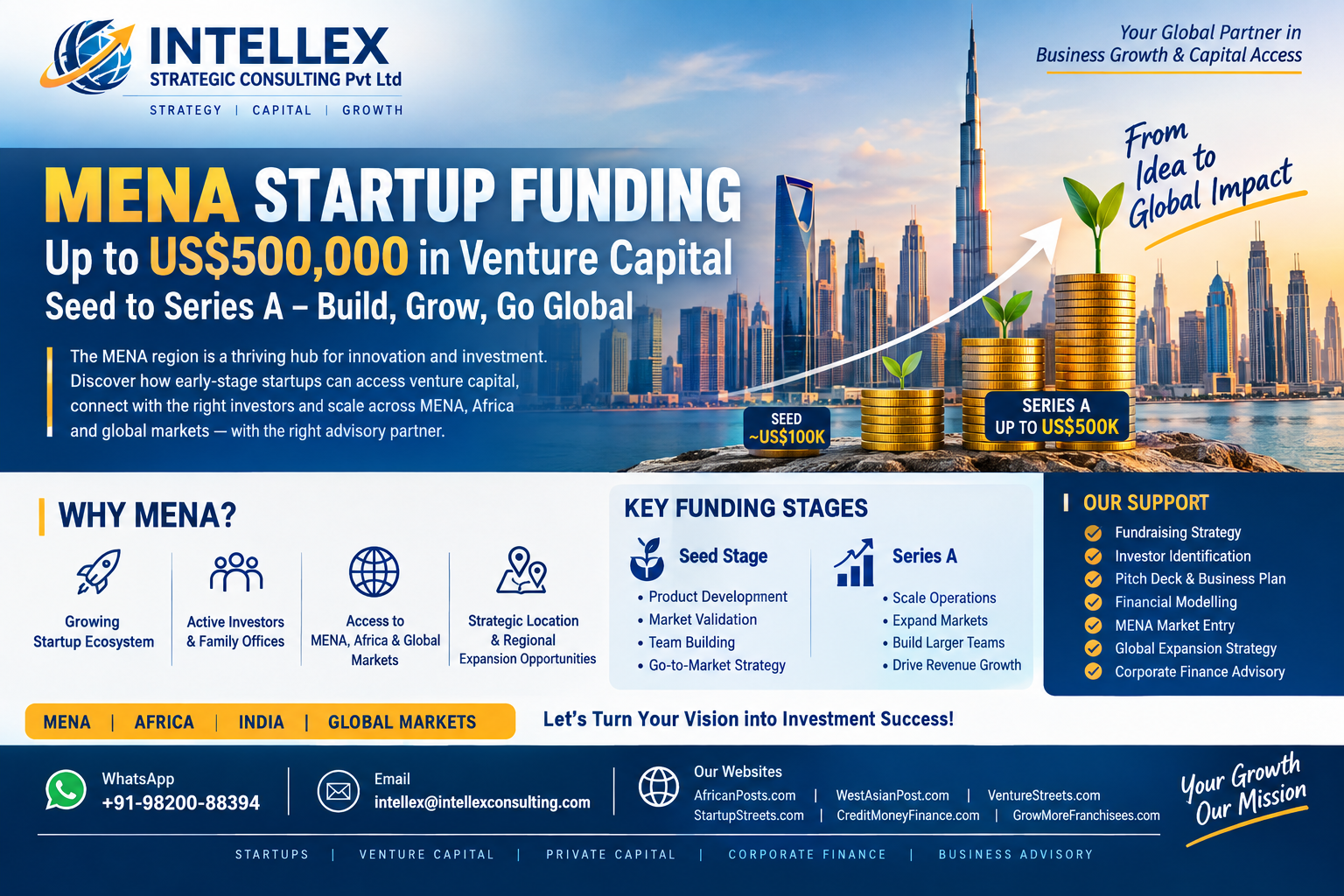
Intellex Strategic Consulting Pvt Ltd: Intermediary for Venture Capital and Private Equity Opportunities
Intellex Strategic Consulting Pvt Ltd acts as an intermediary/advisory platform for venture capital and private equity opportunities, facilitating connections between suitable businesses, promoters and potential capital providers.
The firm can assist businesses exploring:
- Venture Capital
- Private Equity
- Growth Capital
- Strategic Investment
- Equity Funding
- Secondary Transactions
- Business Expansion Capital
- Investor introductions
Intellex can also work with investors seeking potential opportunities across startups, growth-stage companies, established businesses and strategic investment situations.
Every transaction remains subject to investor interest, commercial evaluation, due diligence, applicable laws and regulations, transaction structure and mutually acceptable terms.
For Venture Capital & Private Equity Opportunities
Intellex Strategic Consulting Pvt Ltd
WhatsApp: 98200-88394
Email: intellex@intellexconsulting.com
Four Platforms for the Business, Startup and Finance Ecosystem
For entrepreneurs, investors, financial professionals and business owners, our ecosystem of digital platforms covers different aspects of business, investment, startups and finance:
VentureStreets.com
Startup, investment, venture capital, business opportunities and entrepreneurial ecosystem.
WestAsianPost.com
Business, investment, economic and financial developments across West Asia and emerging markets.
Startupstreets.com
Startup ecosystem, entrepreneurship, funding, business opportunities and founder-focused information.
CreditMoneyFinance.com
Credit, funding, lending, finance and financial services.
A New Capital Cycle Could Be Emerging Across MENA
MENA’s next growth chapter will not be written by governments alone.
It will be written by entrepreneurs who build companies.
It will be written by investors who provide patient and strategic capital.
It will be written by institutions that support innovation.
It will be written by businesses that adopt technology.
And it will be written by millions of people whose productivity and employment opportunities depend on a more dynamic private sector.
The region already has many of the ingredients required for transformation:
Capital.
Entrepreneurial talent.
Large markets.
Young populations.
Technology.
Infrastructure investment.
Government ambition.
The missing ingredient in many cases is the efficient connection between these resources.
Private equity and venture capital can help provide that connection.
They can direct capital toward promising businesses, help entrepreneurs scale, professionalise companies, support acquisitions, create liquidity and potentially connect regional companies with international markets.
MENA’s Next Growth Chapter Will Be About Scale
The first chapter of the MENA startup story was about building.
The next chapter can be about scaling.
Scaling companies.
Scaling capital.
Scaling technology.
Scaling employment.
Scaling exports.
Scaling regional champions.
Scaling investment opportunities.
And ultimately, scaling economic value.
For founders, this means preparing businesses to become investment-ready.
For investors, it means identifying businesses capable of creating sustainable long-term value.
For family businesses, it means considering institutional capital as a potential tool for succession and expansion.
For governments, it means creating environments in which private companies can innovate, invest and grow.
For financial intermediaries, it means helping connect capital with credible opportunities.
The opportunity for MENA is no longer simply to create more startups.
The opportunity is to build the next generation of globally competitive companies.
Private equity and venture capital can play a central role in that journey.
And if capital is matched effectively with entrepreneurship, innovation and execution, MENA’s next growth chapter could be considerably larger than the last.
Connect With Intellex Strategic Consulting Pvt Ltd
Intermediary for Venture Capital & Private Equity Opportunities
📱 WhatsApp: 91-98200-88394
📧 intellex@intellexconsulting.com
Explore our platforms:
VentureStreets.com
WestAsianPost.com
Startupstreets.com
CreditMoneyFinance.com
Editorial Note
This article is intended for informational and thought-leadership purposes and does not constitute an offer, solicitation, investment recommendation or financial advice. Venture capital, private equity and other investment transactions are subject to due diligence, investor suitability, regulatory requirements, commercial negotiations and mutually agreed transaction terms.
WestAsianPost.com.
More Similar Posts:
Ultimate Guide to Early Stage Startup Funding in MENA (2026): Top Investors & Strategies
How Startups in the Middle East Can Successfully Raise Series A Funding: A Complete Strategic Guide.
How Foreign Entrepreneurs Can Start a Company in UAE: A Complete 2026 Guide.
How Startups Can Raise Funding in Dubai: A Comprehensive Guide for Founders and Entrepreneurs.
The Complete Guide to Startup Funding in West Asia (2026 Edition).
Why Kjøller Is an Important Venture Capital Investor for Startups Globally.


3 thoughts on “Private Equity and Venture Capital Can Help Write MENA Region’s Next Growth Chapter. Why Strategic Capital Matters for Startups, Businesses and Investors”