

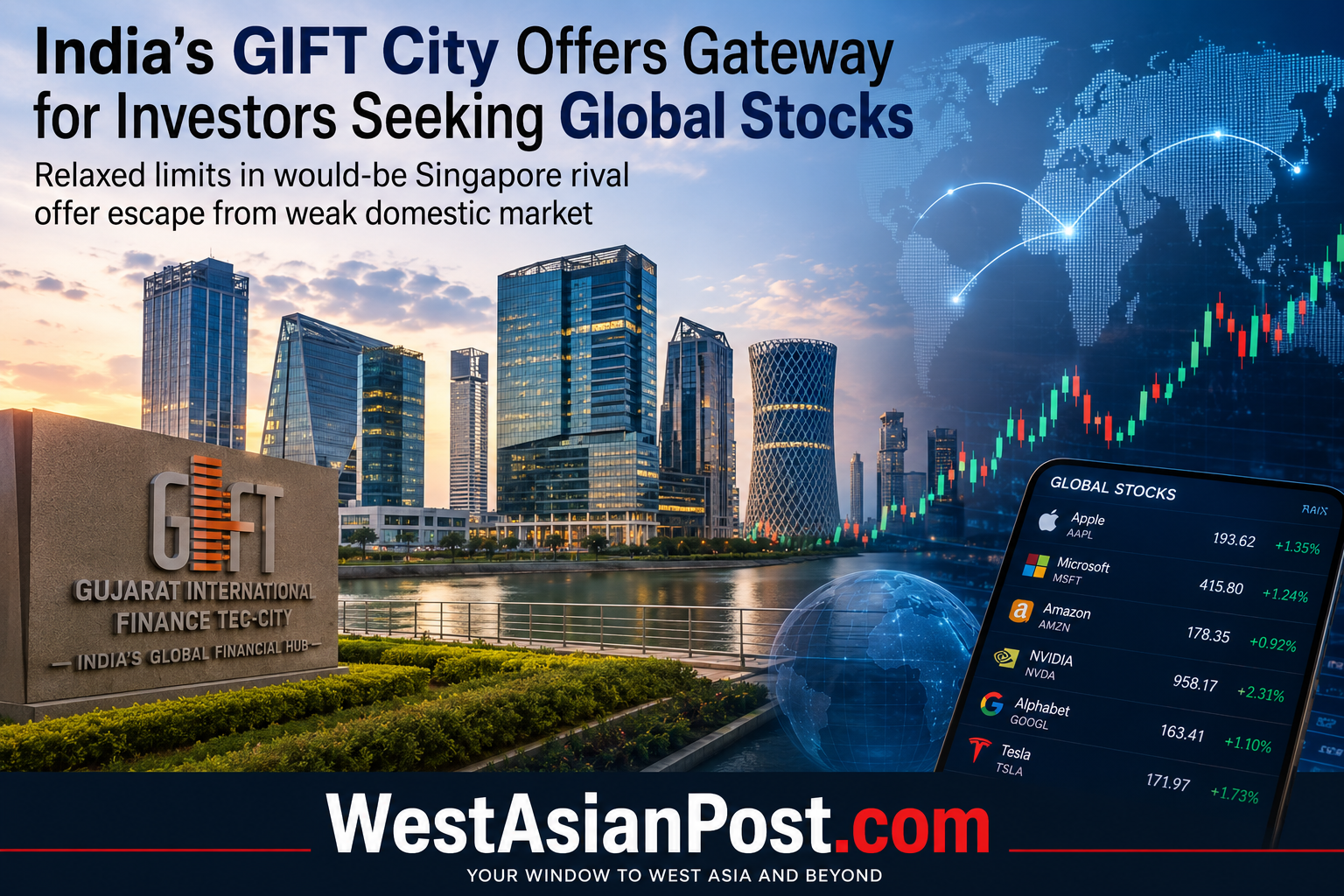
India’s GIFT City Emerges as a Global Investment Gateway for Access to International Stocks and Financial Markets.
India’s GIFT City is rapidly emerging as a global financial hub, offering investors access to international stocks, liberalized regulations, tax incentives, and a strategic alternative to Singapore and Dubai for cross-border investments.
India’s GIFT City Emerges as a Gateway for Investors Seeking Global Stocks
India’s ambition to become a major global financial power is increasingly centered around GIFT City — the country’s flagship international financial services hub that is now attracting investors seeking access to global equities, offshore financial products, and cross-border capital markets.
Positioned as India’s answer to financial centers like Singapore and Dubai, GIFT City is steadily transforming into a strategic gateway for Indian and international investors who want exposure to global stocks while benefiting from a liberalized regulatory framework and attractive tax incentives.
At a time when domestic markets face valuation concerns, slower earnings growth in certain sectors, and heightened geopolitical uncertainty, investors are increasingly looking outward for diversification opportunities. GIFT City is emerging as the platform that could make global investing significantly easier, faster, and more tax-efficient for Indian residents, institutions, family offices, and foreign investors alike.
What Is GIFT City?
GIFT City, officially known as Gujarat International Finance Tec-City, is India’s first operational International Financial Services Centre (IFSC). Located between Ahmedabad and Gandhinagar in the western state of Gujarat, the project was conceived as a world-class financial and technology hub capable of competing with leading international finance centers.
The IFSC framework allows financial institutions operating within GIFT City to transact in foreign currencies under regulations that are considerably more flexible than mainland Indian financial rules.
The hub is regulated by the International Financial Services Centres Authority (IFSCA), a unified regulator established specifically to oversee financial activities within the IFSC ecosystem.
Over the last few years, GIFT City has attracted:
- Global banks
- International exchanges
- Asset management firms
- Insurance companies
- Family offices
- Aircraft leasing firms
- Fintech companies
- Wealth management platforms
The city is increasingly being viewed as a bridge between Indian capital and global financial markets.
Why Investors Are Looking Beyond Domestic Markets
India’s stock markets have delivered exceptional long-term returns, but many investors are becoming more conscious of concentration risks and valuation pressures.
Several factors are driving demand for global diversification:
1. High Valuations in Indian Equities
Many Indian blue-chip and technology stocks trade at premium valuations compared to global peers. Investors seeking relatively lower valuations are increasingly exploring markets such as:
- The United States
- Europe
- Japan
- Southeast Asia
- Middle East markets
2. Access to Global Technology Giants
Indian investors often seek exposure to companies that dominate global innovation but are unavailable on Indian exchanges, including firms in:
- Artificial Intelligence
- Semiconductor manufacturing
- Cloud computing
- Biotechnology
- Electric vehicles
- Cybersecurity
Global investing enables participation in companies shaping the future global economy.
3. Currency Diversification
Investing internationally also provides diversification against currency fluctuations. Exposure to dollar-denominated assets is especially attractive during periods of rupee depreciation.
4. Geopolitical and Sectoral Diversification
Global investing reduces dependence on a single economy or sector and allows investors to benefit from trends unfolding across different regions.
How GIFT City Enables Access to Global Stocks
One of GIFT City’s most important developments is the creation of a regulatory and financial infrastructure that allows easier access to international markets.
Through platforms operating within the IFSC ecosystem, eligible investors can access:
- US equities
- Exchange-traded funds (ETFs)
- Global mutual funds
- Structured products
- Foreign currency deposits
- International bonds
- Alternative investment funds
This marks a major shift from the traditionally cumbersome overseas investing routes that involved multiple intermediaries, regulatory approvals, and operational challenges.
NSE IFSC and India INX: Building Global Market Connectivity
Two major exchanges operating in GIFT City are playing a crucial role in connecting India to international markets:
NSE International Exchange
The international arm of the National Stock Exchange enables global trading products and cross-border financial activity.
India International Exchange
Also known as India INX, the exchange under the BSE Limited ecosystem offers international trading services and financial products for foreign investors and institutions.
These exchanges are helping position GIFT City as a 24-hour financial ecosystem aligned with global trading cycles.
Liberalized Regulations Give GIFT City an Edge
One of the biggest reasons GIFT City is attracting attention is its comparatively relaxed regulatory environment.
Unlike India’s mainland financial system, GIFT City permits several operational flexibilities, including:
- Transactions in foreign currencies
- Simplified cross-border fund structures
- Easier capital movement mechanisms
- Tax-efficient structures
- Liberalized derivatives trading
- Offshore banking operations
For global investors and multinational institutions, these reforms reduce friction and improve operational efficiency.
This regulatory flexibility is one reason analysts increasingly describe GIFT City as a potential regional rival to Singapore’s offshore finance ecosystem.
Tax Incentives Strengthening Investor Interest
Tax benefits remain one of GIFT City’s strongest attractions.
Several incentives offered within the IFSC include:
- Tax holidays for eligible businesses
- Exemptions on certain capital gains
- Reduced securities transaction costs
- GST exemptions on select services
- Benefits for offshore fund management structures
These incentives are particularly attractive for:
- Family offices
- Wealth managers
- Private equity firms
- Venture capital funds
- Global asset managers
India is effectively using fiscal incentives to attract capital flows that would otherwise move through offshore jurisdictions.
Rising Interest from Wealthy Indian Investors
India’s rapidly expanding affluent and ultra-high-net-worth population is also driving GIFT City’s growth.
Many wealthy Indian families have historically used foreign jurisdictions for global investments, wealth management, and succession planning. However, GIFT City offers an India-linked alternative with growing regulatory credibility and international connectivity.
Private banks and wealth management firms are increasingly launching IFSC-based products tailored for Indian investors seeking international exposure.
This trend is expected to accelerate as awareness increases and operational processes become smoother.
Strategic Importance Amid Global Geopolitical Shifts
GIFT City’s emergence comes at a time of major global economic realignment.
As geopolitical tensions reshape trade routes, capital flows, and financial alliances, countries are competing aggressively to establish themselves as neutral, business-friendly financial hubs.
India sees GIFT City as strategically important for several reasons:
- Reducing dependence on offshore financial centers
- Increasing India’s role in global finance
- Attracting foreign capital
- Expanding rupee internationalization efforts
- Enhancing financial sector competitiveness
- Supporting cross-border fintech innovation
For international investors, GIFT City provides exposure to India’s growth story while operating within a globally oriented regulatory framework.
Challenges Ahead for GIFT City
Despite its rapid progress, GIFT City still faces significant challenges before it can truly rival global financial hubs.
1. Competition from Established Centers
Financial hubs such as Singapore, Dubai, Hong Kong, and London possess decades of institutional trust, deep liquidity, and sophisticated ecosystems.
2. Regulatory Learning Curve
Although the framework is liberalized, investors and institutions still face evolving compliance requirements and operational adjustments.
3. Liquidity Depth
Building deep and active international markets requires sustained participation from global institutional investors.
4. Talent and Infrastructure Expansion
Competing globally will require continued investment in skilled financial professionals, international arbitration systems, fintech ecosystems, and urban infrastructure.
The Road Ahead
India’s long-term economic ambitions increasingly depend on its ability to integrate with global capital markets. GIFT City is becoming central to that vision.
The city represents more than just a financial zone — it symbolizes India’s effort to build an internationally competitive financial architecture capable of attracting capital, fostering innovation, and providing global investment access from within India itself.
As more financial institutions establish operations there and regulatory clarity improves, GIFT City could emerge as one of Asia’s most important financial gateways over the next decade.
For investors seeking access to global stocks, diversified portfolios, and international financial opportunities, India’s GIFT City is rapidly positioning itself as a serious alternative to traditional offshore hubs — and potentially one of the most consequential financial experiments in modern India.
WestAsianPost.com
More Featured Articles:
How Startups in the Middle East Can Successfully Raise Series A Funding: A Complete Strategic Guide.
How Foreign Entrepreneurs Can Start a Company in UAE: A Complete 2026 Guide.
How Startups Can Raise Funding in Dubai: A Comprehensive Guide for Founders and Entrepreneurs.
The Complete Guide to Startup Funding in West Asia (2026 Edition).
Why Kjøller Is an Important Venture Capital Investor for Startups Globally.
Ultimate Guide to Early Stage Startup Funding in MENA (2026): Top Investors & Strategies


2 thoughts on “India’s GIFT City Emerges as a Global Investment Gateway for Access to International Stocks and Financial Markets.”