

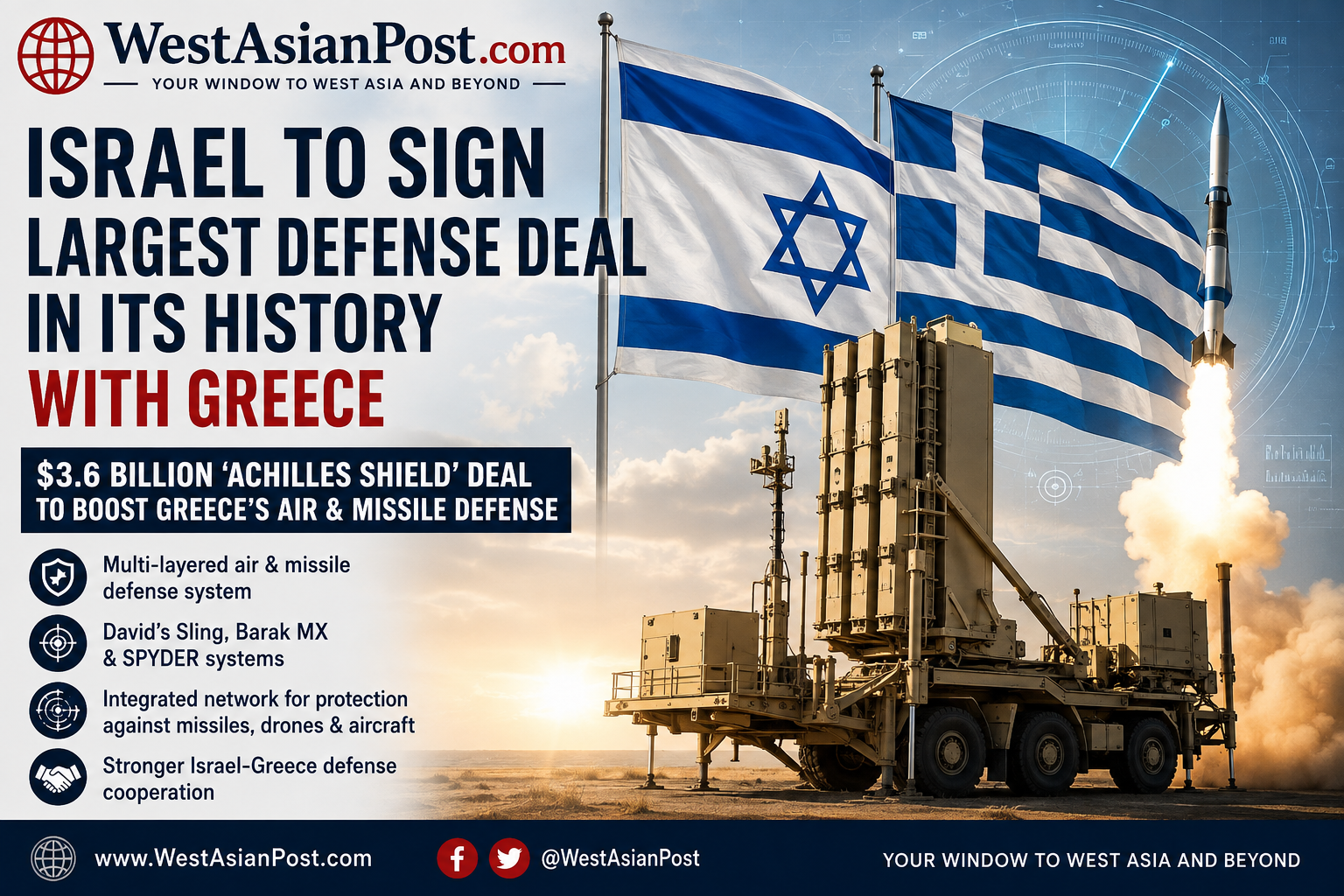
Israel-Greece $3.6 Billion Defense Deal: How ‘Achilles Shield’ Could Transform Greece’s Air and Missile Defense.
Israel and Greece are set to sign a historic $3.6 billion defense agreement for the “Achilles Shield,” a multilayered air, missile and drone defense network.
Israel-Greece $3.6 Billion Defense Deal: ‘Achilles Shield’ Set to Reshape Greece’s Air Defense
By WestAsianPost.com | August 30, 2026
Israel and Greece are preparing to sign one of the most significant defense agreements in their bilateral relationship, with Athens set to acquire a sophisticated Israeli-built multilayered air and missile defense network worth approximately $3.6 billion.
The agreement, expected to be signed in Tel Aviv on August 31, would become the largest defense export deal in Israel’s history, according to reports. The project, known as “Achilles Shield” in Greece, is designed to bring together several Israeli air-defense technologies with Greece’s existing capabilities, including Patriot systems.
The deal comes as Greece accelerates its military modernization program and seeks to strengthen protection against a wide range of threats, including ballistic missiles, cruise missiles, aircraft and increasingly sophisticated drones.
A Multilayered Shield for Greece
Unlike a conventional air-defense purchase involving a single weapon system, Achilles Shield is envisioned as an integrated national air-defense architecture.
The system is expected to combine three major Israeli technologies:
- David’s Sling – designed to counter ballistic missiles, heavy rockets and other longer-range threats.
- Barak MX – a flexible air-defense system capable of engaging aircraft, missiles and other aerial threats at different ranges.
- SPYDER – a mobile system designed to provide shorter-range protection against aircraft, drones and other low-altitude threats.
These systems are expected to operate alongside Greece’s existing Patriot air-defense batteries, creating multiple layers of protection rather than relying on one interception system.
Why multiple layers matter
Modern air warfare increasingly involves combinations of threats rather than isolated attacks.
A country may face ballistic missiles from one direction, cruise missiles or aircraft from another, while drones and loitering munitions can approach at low altitude.
A multilayered system attempts to ensure that if one layer cannot deal with a particular threat, another system can potentially engage it.
This is one of the central concepts behind Israel’s own approach to integrated air defense.
What Is the ‘Achilles Shield’?
The Achilles Shield project represents a broader attempt by Greece to modernize and integrate its air-defense infrastructure.
Rather than allowing different missile-defense and radar systems to operate independently, the planned architecture is expected to connect sensors, command-and-control systems and interceptors into a coordinated network.
Reports indicate that the project will include a national-level command-and-control center, incorporating advanced software and artificial intelligence capabilities to assist with threat assessment and the selection of appropriate defensive responses.
This network-centric approach could be particularly important for Greece because of the country’s geography.
Greece has a large number of islands and extensive maritime territory. Protecting widely dispersed military installations, population centers and strategic infrastructure presents different challenges from defending a geographically compact mainland.
David’s Sling: The Long-Range Layer
A major component of the agreement is expected to be David’s Sling, developed by Israel’s Rafael Advanced Defense Systems in cooperation with the United States.
David’s Sling is designed to intercept threats such as ballistic missiles, cruise missiles and heavy rockets.
For Greece, its inclusion would provide a higher-tier interception capability within the new defense architecture.
The system would complement shorter-range defenses rather than replace them, allowing Greece to create different defensive layers according to the nature and range of an incoming threat.
Barak MX Adds Medium-Range Protection
Another key component is Barak MX, developed by Israel Aerospace Industries (IAI).
The system is designed as a flexible air-defense platform capable of responding to multiple types of aerial threats.
Its role within Achilles Shield would essentially provide an intermediate layer between longer-range missile defenses and shorter-range systems.
The combination of Barak MX, David’s Sling and SPYDER is therefore intended to give Greece a broader defensive envelope against missiles, aircraft and drones.
SPYDER and the Growing Drone Threat
The proliferation of inexpensive drones has fundamentally changed the modern battlefield.
Small unmanned aircraft can be used for reconnaissance, precision attacks and saturation attacks designed to overwhelm conventional defenses.
SPYDER, another Israeli system being acquired by Greece, is designed to counter shorter-range aerial threats, including drones and aircraft.
Reports indicate that SPYDER batteries could be deployed at strategic locations, including Greek islands, providing Greece with a mobile layer of protection.
This could become increasingly important as militaries across Europe reassess their defenses against drone warfare.
Turkey and Iran: The Strategic Context
The proposed system has to be viewed within the wider security environment of the Eastern Mediterranean.
Greece and Turkey are both NATO members but have longstanding disputes involving territorial waters, airspace and sovereignty in the Aegean.
At the same time, developments in Iran’s missile and drone capabilities have contributed to broader European concerns about long-range aerial threats.
Reports on the deal have specifically identified Turkey and Iran as potential threat scenarios that Greece wants its new defensive architecture to be capable of addressing.
Importantly, the system is fundamentally defensive in character. Its purpose is to improve Greece’s ability to detect, track and intercept incoming aerial threats rather than provide Greece with an offensive strike capability.
A Major Boost for Israel’s Defense Industry
The agreement is also enormously significant for Israel.
If signed at the reported value of approximately $3.6 billion, it would surpass Israel’s previous record defense export deal.
The previous record was the approximately $3.5 billion Arrow 3 missile-defense agreement with Germany, signed in 2023.
The Greek agreement therefore demonstrates the growing international demand for Israeli air-defense technology.
Israel’s defense companies have increasingly become major suppliers to European countries seeking to strengthen their air and missile defenses.
Greece Could Also Benefit Economically
The agreement is not expected to benefit Israeli defense manufacturers alone.
Greek companies are reportedly expected to participate as subcontractors, with approximately €700 million of the overall project potentially flowing to Greek industry. Earlier Greek planning also envisaged substantial domestic participation in the program.
This industrial participation could provide opportunities for Greek companies involved in:
- Defense electronics
- Radar and communications
- Maintenance
- Software
- Manufacturing
- Logistics
- Engineering
- Military infrastructure
Such local participation can also make long-term maintenance and upgrades easier for the purchasing country.
A Major Step in Israel-Greece Strategic Relations
The deal represents more than a weapons purchase.
Israel and Greece have steadily expanded cooperation in defense, security and military technology.
Greece has already purchased Israeli military equipment, including Spike missiles, SPICE precision-guided weapons and Heron unmanned systems, while Israel has become an increasingly important defense-technology partner for Athens.
The relationship also has a broader Eastern Mediterranean dimension, with Greece, Israel and Cyprus developing closer strategic cooperation.
The latest defense agreement could further institutionalize that relationship.
Europe’s Growing Interest in Israeli Air Defense
The Greece agreement also comes at a time when European countries are reassessing their defense requirements.
Russia’s war against Ukraine has demonstrated the importance of air-defense systems, while the increasing use of drones and missiles has created new challenges for European militaries.
Germany’s purchase of Arrow 3 and Finland’s selection of David’s Sling are examples of European interest in Israeli missile-defense technology.
For Israel’s defense industry, the European market could therefore become increasingly important.
What the Deal Means for the Eastern Mediterranean
The Achilles Shield project could have implications extending well beyond Greece and Israel.
A stronger Greek air-defense network could alter the strategic calculations of neighboring countries.
For Greece, the principal benefit is greater protection of its territory and critical infrastructure.
For Israel, the agreement strengthens its position as a major defense technology provider to a NATO member.
For the wider Eastern Mediterranean, it adds another layer to the evolving security architecture involving Greece, Israel and Cyprus.
The development is therefore likely to be closely watched in Ankara, Nicosia, Jerusalem and other regional capitals.
From Weapons Purchase to Integrated Defense Network
Perhaps the most important aspect of the agreement is that Greece is not simply purchasing individual missile systems.
The objective is to create an integrated defense network in which radars, command centers, software and interception systems work together.
That distinction is critical.
The effectiveness of modern air defense increasingly depends not merely on the capabilities of an individual interceptor, but on how quickly a military can detect a threat, identify it, calculate its trajectory, select the appropriate response and coordinate multiple defensive assets.
Achilles Shield is intended to bring these capabilities together under a unified architecture.
A New Era for Israel-Greece Defense Cooperation?
If the agreement is formally signed as expected, the $3.6 billion Achilles Shield project will mark a major milestone in Israel’s defense-export history and Greece’s military modernization program.
For Greece, the objective is to create a comprehensive shield against missiles, aircraft and drones.
For Israel, the agreement represents a major commercial and strategic success, reinforcing its position as a global supplier of advanced air-defense technology.
And for the Eastern Mediterranean, it signals that air and missile defense is becoming an increasingly central component of regional security planning.
As modern warfare becomes increasingly dominated by missiles, drones, electronic warfare and networked weapons, the ability to build integrated defensive architectures may become just as important as possessing individual weapons.
Achilles Shield could therefore become much more than a $3.6 billion arms agreement—it could become a defining element of Greece’s future defense strategy and another important chapter in the rapidly expanding Israel-Greece strategic partnership.
WestAsianPost.com will continue to track developments surrounding the Israel-Greece defense agreement and the implementation of the Achilles Shield program.
West Asian Post
More Featured Articles:
Dubai vs Singapore: Which City Will Become the Next Global Financial Hub?
Why Global Entrepreneurs Are Moving to Dubai: The Ultimate Business Hub of the 21st Century.
How Startups in the Middle East Can Successfully Raise Series A Funding: A Complete Strategic Guide.
How Foreign Entrepreneurs Can Start a Company in UAE: A Complete 2026 Guide.
Company Registration in Dubai 2026: Complete Guide to Setup, Costs, Benefits & Compliance.
Launch Your Own Skincare, Haircare & Personal Care Brand Through White-Label Manufacturing.
Why Kjøller Is an Important Venture Capital Investor for Startups Globally.