
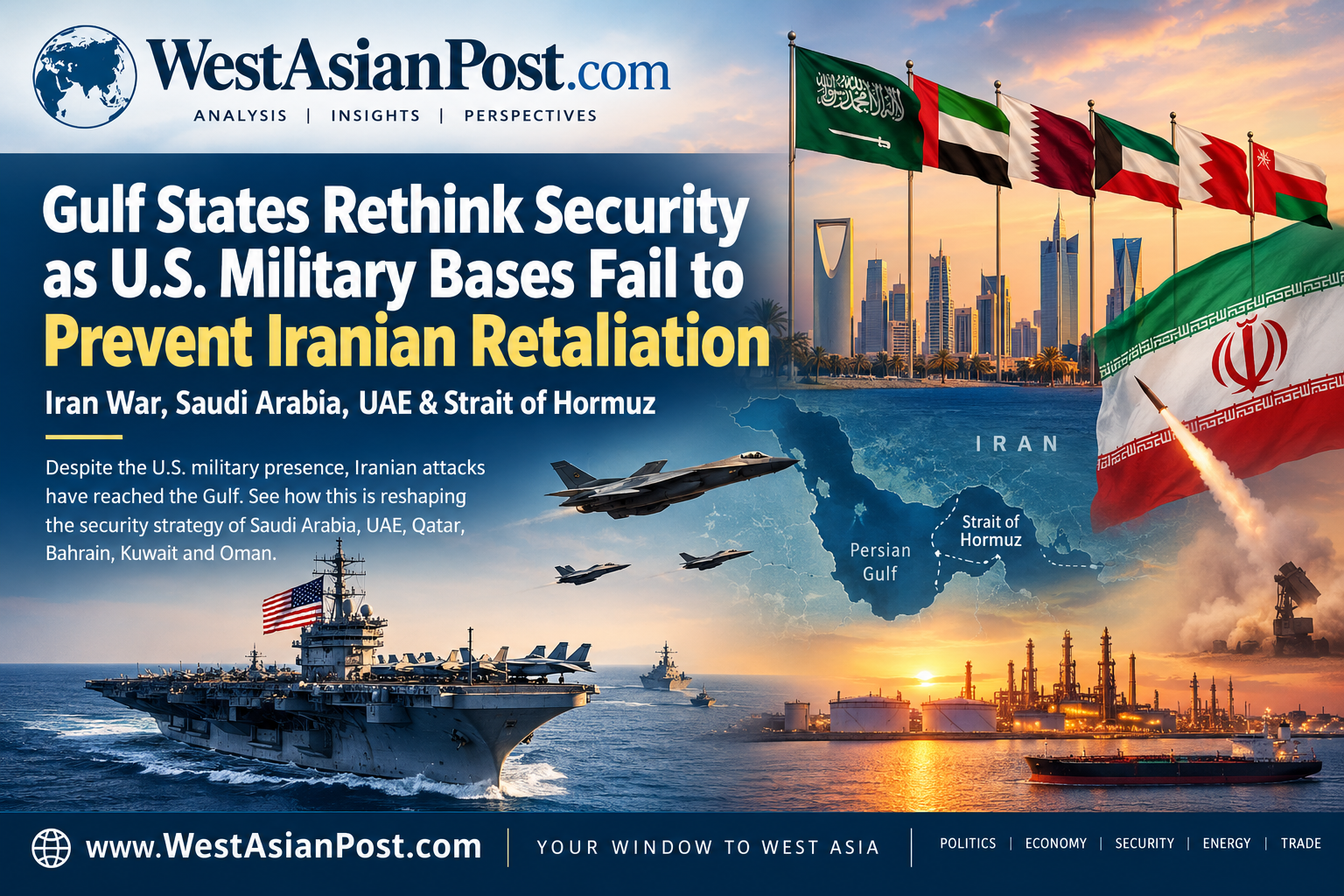
Gulf States Rethink Security as U.S. Military Bases Fail to Prevent Iranian Retaliation | Iran War, Saudi Arabia, UAE & Strait of Hormuz.
Gulf Arab states are reassessing their security strategy as Iranian retaliation reaches the region despite the U.S. military presence. Explore the impact on Saudi Arabia, UAE, Qatar, Bahrain, Kuwait and the Strait of Hormuz.
Gulf States Reassess Their Security Strategy as U.S. Military Presence Fails to Prevent Iranian Retaliation
By West Asian Post | September 18, 2026
The security architecture of the Persian Gulf is facing a major reassessment as Arab states increasingly confront a difficult reality: hosting large U.S. military installations has not completely insulated them from Iranian retaliation during the widening U.S.-Iran conflict.
The issue has become particularly urgent for Saudi Arabia, the United Arab Emirates, Qatar, Bahrain, Kuwait and Oman, where American military cooperation has traditionally been an important component of national security.
Recent attacks involving missiles and drones, threats to energy infrastructure and continuing uncertainty around the Strait of Hormuz have encouraged Gulf governments to explore a combination of military, diplomatic and regional-security options.
The emerging question is no longer simply how much protection the American security umbrella provides, but how Gulf states can reduce their exposure to conflicts between Washington and Tehran.
The limits of the traditional security model
For decades, the United States has maintained a substantial military presence across the Gulf.
American forces operate from or maintain important facilities in countries including Bahrain, Qatar, Kuwait and the UAE, while U.S. forces also maintain military relationships and deployments elsewhere in the region.
U.S. Central Command has said that more than 50,000 American personnel have been operating across the Middle East during the current conflict. Washington has also conducted repeated strikes against Iranian military capabilities, saying the operations were intended to protect American forces and commercial shipping.
Yet the conflict has demonstrated an important distinction between deterrence and protection.
American military power can impose substantial costs on an adversary, but it cannot necessarily prevent missiles, drones or proxy attacks from reaching targets in neighbouring countries.
The U.N. Secretary-General warned in July that the renewed military confrontation included Iranian attacks on targets in neighbouring countries and that a return to full-scale hostilities could have severe consequences for regional populations and the global economy.
Gulf countries are being drawn closer to the conflict
The geographic reality of the Gulf makes complete neutrality extremely difficult.
American military facilities are located close to Iran, while major energy infrastructure, airports, ports and population centres are concentrated within relatively small territories.
This creates a strategic dilemma.
A Gulf state may not want to become a participant in a U.S.-Iran war, but the presence of American military assets on its territory can make it part of the strategic battlefield.
The U.S. State Department’s current travel advisory for Bahrain, for example, cites an ongoing threat of Iranian drone and missile attacks following the beginning of hostilities between Washington and Tehran. The UAE also remains under a U.S. travel advisory because of armed-conflict and terrorism risks.
That situation raises a fundamental question for Gulf governments:
Can an American military presence simultaneously provide security while also increasing the strategic value of their territory as a potential target?
There is no simple answer.
Iran’s strategy creates a difficult calculation
Iran has demonstrated that it can attempt to widen the consequences of a conflict beyond its own borders.
Attacks have involved U.S. military facilities and commercial shipping, while Iran-aligned groups have operated in other theatres.
Reuters reported in August that Iranian officials had warned Gulf states that Iranian forces could target oil, power and water infrastructure if Gulf governments were unable to persuade Washington to stop its military campaign.
More recently, Iran-aligned Houthi forces have attacked Saudi targets, while attacks attributed to Iran-aligned groups have also threatened Saudi energy infrastructure. Reuters reported on September 15 that Saudi authorities issued security alerts across parts of the kingdom following a week of attacks.
For Gulf governments, this creates a complex security equation.
Their most important economic assets — oil fields, refineries, pipelines, ports, desalination facilities and power plants — are also among the infrastructure that could be vulnerable during a major regional conflict.
The Strait of Hormuz changes everything
At the centre of the crisis is the Strait of Hormuz, one of the world’s most strategically important maritime chokepoints.
Before the current hostilities, approximately one-fifth of global oil supplies passed through the strait.
Any prolonged disruption can therefore affect not only Gulf economies but also energy prices, shipping costs, inflation and industrial production worldwide.
The United States has repeatedly said that its military operations are aimed partly at protecting commercial navigation.
CENTCOM said in July that American forces had helped facilitate the passage of hundreds of commercial vessels and hundreds of millions of barrels of crude through the waterway.
But the continuing attacks demonstrate how difficult it is to guarantee maritime security during a major interstate conflict.
The United Nations has called for restoration of full freedom of navigation in the Strait and urged Washington and Tehran to return to negotiations.
Diplomacy is returning to the Gulf security equation
This is perhaps the most significant development.
Gulf states are not abandoning their relationships with Washington. Instead, there are indications that diplomacy with Tehran is being considered as another layer of national security.
Oman has played a particularly important mediating role.
A planned regional meeting concerning the Strait of Hormuz was postponed in September after disagreements among regional governments. Reuters reported that the discussions were intended to address the future management and navigation of the strategic waterway.
The postponement illustrates the difficulty of constructing a common Gulf position.
Saudi Arabia, the UAE, Bahrain, Qatar, Kuwait and Oman have different relationships with both Washington and Tehran and do not necessarily share identical threat perceptions.
Saudi Arabia faces an especially complicated position
Saudi Arabia is simultaneously a major U.S. security partner, an important energy producer and a direct target of attacks involving Iran-aligned forces.
The kingdom has therefore found itself managing several priorities at once:
- Protecting critical energy infrastructure
- Maintaining its strategic relationship with Washington
- Preventing further escalation with Iran
- Containing threats from Yemen
- Protecting shipping and trade routes
- Preserving oil-export capacity
- Avoiding a broader regional war
The recent attacks involving the Houthis have added another dimension to the problem.
Reuters reported that the Houthis launched a significant missile and drone attack against a Saudi military facility while diplomatic efforts concerning the Strait of Hormuz were encountering difficulties.
For Riyadh, the security challenge is therefore no longer confined to the eastern Gulf.
Threats can emerge from multiple directions.
The rise of regional security thinking
The current crisis could encourage Gulf countries to reconsider the structure of their security relationships.
This does not necessarily mean replacing the United States.
Instead, several approaches could develop simultaneously:
1. Stronger national air and missile defence
Gulf governments may increase investment in indigenous surveillance, missile defence, drones, electronic warfare and early-warning systems.
2. Greater intelligence cooperation
Regional intelligence-sharing could become increasingly important, particularly for identifying missile launches, drone movements and proxy activity.
3. Direct communication channels with Iran
Even countries maintaining close U.S. relationships may conclude that direct communication with Tehran is necessary to reduce the possibility of miscalculation.
4. Greater protection of critical infrastructure
Oil facilities, desalination plants, electricity networks, ports and telecommunications infrastructure could receive greater physical and technological protection.
5. Diversification of strategic partnerships
Gulf states could seek additional defence, technology and diplomatic relationships with countries outside the traditional U.S.-centred security framework.
6. Maritime-security arrangements
The continuing crisis around Hormuz could encourage new regional mechanisms involving Gulf states, Iran and external maritime powers.
The economic consequences could be enormous
The security crisis is not confined to military affairs.
Energy markets have already reacted to disruptions surrounding the Gulf.
Reuters reported on September 15 that oil prices had climbed above $108 per barrel amid concerns over supply disruptions following attacks involving Saudi Arabia and difficulties surrounding diplomatic efforts over the Strait of Hormuz.
For Gulf governments, the stakes are therefore exceptionally high.
A prolonged conflict could affect:
Oil production → exports → government revenues → infrastructure spending → investment → employment → regional economic growth.
The consequences would extend well beyond the Middle East.
Asian economies, particularly major energy-importing countries, would also face higher transportation and manufacturing costs.
A new Gulf security architecture?
The central issue emerging from the present crisis is whether the Gulf’s traditional security structure is entering a period of adjustment.
The United States remains a major military power in the region, and Gulf governments continue to maintain important defence relationships with Washington.
At the same time, recent events have demonstrated that American military presence cannot guarantee that Gulf territory or infrastructure will remain outside the battlefield.
That reality could push Gulf governments toward a multi-layered security strategy combining American military cooperation, domestic defence capabilities, regional diplomacy and direct communication with Iran.
The result may not be a dramatic break with Washington.
It could instead be something more gradual: Gulf states seeking greater strategic autonomy while maintaining the U.S. relationship.
What happens next?
Several developments will be closely watched:
- Whether Gulf-Iran diplomatic talks concerning the Strait of Hormuz resume.
- Whether attacks on Saudi Arabia and other Gulf states continue.
- Whether Washington expands or reduces its military operations.
- Whether Iran continues targeting U.S.-linked facilities in the region.
- Whether Gulf governments develop a coordinated regional security mechanism.
- Whether maritime traffic through Hormuz returns to normal.
- Whether oil infrastructure becomes a larger target.
- Whether China, India, Pakistan, Oman or other regional actors become more involved diplomatically.
The most important question may ultimately be whether diplomacy can establish mechanisms that separate Gulf states from direct retaliation in conflicts between Iran and the United States.
For the Gulf monarchies, the lesson of the current conflict is not necessarily that the American security relationship has become irrelevant.
Rather, it is that no single security partnership can eliminate the risks created by geography, missiles, drones, proxy forces and disruption of strategic waterways.
The Gulf’s next security architecture may therefore be built around multiple pillars — American defence cooperation, stronger indigenous capabilities and, potentially, direct regional diplomacy.
The outcome could influence not only the future of the Persian Gulf but also the stability of global energy markets and international trade.
WestAsianPost.com
More Featured Articles:
The Complete Guide to Startup Funding in West Asia (2026 Edition).