

MENA(Middle East & North Africa) Startup Funding in 2026: How Early-Stage Startups Can Access Up to US$500,000 in Venture Capital.
MENA startup funding guide 2026: discover how early-stage startups can pursue seed and Series A venture capital up to US$500,000 and how Intellex Strategic Consulting supports global fundraising.
The Middle East and North Africa (MENA) startup ecosystem continues to attract entrepreneurs, venture capital firms, strategic investors and international capital. For founders building technology and technology-enabled businesses, seed and early-stage venture capital can provide not only funding but also mentorship, market access, strategic connections and support for regional expansion.
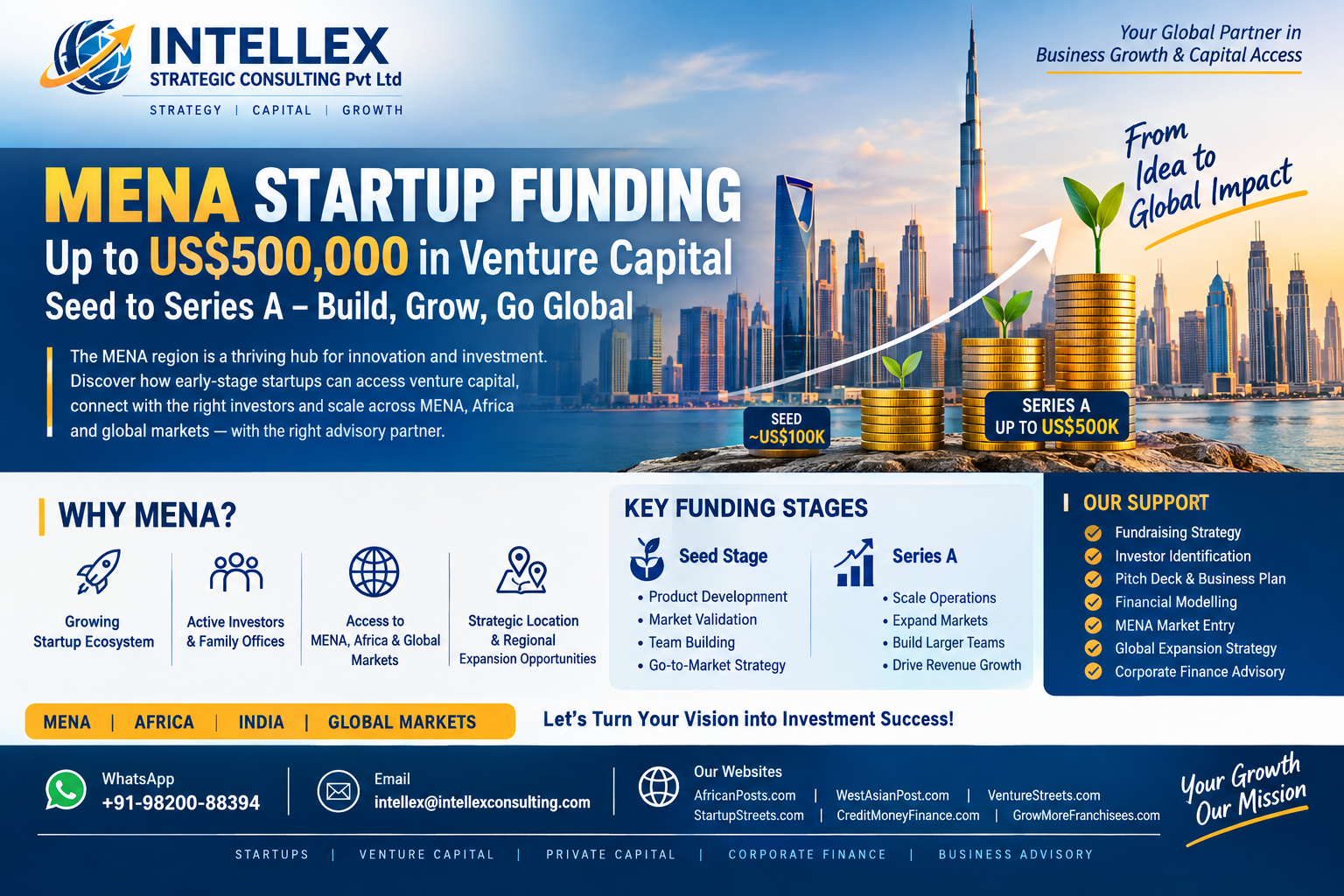
One example highlighted in the supplied image is Plus VC, a MENA-focused early-stage venture capital firm. According to Plus VC’s own website, the firm typically invests around US$100,000 at the seed stage, with follow-on investments of up to US$500,000 in subsequent rounds through Series A for selected portfolio companies.
This creates an important opportunity for founders across MENA—and potentially for businesses with ambitions to expand between MENA, Africa, India, the United States and other international markets.
Understanding the US$500,000 MENA Startup Funding Opportunity
The funding opportunity shown in the image should not be interpreted as an automatic US$500,000 grant or guaranteed investment for every startup.
Rather, Plus VC describes an investment model in which it generally makes an initial seed investment of approximately US$100,000, while follow-on investments can reach US$500,000 for selected companies as they progress toward Series A. Plus VC states that it invests in technology and technology-enabled startups across MENA and beyond.
This distinction is important for founders preparing their fundraising strategy.
A startup seeking capital should therefore focus on:
- Demonstrating a strong business problem and solution
- Showing product development and market validation
- Building customer or user traction
- Presenting a scalable business model
- Demonstrating a credible founding team
- Explaining the size of the addressable market
- Establishing a clear path to regional or international expansion
- Preparing professional financial projections
- Showing how the investment will accelerate growth
Who Is Plus VC Looking to Invest In?
Plus VC describes itself as an early-stage VC firm investing in tech and tech-enabled startups across MENA and beyond. Its stated strategy is to invest initially at seed stage and provide follow-on funding to high-performing portfolio companies up to Series A.
The firm’s portfolio demonstrates exposure to areas including:
- FinTech
- Enterprise SaaS
- Construction technology
- FoodTech
- EdTech
- HealthTech
- AI and technology
- Digital financial services
- Marketplaces
- B2B technology
Its portfolio includes companies from countries such as Saudi Arabia, Egypt, the UAE, Oman and Kuwait, among others.
This illustrates the diversity of the MENA startup ecosystem.
Why MENA Has Become an Important Startup Investment Market
MENA is no longer simply a collection of individual national startup ecosystems. Increasingly, entrepreneurs are building businesses capable of operating across multiple countries.
The region includes major economic centres such as:
- United Arab Emirates
- Saudi Arabia
- Egypt
- Bahrain
- Qatar
- Kuwait
- Oman
- Jordan
- Morocco
- Tunisia
For technology companies, the opportunity can be significantly larger than the domestic market of one country.
A successful startup may potentially develop a business model that expands from Dubai to Riyadh, Cairo, Doha, Kuwait City and other regional markets, while subsequently targeting Europe, Africa, India or North America.
This is one reason investors increasingly look for businesses with regional scalability rather than merely a local business model.
Seed Funding vs Series A Funding
Understanding the difference between funding stages is critical.
Seed Stage
Seed funding is generally used to establish and validate the business.
Typical uses include:
- Product development
- Technology infrastructure
- Hiring initial employees
- Customer acquisition
- Market validation
- Regulatory preparation
- Building sales channels
Series A
Series A generally comes after a startup has demonstrated stronger evidence that its business model can scale.
Capital may be used for:
- Geographic expansion
- Larger teams
- Sales and marketing
- Technology development
- New products
- Customer acquisition
- Operational infrastructure
- Regional expansion
Plus VC’s stated model specifically provides initial seed-stage capital and follow-on funding for selected portfolio companies progressing toward Series A.
What Startups Need Before Approaching Investors
Many founders make the mistake of approaching investors too early with only an idea and an attractive presentation.
A professional fundraising process requires substantially more preparation.
1. Professional Pitch Deck
A strong pitch deck should clearly explain:
- The problem
- The solution
- Product/service
- Target market
- Market size
- Business model
- Existing traction
- Revenue
- Customer acquisition
- Competition
- Competitive advantage
- Management team
- Financial projections
- Funding requirement
- Use of funds
- Expected milestones
2. Demonstrable Traction
Traction can significantly strengthen an early-stage fundraising proposition.
Depending on the business, this could include:
- Paying customers
- Monthly recurring revenue
- Annual recurring revenue
- Active users
- Customer retention
- Transaction volume
- Partnerships
- Pilot projects
- Letters of intent
- Distribution agreements
- Growing order volumes
Investors are generally more interested when founders can demonstrate that the market is responding to their product.
3. Clear Financial Model
Investors need to understand how the company can become valuable.
The financial model should generally include:
- Revenue projections
- Gross margins
- Operating expenses
- Customer acquisition costs
- Lifetime customer value
- Cash burn
- Runway
- EBITDA assumptions
- Capital requirements
- Break-even projections
Founders should also understand their current valuation and proposed dilution before negotiating investment terms.
4. Regulatory and Legal Readiness
For MENA startups, regulatory considerations can be particularly important.
FinTech, healthcare, financial services, education, logistics, mobility and other regulated sectors may require specific licences or approvals.
Investors will typically want confidence that the company has appropriately addressed:
- Corporate structure
- Shareholding
- Intellectual property
- Contracts
- Regulatory compliance
- Employment matters
- Tax
- Data protection
- Customer agreements
- Existing investor rights
A clean due-diligence process can significantly reduce friction during fundraising.
The Importance of Cross-Border Expansion
One of the strongest characteristics of a MENA startup can be its ability to expand beyond its initial market.
For example, a technology company established in the UAE might develop a business model suitable for:
UAE → Saudi Arabia → GCC → Egypt → North Africa → Africa → International Markets
However, geographic expansion requires more than translating a website.
Founders must consider:
- Local regulations
- Local competitors
- Pricing
- Distribution
- Payment systems
- Talent
- Partnerships
- Cultural differences
- Customer acquisition costs
This is where strategic advisory support can become valuable.
MENA and Africa: Increasingly Connected Startup Markets
The MENA and African startup ecosystems increasingly overlap through investment, technology, trade and entrepreneurship.
UAE and Saudi-based investors, family offices, venture funds and strategic investors can provide potential routes for African businesses seeking capital and regional expansion.
Likewise, MENA companies may find significant opportunities in African markets.
For founders considering both regions, a fundraising strategy should therefore address not only “How much money do we need?” but also:
“Which investors can help us enter our next market?”
This is an important distinction between purely financial fundraising and strategic capital.
How Intellex Strategic Consulting Pvt Ltd Can Support MENA and Global Startups
Intellex Strategic Consulting Pvt Ltd can act as a strategic advisory and capital-raising support partner for entrepreneurs, startups and growing businesses seeking access to investors and business opportunities across MENA, India, Africa and global markets.
Our objective is not simply to help a founder prepare a pitch deck.
The broader objective is to help businesses become investment-ready and investor-presentable.
Potential areas of support include:
- Startup fundraising strategy
- Investor identification
- Capital-raising preparation
- Pitch deck strategy
- Business plan development
- Financial modelling
- Investor documentation
- Strategic positioning
- International expansion strategy
- MENA market-entry strategy
- India–MENA business opportunities
- Africa–MENA business opportunities
- Private capital introductions
- Venture capital outreach
- Strategic investor outreach
- Corporate finance advisory
- Business growth strategy
Important: Intellex Strategic Consulting Pvt Ltd does not represent that any particular investor, including Plus VC, will invest in a client. Investment decisions remain solely with the relevant investor after its own evaluation and due diligence.
Why Professional Fundraising Advisory Matters
Founders frequently concentrate on finding investors but overlook the importance of investor fit.
A startup can have a strong product and still struggle to raise capital if it approaches investors whose:
- Geography doesn’t match
- Investment stage doesn’t match
- Ticket size doesn’t match
- Sector doesn’t match
- Risk appetite doesn’t match
- Investment thesis doesn’t match
A professional fundraising strategy therefore starts with investor mapping.
For example:
| Startup Requirement | Investor-Matching Consideration |
|---|---|
| Seed funding | Seed-focused VC / angel investors |
| US$100K–US$500K | Early-stage VC funds |
| Series A | Institutional VC |
| MENA expansion | MENA-focused investors |
| Africa expansion | Africa-focused investors |
| Strategic corporate capital | Corporate/strategic investors |
| Larger growth capital | Growth funds / PE / family offices |
The objective is to approach the right investor with the right proposition at the right stage.
What Founders Should Do Now
Entrepreneurs interested in MENA or global fundraising should begin by preparing a structured investment package.
Recommended preparation checklist:
Step 1: Prepare your investor-ready pitch deck.
Step 2: Establish your current valuation and funding requirement.
Step 3: Prepare historical financial information.
Step 4: Develop a 3–5 year financial projection.
Step 5: Document customer and revenue traction.
Step 6: Identify your target countries.
Step 7: Prepare a clear use-of-funds plan.
Step 8: Map suitable VC funds, family offices and strategic investors.
Step 9: Conduct investor outreach systematically.
Step 10: Prepare for due diligence and investment negotiations.
The Bigger Opportunity for MENA Startups
The MENA venture ecosystem is becoming increasingly sophisticated.
Plus VC’s own website says the firm aims for a diversified portfolio with 100–120 initial investments, with approximately half of its targeted fund allocation intended for initial investments and the other half for follow-ons, depending on the final fund size.
Independent ecosystem reporting also shows Plus VC among active MENA investors, highlighting the growing depth of the regional venture market.
For founders, this means the fundraising landscape is expanding—but so is competition for investment.
A good idea alone is rarely enough.
The strongest fundraising propositions combine:
Strong Founder + Real Problem + Scalable Product + Market Traction + Strong Financial Model + Regional Opportunity + Investor Fit.
Conclusion
The US$500,000 funding opportunity highlighted in the supplied image is best understood as part of an early-stage venture investment pathway rather than a guaranteed grant. Plus VC states that it typically invests approximately US$100,000 at seed stage, with follow-on investments of up to US$500,000 for selected portfolio companies progressing toward Series A.
For entrepreneurs in MENA, Africa, India and other international markets, the larger lesson is clear:
Access to capital increasingly depends on investment readiness, strategic positioning and the ability to demonstrate scalable growth.
Intellex Strategic Consulting Pvt Ltd can support founders and businesses in developing their fundraising strategy, identifying suitable capital sources and preparing for investor engagement across MENA and global markets.
🚀 Looking for Startup Funding, Investors or MENA Market Expansion?
Intellex Strategic Consulting Pvt Ltd
Startup | Venture Capital | Private Capital | Corporate Finance | Global Business Advisory
WhatsApp: +91-98200-88394
Email: intellex@intellexconsulting.com
Our Websites
AfricanPosts.com
WestAsianPost.com
VentureStreets.com
StartupStreets.com
CreditMoneyFinance.com
GrowMoreFranchisees.com
MENA | Africa | India | Global Markets
Funding is subject to investor eligibility, due diligence, investment mandate, valuation, negotiations and final investor approval. No funding amount or investment outcome is guaranteed.
More Featured Articles:
How Startups in the Middle East Can Successfully Raise Series A Funding: A Complete Strategic Guide.
How Foreign Entrepreneurs Can Start a Company in UAE: A Complete 2026 Guide.
How Startups Can Raise Funding in Dubai: A Comprehensive Guide for Founders and Entrepreneurs.
The Complete Guide to Startup Funding in West Asia (2026 Edition).
Ultimate Guide to Early Stage Startup Funding in MENA (2026): Top Investors & Strategies
Why Kjøller Is an Important Venture Capital Investor for Startups Globally.


One thought on “MENA(Middle East & North Africa) Startup Funding in 2026: How Early-Stage Startups Can Access Up to US$500,000 in Venture Capital.”