
Israeli Defence Exports Hit Record High in 2025: What It Means for Global Security, Israel’s Strategic Rise, and India’s Defence Future.
Israel’s defence exports reached a record $19.2 billion in 2025, marking the fifth consecutive year of growth. Explore the drivers behind Israel’s defence success, the geopolitical implications, and how India stands to benefit through technology partnerships, defence cooperation, and strategic alignment.
Israeli Defence Exports Reach Historic $19.2 Billion: A Testament to Innovation, Security, and Strategic Partnerships
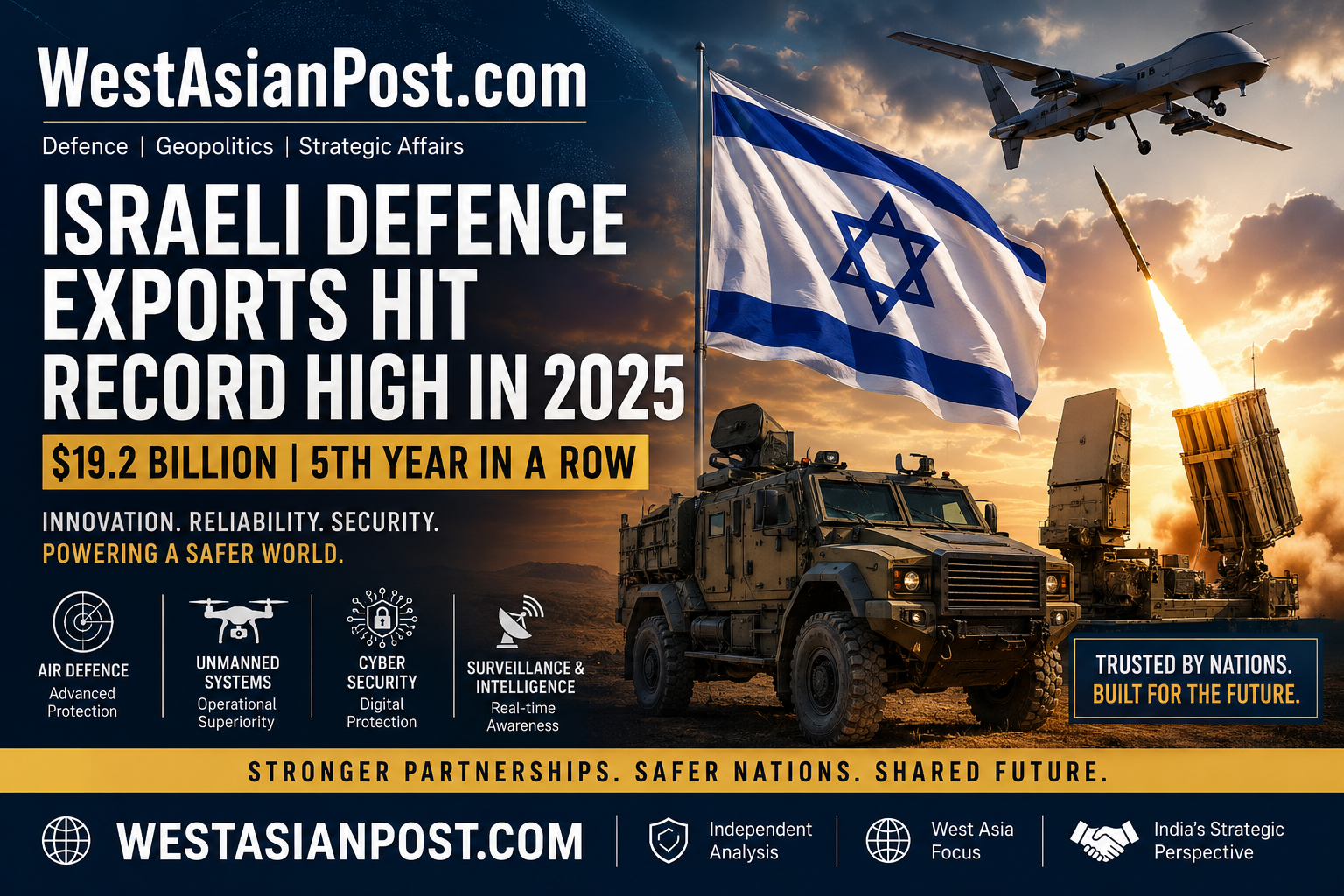
In a remarkable demonstration of technological excellence and strategic resilience, Israel’s defence exports surged to an unprecedented $19.2 billion in 2025, marking the fifth consecutive year of record-breaking growth. The achievement represents nearly a 30 percent increase over the previous year, underscoring Israel’s emergence as one of the world’s most influential defence technology powers.
For a nation surrounded by complex security challenges, Israel’s defence industry has long been built on a simple principle: necessity drives innovation. Today, that innovation has evolved into a global export success story, with nations across Europe, Asia, the Middle East, and beyond increasingly turning to Israeli defence solutions to strengthen their own security capabilities.
The latest figures are more than an economic milestone—they are a reflection of Israel’s growing geopolitical importance in an increasingly uncertain world.
Why Israeli Defence Exports Continue to Surge
Israel’s defence industry has become synonymous with cutting-edge military technology, battlefield-tested systems, and rapid innovation cycles.
Several factors have contributed to the dramatic rise in exports:
1. Combat-Proven Technology
Unlike many defence manufacturers whose products are tested primarily in simulations, Israeli systems are often developed and refined under real-world operational conditions.
Countries seeking reliable military solutions increasingly value technologies that have demonstrated effectiveness in actual security environments.
This reputation has significantly boosted demand for Israeli:
- Air defence systems
- Missile interception technologies
- Intelligence and surveillance platforms
- Cybersecurity solutions
- Drone and anti-drone systems
- Electronic warfare capabilities
2. Rising Global Security Concerns
The geopolitical landscape has changed dramatically over the past decade.
The Russia-Ukraine conflict, instability in parts of the Middle East, tensions in the Indo-Pacific, and growing concerns over missile and drone warfare have prompted governments worldwide to accelerate defence spending.
Israel’s expertise in precisely these domains has made its defence industry a preferred supplier for many nations seeking rapid modernization.
3. Strong Research and Development Ecosystem
Israel consistently ranks among the world’s leading countries in research and development spending as a percentage of GDP.
The close collaboration between:
- Military institutions
- Universities
- Startups
- Private defence firms
has created an innovation ecosystem capable of rapidly producing next-generation military technologies.
This model has become one of Israel’s greatest strategic advantages.
Europe Emerges as a Major Buyer
One of the most significant developments in recent years has been Europe’s increasing reliance on Israeli defence systems.
Following growing security concerns across the continent, many European governments have accelerated procurement programs aimed at strengthening:
- Air defence networks
- Border surveillance systems
- Missile interception capabilities
- Intelligence-sharing infrastructure
Israeli firms have been major beneficiaries of this trend.
Several European countries now view Israeli technologies as critical components of their national defence strategies.
The Strategic Importance of Missile Defence
Perhaps no area better illustrates Israel’s technological leadership than missile defence.
Israel has spent decades developing layered defence systems designed to counter threats ranging from short-range rockets to sophisticated ballistic missiles.
The success of these systems has attracted global attention.
As missile threats become increasingly common worldwide, demand for advanced interception technologies continues to rise.
For many countries, Israel’s expertise offers a proven blueprint for protecting critical infrastructure, military assets, and civilian populations.
Defence Exports Strengthen Israel’s Economy
The defence sector has become a significant contributor to Israel’s economy.
Record export earnings generate:
- High-value employment
- Advanced manufacturing growth
- Increased investment in research
- Expansion of technology ecosystems
- Foreign currency inflows
The industry’s success also reinforces Israel’s broader reputation as a global innovation hub.
Many technologies originally developed for defence applications later find commercial uses in sectors such as:
- Artificial intelligence
- Telecommunications
- Medical technology
- Autonomous systems
- Cybersecurity
What Does This Mean for India?
For India, Israel’s defence export success carries important strategic implications.
The India-Israel relationship has evolved into one of the most significant defence partnerships in Asia.
Over the past two decades, Israel has become a trusted source of advanced military technology for India’s armed forces.
1. Access to Advanced Defence Technologies
India’s military modernization program requires cutting-edge solutions in areas such as:
- Air defence
- Border surveillance
- Unmanned systems
- Electronic warfare
- Intelligence gathering
Israel’s growing technological capabilities provide India with access to proven systems that can be adapted to Indian operational requirements.
2. Strengthening India’s Indigenous Defence Industry
A key feature of modern India-Israel cooperation is joint development and technology transfer.
Rather than merely importing equipment, India increasingly seeks partnerships that support:
- Domestic manufacturing
- Technology sharing
- Skill development
- Research collaboration
This aligns perfectly with India’s “Make in India” and “Atmanirbhar Bharat” initiatives.
Israeli expertise can help accelerate India’s journey toward defence self-reliance.
3. Countering Emerging Security Threats
India faces a diverse spectrum of security challenges, including:
- Cross-border terrorism
- Drone incursions
- Missile threats
- Cyber warfare
Israel’s experience in dealing with similar challenges offers valuable lessons and technologies that can enhance India’s security preparedness.
4. Expanding Strategic Cooperation
The relationship between India and Israel increasingly extends beyond defence procurement.
Areas of growing cooperation include:
- Cybersecurity
- Artificial intelligence
- Space technology
- Agriculture
- Water management
- Homeland security
As Israel’s technological influence grows globally, India’s strategic partnership with Jerusalem is likely to become even more valuable.
The Emerging India-Israel Strategic Axis
From a geopolitical perspective, closer India-Israel cooperation serves the interests of both nations.
Both countries:
- Face persistent security challenges
- Value technological innovation
- Support democratic governance
- Seek strategic autonomy in foreign policy
These shared interests provide a strong foundation for deeper collaboration in an increasingly multipolar world.
For India, maintaining robust ties with Israel enhances access to advanced technologies while diversifying defence partnerships beyond traditional suppliers.
For Israel, India represents one of the world’s largest and most promising defence markets as well as a major strategic partner in Asia.
Challenges and Criticisms
While Israel’s defence export growth is impressive, it also attracts criticism from various international groups concerned about the militarization of global politics.
Supporters argue that robust defence capabilities deter aggression and enhance national security.
Critics contend that expanding arms sales can contribute to regional arms races.
Regardless of differing perspectives, the market reality is clear: governments worldwide continue to prioritize security investments amid rising geopolitical uncertainty.
Looking Ahead: Israel’s Defence Industry Poised for Further Growth
The future appears bright for Israel’s defence sector.
Key trends likely to drive continued expansion include:
- Increased demand for air defence systems
- Growth in drone and counter-drone technologies
- Rising cybersecurity requirements
- Expansion of artificial intelligence applications in defence
- Enhanced border security investments
- Greater emphasis on integrated military networks
As global security challenges become more complex, Israel’s reputation for innovation and operational effectiveness positions it strongly for sustained growth.
Conclusion
Israel’s record-breaking $19.2 billion in defence exports during 2025 represents far more than a commercial achievement. It reflects the country’s transformation into a leading global defence technology powerhouse whose innovations are shaping modern military capabilities worldwide.
For India, this development presents significant opportunities. Stronger defence cooperation, technology partnerships, and joint innovation initiatives can help accelerate India’s military modernization while supporting the country’s long-term goal of strategic self-reliance.
In an era defined by geopolitical uncertainty, emerging technologies, and evolving security threats, the growing partnership between India and Israel may prove to be one of the most consequential strategic relationships of the 21st century.
Published by WestAsianPost.com
Independent Analysis | Geopolitics | Defence | Strategic Affairs
For Editorial Collaborations & Strategic Consulting
Intellex Strategic Consulting Pvt Ltd
📱 WhatsApp: +91-98200-88394
📧 Email: intellex@intellexconsulting.com
🌐 Website: IntellexConsulting.com
WestAsianPost.com – Bringing West Asia Closer to India Through Insightful Analysis and Strategic Perspectives.
More Featured Posts:
Suez Crisis 1956: The War That Reshaped the Middle East and Marked the End of European Empire.
India’s Strategic Depth in West Asia: Why Pakistan’s Iran Diplomacy Narrative Doesn’t Hold.
The Complete Guide to Startup Funding in West Asia (2026 Edition).
How Businesses in the UAE Can Stay Ahead of Compliance Demands in 2026.
UAE’s Rise as a Global Powerhouse: Stability, Innovation, and Strategic Leadership in West Asia.
Why Kjøller Is an Important Venture Capital Investor for Startups Globally.
How Startups Can Raise Funding in Dubai: A Comprehensive Guide for Founders and Entrepreneurs.