

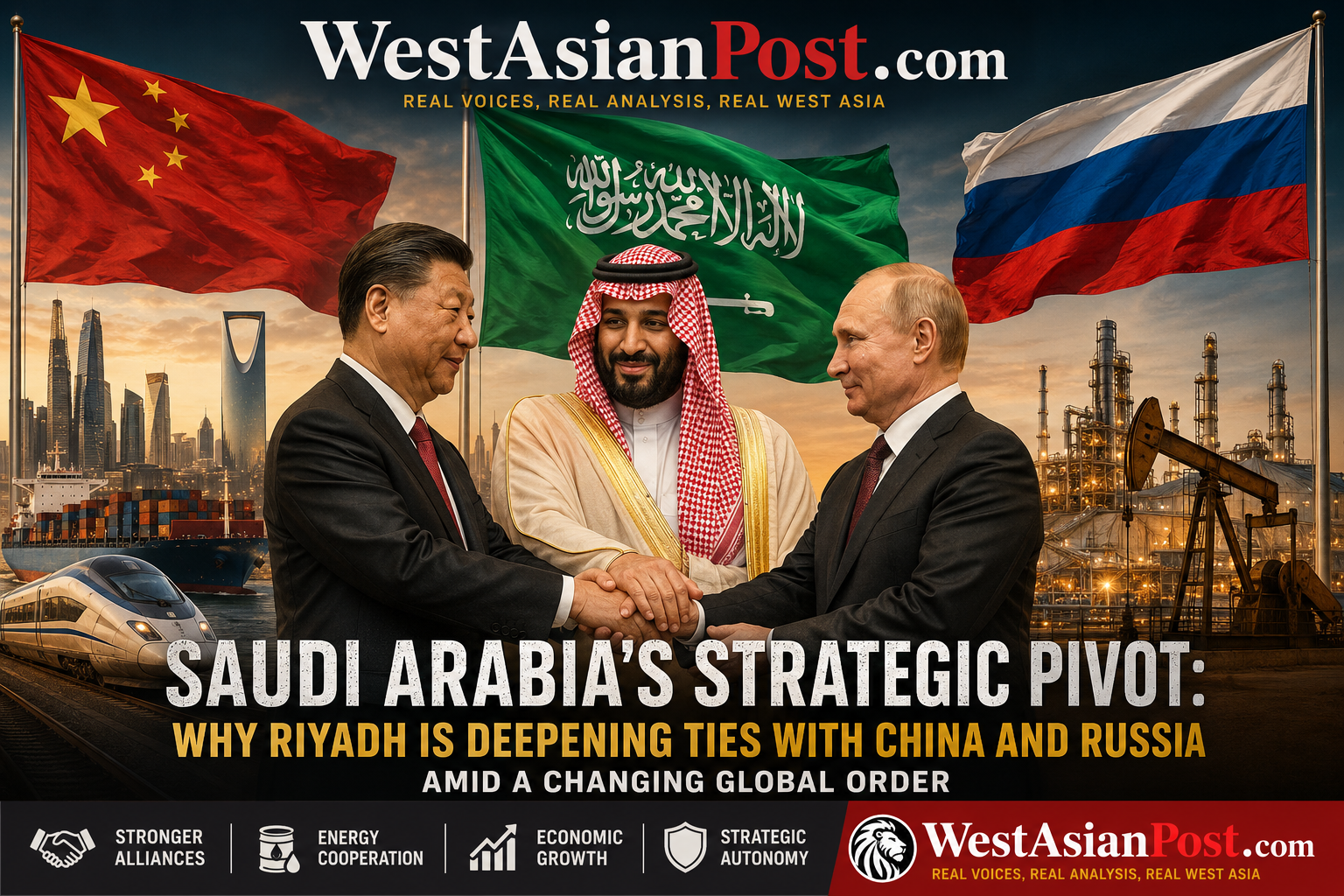
Saudi Arabia’s Strategic Pivot: Why Riyadh Is Deepening Ties with China and Russia Amid a Changing Global Order.
Saudi Arabia is redefining its global alliances by strengthening ties with China and Russia while maintaining relations with the United States. Explore the geopolitical, economic, energy, and security implications of Riyadh’s strategic shift and what it means for West Asia’s future.
Saudi Arabia’s Strategic Pivot: Why Riyadh Is Deepening Ties with China and Russia Amid a Changing Global Order
Introduction
For nearly eight decades, the strategic partnership between Saudi Arabia and the United States has been one of the defining pillars of Middle Eastern geopolitics. The relationship, built upon the exchange of energy security for military protection, survived wars, revolutions, economic crises, and shifting global dynamics.
However, the geopolitical landscape of 2026 is markedly different. Saudi Arabia today is pursuing a far more independent foreign policy, strengthening its economic and strategic relationships with China and Russia while maintaining pragmatic ties with Washington. This evolution reflects Riyadh’s desire to maximize its national interests in an increasingly multipolar world.
Recent diplomatic engagements, energy cooperation agreements, and investment partnerships suggest that Saudi Arabia is no longer willing to depend exclusively on any single global power. Instead, the Kingdom is positioning itself as an autonomous regional power capable of balancing relations among competing global giants.
The Historical Foundation of the U.S.-Saudi Partnership
The modern Saudi-American relationship dates back to 1945 when U.S. President Franklin D. Roosevelt met Saudi King King Abdulaziz Ibn Saud aboard the USS Quincy.
The understanding was straightforward:
- Saudi Arabia would ensure stable energy supplies.
- The United States would provide military protection and security guarantees.
For decades this arrangement worked effectively. The United States became one of Saudi Arabia’s largest defense partners, while Saudi oil played a crucial role in global energy markets.
Yet, major shifts over the last twenty years have gradually weakened the exclusivity of this partnership.
Why Saudi Arabia Is Looking East
1. China’s Rise as the World’s Energy Powerhouse
China has become the largest importer of Saudi crude oil and one of Riyadh’s most important economic partners.
Unlike Western nations that often attach political conditions to economic cooperation, Beijing focuses primarily on trade, investment, infrastructure, and technological collaboration.
China offers Saudi Arabia:
- Massive energy demand
- Infrastructure investment
- Technology partnerships
- Manufacturing cooperation
- Access to Asian markets
For Riyadh, China represents not only a customer but also a long-term development partner capable of supporting the Kingdom’s economic transformation agenda.
2. Vision 2030 Requires New Global Partners
Saudi Crown Prince Mohammed bin Salman launched Vision 2030 to diversify the Saudi economy beyond oil.
The ambitious program includes:
- Smart cities
- Tourism development
- Renewable energy projects
- Artificial intelligence initiatives
- Advanced manufacturing
- Logistics and transportation hubs
China’s expertise in large-scale infrastructure development aligns closely with these goals.
Chinese companies are increasingly involved in major Saudi projects, creating a mutually beneficial relationship that extends far beyond energy exports.
3. Russia’s Importance in Energy Markets
Russia has emerged as an indispensable partner through the OPEC+ framework.
The cooperation between Riyadh and Moscow has transformed global oil market management.
Despite geopolitical tensions elsewhere, Saudi Arabia and Russia have maintained coordination on:
- Production cuts
- Oil pricing stability
- Energy market balancing
- Long-term supply management
This collaboration has strengthened Saudi Arabia’s ability to influence global energy markets while protecting national revenues.
Security Concerns and Strategic Reassessment
One of the most significant drivers of Saudi Arabia’s evolving foreign policy has been changing perceptions regarding security guarantees.
Several incidents over recent years have raised questions in Riyadh regarding the reliability of external military protection.
Saudi policymakers increasingly recognize that national security cannot depend solely on one foreign partner.
As a result, the Kingdom has adopted a diversified approach that includes:
- Strengthening domestic defense capabilities
- Expanding diplomatic engagement
- Building regional partnerships
- Maintaining multiple global relationships
This strategy provides greater flexibility in a volatile geopolitical environment.
The BRICS Factor
Saudi Arabia’s growing engagement with the BRICS grouping reflects another important dimension of its foreign policy evolution.
BRICS nations collectively represent:
- A significant share of global GDP
- Major energy consumers
- Emerging financial systems
- Expanding trade networks
Participation in BRICS-related initiatives allows Saudi Arabia to reduce overdependence on traditional Western economic structures while expanding opportunities across Asia, Africa, and Latin America.
For Riyadh, BRICS membership is less about replacing the West and more about increasing strategic options.
The Energy Dimension: The Heart of the Relationship
Energy remains the central pillar connecting Saudi Arabia with both China and Russia.
Saudi-China Energy Cooperation
Key areas include:
- Long-term crude supply agreements
- Refinery investments
- Petrochemical partnerships
- Renewable energy projects
- Hydrogen development
China views Saudi Arabia as a reliable supplier, while Riyadh views China as a dependable long-term customer.
Saudi-Russia Energy Coordination
Through OPEC+, Riyadh and Moscow have demonstrated unprecedented cooperation.
This partnership has:
- Stabilized oil prices during market volatility
- Enhanced producer influence
- Reduced destructive price wars
- Increased revenue predictability
Energy cooperation remains one of the strongest foundations of the Saudi-Russian relationship.
What This Means for the United States
Saudi Arabia’s outreach to China and Russia should not necessarily be interpreted as a complete rejection of the United States.
The Kingdom continues to value:
- Military cooperation
- Intelligence sharing
- Advanced defense technologies
- Financial market access
- Educational partnerships
However, Riyadh increasingly seeks a balanced foreign policy rather than exclusive alignment.
This reflects a broader global trend in which middle powers pursue strategic autonomy instead of choosing sides between competing superpowers.
Implications for West Asia
Saudi Arabia’s evolving diplomacy carries significant implications for the broader region.
Greater Strategic Flexibility
Regional states may increasingly adopt multi-vector foreign policies similar to Saudi Arabia’s approach.
Reduced Dependence on Single Powers
West Asian nations are likely to diversify their economic and security partnerships.
New Investment Opportunities
Closer ties with China could accelerate infrastructure development, trade corridors, and industrial investment across the region.
Energy Market Stability
Continued Saudi-Russian cooperation could help maintain greater predictability in global oil markets.
The Emergence of a Multipolar World
The deeper significance of Saudi Arabia’s diplomatic recalibration lies in what it reveals about the changing international system.
The post-Cold War era was largely defined by American dominance. Today, emerging powers such as China, India, and Russia are reshaping global power dynamics.
Saudi Arabia’s strategy reflects an understanding that future influence will come from maintaining relationships with multiple centers of power rather than relying exclusively on one.
This is not necessarily an anti-American policy; rather, it is a pro-Saudi policy focused on maximizing national interests.
Conclusion
Saudi Arabia’s growing engagement with China and Russia represents one of the most significant geopolitical developments in West Asia today. Driven by economic transformation, energy cooperation, security considerations, and the realities of a multipolar world, Riyadh is pursuing a more independent and diversified foreign policy than at any point in modern history.
While the Kingdom is unlikely to sever its longstanding relationship with the United States, it is increasingly clear that Saudi leaders envision a future where national interests are best served through balanced partnerships with multiple global powers.
For West Asia, this shift signals the emergence of a new diplomatic era—one characterized by strategic flexibility, economic pragmatism, and a relentless focus on national development. As global power centers continue to evolve, Saudi Arabia appears determined not merely to adapt to the new world order but to help shape it.
WestAsianPost.com Analysis Desk
“Understanding the Geopolitics Shaping the Future of West Asia.”
More Featured Articles:
How Foreign Entrepreneurs Can Start a Company in UAE: A Complete 2026 Guide.
How Businesses in the UAE Can Stay Ahead of Compliance Demands in 2026.
How Startups in the Middle East Can Successfully Raise Series A Funding: A Complete Strategic Guide.
Why Global Entrepreneurs Are Moving to Dubai: The Ultimate Business Hub of the 21st Century.
Why Kjøller Is an Important Venture Capital Investor for Startups Globally.

One thought on “Saudi Arabia’s Strategic Pivot: Why Riyadh Is Deepening Ties with China and Russia Amid a Changing Global Order.”