
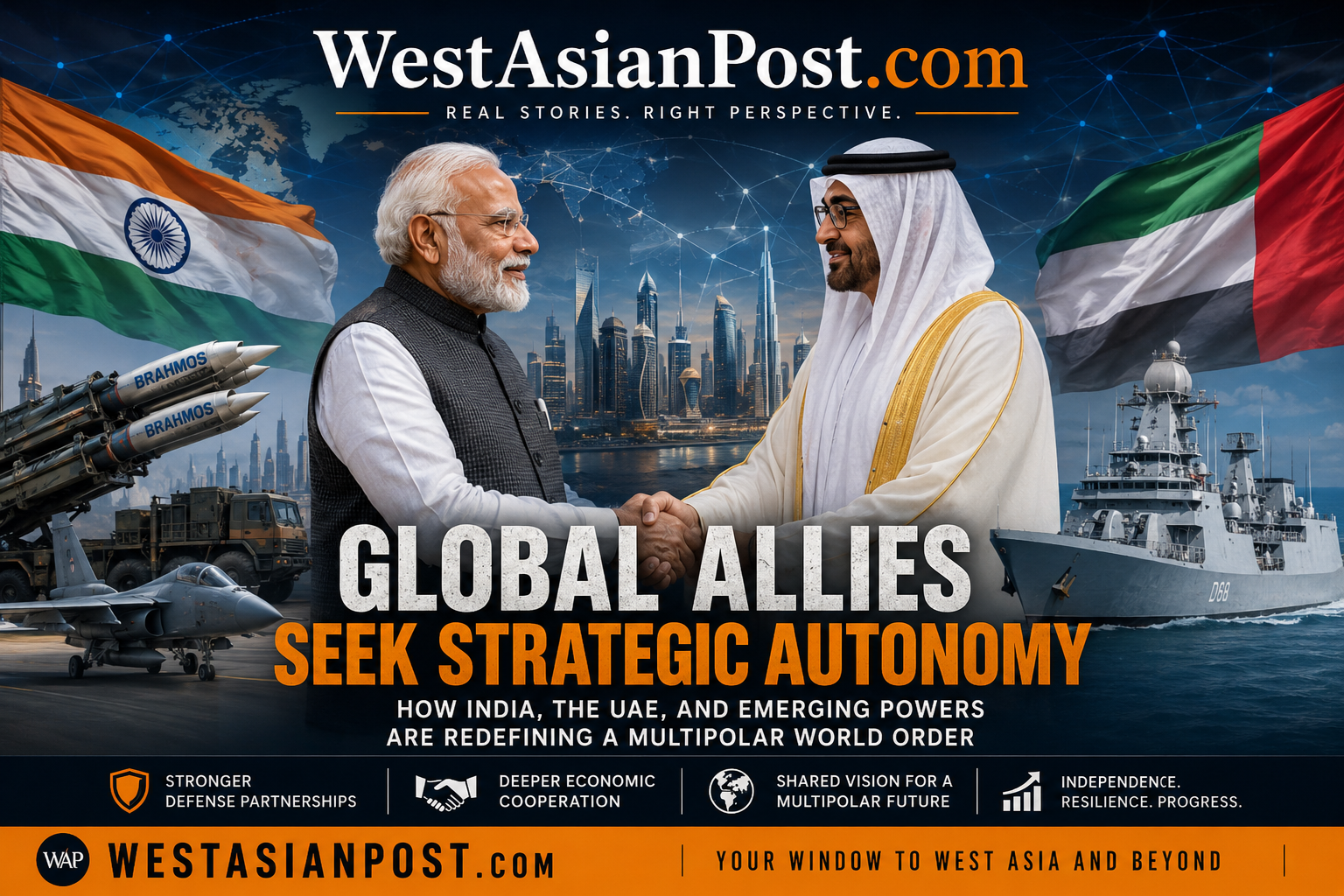
Global Allies Seek Strategic Autonomy: How India, the UAE, and Emerging Powers Are Redefining a Multipolar World Order.
As global powers reassess their strategic priorities, India and the UAE deepen defense cooperation while nations across Europe and West Asia pursue greater strategic autonomy. Explore how these developments are reshaping the global balance of power.
Introduction
A significant geopolitical transformation is underway across the world. Nations that traditionally relied heavily on major powers for security guarantees, economic stability, and diplomatic support are increasingly seeking greater strategic autonomy. From Europe to West Asia and the Indo-Pacific, governments are pursuing policies designed to protect national interests while reducing dependence on any single global power.
Recent reports highlighting expanding defense discussions between India and the United Arab Emirates (UAE), coupled with Europe’s push for economic independence, reflect a broader international trend. Countries are reassessing their strategic relationships amid growing uncertainty surrounding global security, shifting economic realities, and the emergence of a multipolar world order.
For India, these developments present a historic opportunity to strengthen its role as a trusted strategic partner and defense supplier while advancing its vision of becoming a leading global power.
What Is Strategic Autonomy?
Strategic autonomy refers to a nation’s ability to make independent decisions regarding its security, economy, and foreign policy without excessive reliance on external powers.
Historically, many countries aligned themselves closely with either Washington, Moscow, or Beijing to secure military protection, economic support, or political influence. However, changing geopolitical realities have prompted nations to diversify their partnerships and pursue a more balanced approach.
Strategic autonomy allows countries to:
- Protect national interests more effectively.
- Reduce vulnerability to geopolitical pressure.
- Diversify defense and economic partnerships.
- Enhance resilience against global shocks.
- Maintain flexibility in foreign policy decision-making.
Today, strategic autonomy has become a central objective for many nations, particularly in Europe, the Gulf region, and Asia.
India-UAE Relations Enter a New Strategic Phase
The relationship between India and the UAE has evolved dramatically over the past decade. What was once primarily an economic partnership has expanded into a comprehensive strategic relationship encompassing defense, technology, energy security, investment, and regional stability.
Under the leadership of Prime Minister Narendra Modi and UAE President Sheikh Mohamed bin Zayed Al Nahyan, bilateral ties have reached unprecedented levels.
Key pillars of the partnership include:
Defense Cooperation
India and the UAE have steadily expanded military cooperation through:
- Joint military exercises.
- Intelligence sharing.
- Counterterrorism cooperation.
- Maritime security initiatives.
- Defense technology collaboration.
Recent reports suggest that discussions involving advanced Indian defense systems have attracted serious interest from Gulf nations seeking reliable alternatives to traditional suppliers.
Economic Integration
The Comprehensive Economic Partnership Agreement (CEPA) has significantly strengthened trade relations between the two countries.
The UAE remains one of India’s largest trading partners and a major source of investment across sectors including:
- Infrastructure
- Renewable energy
- Logistics
- Technology
- Financial services
Energy Security
Despite global energy transitions, the UAE continues to play a critical role in India’s energy security strategy. Simultaneously, both nations are investing in clean energy and green hydrogen initiatives to prepare for future economic realities.
Why Gulf Nations Are Diversifying Their Strategic Partnerships
For decades, Gulf countries relied heavily on Western military equipment and security arrangements. However, changing regional dynamics have encouraged many states to diversify their strategic relationships.
Several factors are driving this shift:
Geopolitical Uncertainty
Recent international crises have demonstrated that global power politics can change rapidly. Nations increasingly seek multiple strategic partners to avoid overdependence on any single country.
Technology Access
Countries want access to advanced technologies without restrictive political conditions. Emerging defense exporters such as India offer attractive alternatives.
Economic Diversification
Gulf states pursuing ambitious economic transformation programs require broader international partnerships spanning defense, technology, manufacturing, and innovation sectors.
Regional Security Challenges
The Gulf region continues to face evolving security threats, making defense diversification an important strategic objective.
India’s Rise as a Defense Manufacturing Power
India’s growing defense capabilities have transformed the country from one of the world’s largest arms importers into an emerging defense exporter.
The government’s “Atmanirbhar Bharat” initiative has accelerated indigenous defense production across multiple sectors.
Key achievements include:
Missile Systems
India has developed world-class missile platforms capable of competing internationally.
Notable systems include:
- BrahMos supersonic cruise missile
- Akash air defense system
- Astra beyond-visual-range missile
- Pinaka rocket system
Naval Platforms
Indian shipyards are increasingly producing:
- Aircraft carriers
- Destroyers
- Frigates
- Offshore patrol vessels
Aerospace Development
India’s aerospace sector has advanced significantly through:
- Tejas fighter aircraft
- Advanced helicopters
- Drone technologies
- Space-based defense capabilities
These developments have enhanced India’s attractiveness as a defense partner for countries seeking high-performance systems at competitive costs.
Europe’s Quest for Economic Independence
While West Asia pursues diversified security partnerships, Europe is simultaneously exploring greater economic independence.
Several recent developments have accelerated discussions around strategic autonomy across European capitals.
Supply Chain Vulnerabilities
The pandemic exposed weaknesses in global supply chains, highlighting the risks of excessive dependence on external manufacturing hubs.
Energy Security Concerns
Geopolitical disruptions have forced European nations to reconsider their energy dependencies and invest heavily in alternative sources.
Technological Sovereignty
European policymakers increasingly advocate:
- Domestic semiconductor production.
- Digital infrastructure independence.
- Artificial intelligence development.
- Critical technology protection.
Defense Self-Reliance
European countries are expanding defense spending and encouraging domestic military-industrial growth to reduce vulnerabilities.
The Decline of Unipolarity
Following the end of the Cold War, the international system was largely dominated by a single superpower. However, the current global landscape is increasingly characterized by multiple centers of influence.
Major emerging poles include:
- India
- China
- European Union
- Gulf powers
- ASEAN economies
This evolution toward multipolarity encourages nations to pursue flexible partnerships rather than exclusive alliances.
As a result, countries are increasingly engaging simultaneously with multiple powers based on practical interests rather than ideological alignment.
Why India Is Well Positioned in the New World Order
India occupies a unique position in the emerging geopolitical landscape.
Unlike many major powers, India enjoys strong relationships across diverse regions and political systems.
India maintains productive engagement with:
- The United States
- Russia
- European nations
- Gulf countries
- ASEAN members
- African partners
This balanced approach strengthens India’s credibility as a reliable strategic partner.
Key Indian Advantages
Democratic Stability
India’s democratic institutions provide predictability and long-term policy continuity.
Economic Growth
India remains among the fastest-growing major economies globally.
Technological Capability
Rapid advancements in:
- Digital infrastructure
- Space technology
- Defense manufacturing
- Artificial intelligence
have enhanced India’s global standing.
Strategic Geography
India’s location at the crossroads of critical maritime trade routes makes it a natural security partner for nations across the Indo-Pacific and West Asia.
Implications for West Asia
For West Asian countries, strategic autonomy does not necessarily mean abandoning traditional alliances. Instead, it involves building a broader network of partnerships that enhance national resilience.
The region is likely to witness:
- Increased defense cooperation with India.
- Greater technology partnerships.
- Expanded trade integration.
- Joint investment initiatives.
- Enhanced maritime security collaboration.
These developments could contribute to a more stable and balanced regional security architecture.
Conclusion
The growing emphasis on strategic autonomy represents one of the most important geopolitical trends of the 21st century. Whether in Europe, West Asia, or the Indo-Pacific, nations are seeking greater flexibility, resilience, and independence in an increasingly uncertain world.
The expanding partnership between India and the UAE exemplifies this shift. By strengthening defense cooperation, economic integration, and technological collaboration, both countries are positioning themselves to navigate the challenges and opportunities of a rapidly evolving global landscape.
As the world transitions toward a more multipolar order, India’s rise as a trusted strategic partner and defense exporter is likely to play a defining role in shaping the future of international relations. For West Asia, deeper engagement with India offers not only economic benefits but also a pathway toward greater strategic flexibility in an era where national interests increasingly drive global partnerships.
For policymakers and observers alike, the message is clear: the age of strategic autonomy has arrived, and India is emerging as one of its most important pillars.
West Asian Post
More Featured Posts:
How Foreign Entrepreneurs Can Start a Company in UAE: A Complete 2026 Guide.
How Businesses in the UAE Can Stay Ahead of Compliance Demands in 2026.
UAE’s Rise as a Global Powerhouse: Stability, Innovation, and Strategic Leadership in West Asia.
How Startups in the Middle East Can Successfully Raise Series A Funding: A Complete Strategic Guide.
The Complete Guide to Startup Funding in West Asia (2026 Edition).
Why Kjøller Is an Important Venture Capital Investor for Startups Globally.