
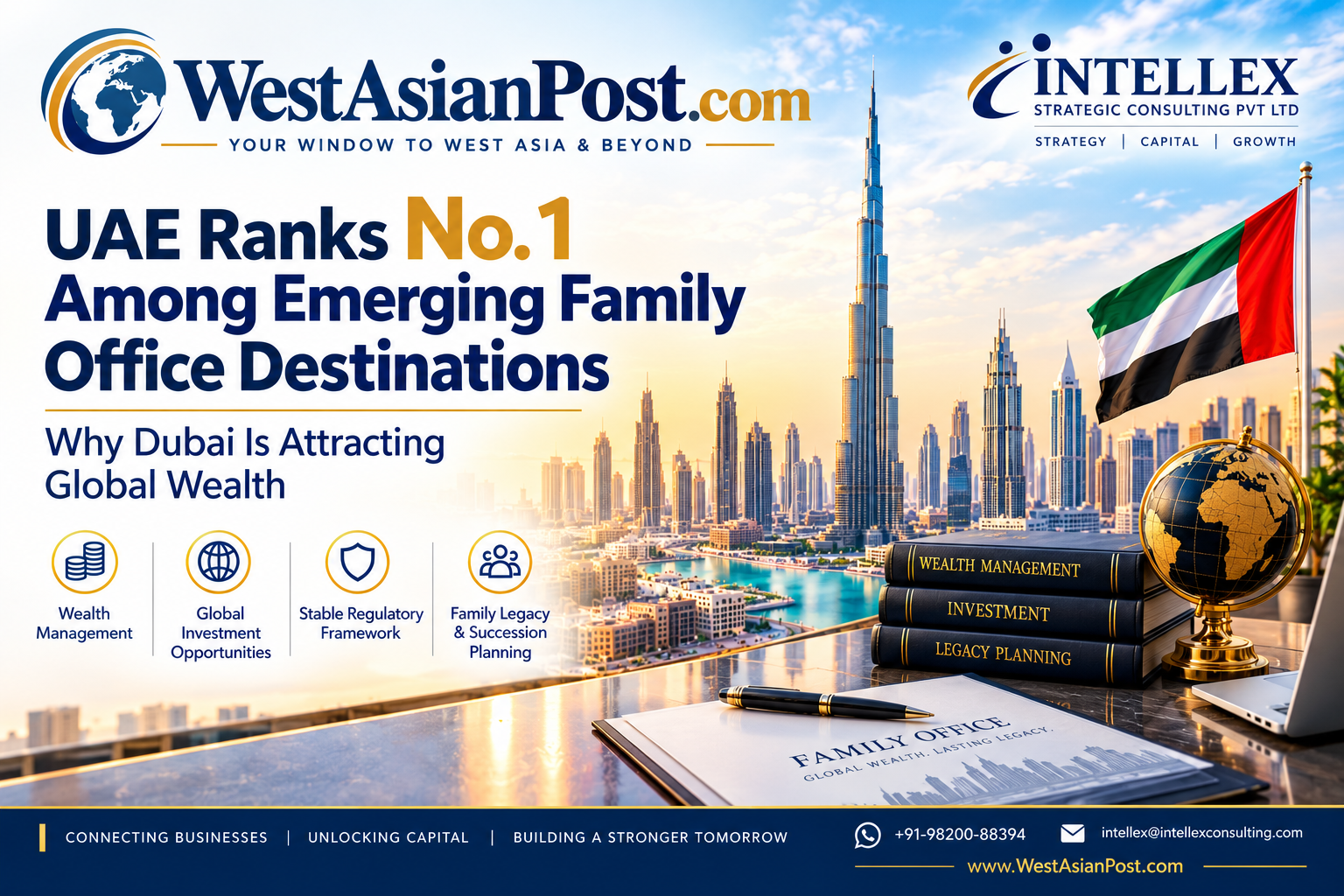
UAE Ranks No. 1 Among Emerging Family Office Destinations: Why Dubai Is Attracting Global Wealth.
The UAE ranks first among emerging family office destinations worldwide as DIFC records 1,408 family-related entities. Explore Dubai’s tax framework, wealth management ecosystem and global investment opportunities.
The United Arab Emirates is strengthening its position as an international centre for private wealth, family offices and cross-border investment, with Dubai’s DIFC recording 1,408 family-related entities by June 2026.
The United Arab Emirates (UAE) has secured the top position among emerging family office destinations worldwide, highlighting the country’s growing importance in international wealth management, investment structuring and multigenerational financial planning.
According to the Family Offices: Best Jurisdictions Worldwide report published by the Global Intelligence Unit of Global Citizen Solutions, the UAE achieved an overall score of 74 points in the emerging-destinations category. Its performance reflects a combination of favourable tax conditions, dedicated regulatory frameworks and an increasingly sophisticated financial services ecosystem.
The development comes as wealthy families, entrepreneurs, business owners and investors increasingly seek international locations from which to manage investments, protect assets, diversify geographical exposure and plan the transfer of wealth to future generations.
Dubai is at the centre of this transformation. The Dubai International Financial Centre (DIFC) reported 1,408 family-related entities at the end of June 2026, representing a 36% increase compared with the previous year.
The figures underline the UAE’s growing ambition to compete with established wealth management centres while providing international families with access to financial institutions, investment opportunities and specialised professional services.
Sources: Global Citizen Solutions and Dubai International Financial Centre.
1. What Is a Family Office and Why Is It Important?
A family office is a specialised organisation established to manage the financial affairs, investments and broader wealth-related requirements of a wealthy individual or family.
Unlike a conventional investment account or a standard wealth management arrangement, a family office can coordinate several aspects of a family’s financial life through a central structure.
Depending on its mandate, a family office may oversee:
- Investment portfolios across equities, bonds and other financial instruments.
- Private equity, venture capital and private credit investments.
- Direct investments in businesses and strategic acquisitions.
- Real estate investments and property portfolios.
- Wealth preservation and succession planning.
- Family governance and the transfer of ownership between generations.
- Coordination with legal, tax, banking and estate-planning professionals.
- Philanthropy, charitable foundations and family legacy initiatives.
- International asset allocation and risk management.
There are two broad types of family offices.
Single-family office: This structure serves one family and can be tailored to its specific investment strategy, governance arrangements, privacy requirements and long-term objectives.
Multi-family office: This structure provides services to several unrelated wealthy families, allowing them to access professional expertise and administrative capabilities without each having to establish an entirely separate organisation.
The growing interest in family offices reflects a broader change in wealth management. Many wealthy families are no longer concerned solely with generating investment returns. They also want to preserve capital, manage risks, maintain control over family businesses and ensure that wealth is transferred effectively to future generations.
2. Why Has the UAE Emerged as a Leading Family Office Destination?
The UAE’s leading position among emerging destinations is attributable to several interconnected advantages.
A. A favourable tax environment
The UAE does not levy personal income tax under its current general tax framework. Its tax environment is therefore an important consideration for entrepreneurs, investors and internationally mobile families evaluating where to establish their financial affairs.
However, this should not be interpreted as meaning that every family office or investment structure is automatically exempt from taxation.
Corporate tax can apply to businesses and qualifying entities, while VAT, withholding considerations in other jurisdictions and other regulatory obligations may also be relevant. Tax treatment depends on the nature of the income, the legal structure, applicable exemptions and the circumstances of the individuals involved.
For international families, tax residence and reporting obligations in their home countries remain important. Establishing an office in Dubai does not, by itself, eliminate tax liabilities elsewhere.
The UAE’s attraction lies in the overall framework and the opportunity to structure legitimate financial activities efficiently, subject to applicable laws.
B. Dedicated regulatory frameworks
The UAE offers specialised environments for family wealth structures through the Dubai International Financial Centre and Abu Dhabi Global Market.
DIFC has developed a legal and regulatory environment designed to support family offices, foundations, wealth management businesses and other financial services organisations.
Its Family Arrangements Regulations provide a framework for relevant family arrangements, while its broader ecosystem connects families with professional advisers, financial institutions and investment service providers.
Abu Dhabi Global Market (ADGM) provides another international financial centre with its own legal and regulatory framework.
The availability of these specialised environments allows families and their advisers to evaluate structures based on their requirements for governance, asset holding, administration and investment management.
The choice between DIFC, ADGM and other jurisdictions should be made after considering the proposed activities, costs, regulatory requirements and family circumstances.
C. Access to international financial markets
Dubai’s geographical position gives it a useful role connecting businesses and investors across the Middle East, Africa, South Asia, Europe and Asia-Pacific.
For families with business interests in multiple countries, the ability to coordinate investments, banking relationships and professional services across regions can be a significant advantage.
The city also hosts international banks, wealth managers, asset managers, investment advisers, legal firms, accounting firms and other specialist service providers.
These services are particularly relevant to families whose wealth originates from operating businesses but who increasingly want to diversify into financial assets, private markets and international investments.
D. A growing financial ecosystem
A family office requires more than an attractive tax regime. It needs experienced professionals, reliable institutions, appropriate legal structures and access to investment opportunities.
The UAE’s expanding financial services ecosystem is helping address these requirements.
Dubai’s seventh-place ranking among global financial centres in the 2026 Z/Yen Partners classification, as cited in the Global Citizen Solutions report, further supports its international financial standing.
The combination of financial infrastructure, professional services and regional market access makes the UAE an increasingly important option for families considering where to establish or expand their wealth management operations.
3. DIFC Records 1,408 Family-Related Entities
One of the clearest indicators of the sector’s development is the growth in family-related entities registered in DIFC.
At the end of June 2026, DIFC reported 1,408 family-related entities, representing year-on-year growth of 36%.
This expansion indicates increasing interest in Dubai as a location for family wealth administration, investment structuring and long-term financial planning.
DIFC’s broader business environment is also growing. According to its July 2026 announcement, the centre had 10,018 active registered companies at the end of the first half of the year. It also reported 1,134 regulated financial services firms and 1,933 companies within its innovation ecosystem.
These developments matter because family offices often depend on an interconnected network of financial and professional services rather than operating in isolation.
A family may require private banking, investment management, legal advice, corporate administration, tax expertise, property advisory services and succession planning. The presence of a broad professional ecosystem can make it easier to coordinate these functions.
Official source: DIFC’s H1 2026 performance announcement.
4. UAE Leads the Emerging Category, but Established Centres Remain Important
The Global Citizen Solutions report assesses 33 jurisdictions across four broad pillars: stability and reputation, regulatory and tax arrangements, financial ecosystem depth, and status and succession considerations for families.
It separates eight established family office centres from nine emerging contenders. This distinction is important when interpreting the UAE’s ranking.
The UAE ranks first among the nine emerging destinations, rather than being declared the single best jurisdiction for every family office worldwide.
Singapore, Switzerland, Hong Kong, Luxembourg, the United States, the United Kingdom, Liechtenstein and Monaco are classified separately as established centres.
The report’s findings show that the UAE can outperform several established jurisdictions on selected measures, particularly those related to its regulatory and tax framework and financial ecosystem.
The emerging-destination rankings are as follows:
| Rank | Emerging destination | Overall score |
|---|---|---|
| 1 | United Arab Emirates | 74.0 |
| 2 | Qatar | 66.8 |
| 3 | India | Below the UAE and Qatar |
| 4 | Malaysia | Below India |
| 5 | Italy | Below Malaysia |
The first two composite scores are reported in the coverage of the index. The remaining destinations are shown in order here without assigning unverified numerical scores.
India’s position in third place is noteworthy. It reflects the growing competition among jurisdictions seeking to attract wealth management structures and international investment activity.
For families operating across the Gulf and South Asia, the choice of location may involve evaluating several jurisdictions rather than selecting one country for every financial and personal requirement.
5. Qatar, India and Saudi Arabia: Regional Competition Is Increasing
The UAE’s performance should also be viewed against the growing ambitions of other countries in the region.
Qatar
Qatar ranks second among the emerging centres, with a reported score of 66.8. Its regulatory and tax arrangements, including the framework available through the Qatar Financial Centre, provide an alternative for families assessing the Gulf region.
Qatar’s smaller family office ecosystem relative to the UAE is one consideration when comparing the two markets.
India
India ranks third in the emerging-destination category. Its financial markets, entrepreneurial ecosystem and substantial base of wealthy business families make it an important participant in the global family wealth industry.
India’s regulatory framework for family investment funds, introduced through the International Financial Services Centres Authority’s fund management regulations in 2025, is also relevant to the development of wealth management structures in its international financial services ecosystem.
For Indian business families, the decision to maintain wealth management activities in India, establish an international presence in the UAE or use multiple jurisdictions depends on investment objectives, legal requirements, tax residence and business operations.
Saudi Arabia
Saudi Arabia is another significant regional market, supported by its economic transformation agenda and efforts to attract international investment.
However, the report places Saudi Arabia below the UAE, Qatar, India, Malaysia and Italy in the emerging-centre ranking.
The competitive landscape is evolving, and differences in regulatory frameworks, market maturity, financial services availability and family requirements will continue to influence the relative attractiveness of these jurisdictions.
6. How Family Offices Are Changing Their Global Investment Strategies
The expansion of the family office industry is occurring alongside a significant change in how wealthy families allocate their capital.
Historically, a family might have concentrated most of its investments in the country where its business was established. Today, many families are increasingly considering international diversification.
According to the UBS Global Family Office Report 2026, cited in the Global Citizen Solutions study, 88% of surveyed family offices held bankable assets in two or more jurisdictions.
This trend is not simply about finding lower-tax locations. It also reflects the need to manage geopolitical exposure, currency risks, access to investment opportunities and the practical requirements of family members living in different countries.
Several investment themes are relevant.
Private equity and direct business investments
Family offices may invest directly in established companies or participate in private equity transactions alongside institutional investors.
Such investments can provide exposure to businesses outside publicly traded markets, although they can also involve long holding periods, limited liquidity and significant execution risk.
Venture capital and startup investments
Entrepreneurial families increasingly consider investments in technology, healthcare, financial services, consumer businesses and other growth sectors.
Family offices can participate through venture capital funds, co-investments or direct investments, depending on their capabilities and risk appetite.
Real estate
Commercial, residential, logistics, hospitality and other property investments may form part of a diversified family portfolio.
Dubai’s international profile and property market make it relevant to families assessing real estate opportunities in the Gulf, although individual investments require careful valuation, due diligence and risk assessment.
Private credit and structured investments
Private credit, secured lending and other structured investment opportunities can provide alternative sources of income and diversification.
These investments require careful assessment of borrower quality, collateral, covenants, liquidity and the possibility of default.
Listed financial assets
Equities, fixed-income securities, funds and other liquid investments remain important tools for diversification and liquidity management.
The appropriate allocation depends on the family’s financial objectives, time horizon, risk tolerance and liquidity requirements.
A well-designed family office strategy should not rely on a single asset class or country merely because it offers attractive tax treatment.
7. Wealth Preservation and Succession Planning Are Becoming More Important
The growing family office industry is also connected to the transfer of wealth between generations.
Business founders who have spent decades building companies often face a different set of challenges as they approach retirement or consider transferring ownership to children and other family members.
These challenges can include:
- Deciding who will lead the family business.
- Separating family ownership from day-to-day management.
- Establishing rules for distributions and reinvestment.
- Preparing the next generation to make investment decisions.
- Creating suitable estate and succession arrangements.
- Managing disagreements among family members.
- Coordinating assets held in different countries.
- Maintaining appropriate records and governance procedures.
A family office can help coordinate these activities, working with qualified legal, tax and investment professionals.
For families with substantial operating businesses, succession planning may be as important as portfolio management. A lack of clear governance can create uncertainty, disputes or disruption during a transfer of ownership.
International structures can also introduce additional complexity. Families must consider inheritance and estate rules, company ownership, reporting requirements and the legal treatment of assets in each relevant jurisdiction.
The UAE’s developing family wealth ecosystem offers a platform for addressing these requirements, but the most suitable structure will depend on the family’s circumstances.
8. What Does the UAE’s Ranking Mean for Wealthy Indian Families?
India’s third-place position among emerging family office destinations creates an interesting context for Indian entrepreneurs and business families with international ambitions.
Many Indian families have businesses, property, investments and family members across multiple countries. They may therefore need a coordinated approach to wealth management rather than relying on a single domestic adviser or financial institution.
Dubai can serve as an international base for eligible wealth management and investment activities, particularly where a family has commercial interests in the Middle East, Africa or other international markets.
Potential considerations include:
International diversification: Families may assess investment opportunities in different markets, currencies and asset classes.
Business expansion: Dubai may provide access to regional partners, financial institutions and commercial networks.
Family governance: A centralised wealth management structure can help coordinate investment policies, reporting and succession planning.
Professional services: Access to legal, tax, banking and investment professionals can support more complex financial arrangements.
Cross-border compliance: Families must carefully assess Indian foreign exchange regulations, tax residency, reporting obligations and other applicable laws before moving assets or establishing overseas structures.
It is essential to distinguish between legitimate international diversification and the assumption that establishing an overseas family office automatically changes an individual’s tax status or removes obligations in India.
Indian residents and businesses should obtain advice from qualified professionals familiar with the relevant Indian and UAE requirements before implementing cross-border arrangements.
9. Important Factors to Consider Before Establishing a Family Office in Dubai
Despite the UAE’s strong ranking, establishing a family office is not automatically appropriate for every wealthy family.
The decision should be based on the scale and complexity of the family’s financial affairs, not simply on a jurisdiction’s position in a ranking.
Define the purpose
The family should establish whether it needs a dedicated single-family office, a multi-family office service provider or a more limited arrangement involving professional wealth managers and advisers.
Evaluate the costs
A dedicated office may require personnel, premises, technology, compliance systems, legal support, accounting and investment administration.
For some families, outsourcing selected services can be more cost-effective than building an independent organisation.
Review legal and regulatory requirements
The appropriate structure depends on the activities being undertaken. Investment management, fund management, financial advice and other regulated services may require specific permissions or appropriately authorised service providers.
Understand the tax position
The family should assess corporate tax, personal tax residence, international reporting and the treatment of income and assets across all relevant countries.
Tax advice should reflect the actual structure and activities rather than relying solely on headline tax rates.
Establish governance and risk controls
Written investment policies, approval procedures, reporting standards, conflict-of-interest policies and succession arrangements can help protect family interests over time.
Assess investment suitability
An attractive financial centre does not guarantee investment performance. Each proposed investment requires independent due diligence, an assessment of downside risk and an understanding of liquidity constraints.
10. Outlook: The UAE’s Family Office Industry Has Significant Growth Potential
The UAE’s first-place ranking among emerging family office destinations reinforces the country’s ambition to become a major international centre for private wealth and investment management.
The 36% annual growth in DIFC’s family-related entities to 1,408 by the end of June 2026 provides a measurable indication of the market’s momentum.
Nevertheless, continued growth will depend on more than tax advantages or the introduction of dedicated regulations.
Family offices need a deep professional ecosystem, reliable institutions, appropriate legal protections, access to global investment opportunities and confidence that their structures can adapt to changing family requirements.
The competition among the UAE, Qatar, India, Singapore, Hong Kong and other international centres is therefore likely to increasingly focus on the quality of financial services, regulatory clarity, investment access and long-term wealth planning.
For the UAE, the opportunity is to translate its current advantages into a durable ecosystem that serves both regional and international families.
For investors and entrepreneurs, the key lesson is that selecting a family office location should be part of a broader strategy covering wealth preservation, investment diversification, governance, succession and international business development.
The UAE has established a strong position in this competition. Whether it is the right choice for a particular family will ultimately depend on how effectively its legal framework, financial ecosystem and professional services match that family’s long-term objectives.
Conclusion
The UAE’s leading position among emerging family office destinations signals the growing importance of Dubai and Abu Dhabi in the international wealth management industry.
DIFC’s expanding family-related ecosystem, specialised regulatory arrangements and access to international financial services are helping attract wealthy families and investment structures.
However, a jurisdiction ranking should be treated as a starting point for evaluation rather than a substitute for professional advice. Successful family wealth management requires a coordinated approach to investment decisions, tax compliance, risk management and succession planning.
As international families continue to diversify their assets and operations across borders, the UAE is well positioned to remain an important participant in the evolving global family office landscape.
More Featured Articles:
How Startups in the Middle East Can Successfully Raise Series A Funding: A Complete Strategic Guide.
How Foreign Entrepreneurs Can Start a Company in UAE: A Complete 2026 Guide.
How Startups Can Raise Funding in Dubai: A Comprehensive Guide for Founders and Entrepreneurs.
Launch Your Own Skincare, Haircare & Personal Care Brand Through White-Label Manufacturing.
Company Registration in Dubai 2026: Complete Guide to Setup, Costs, Benefits & Compliance.