

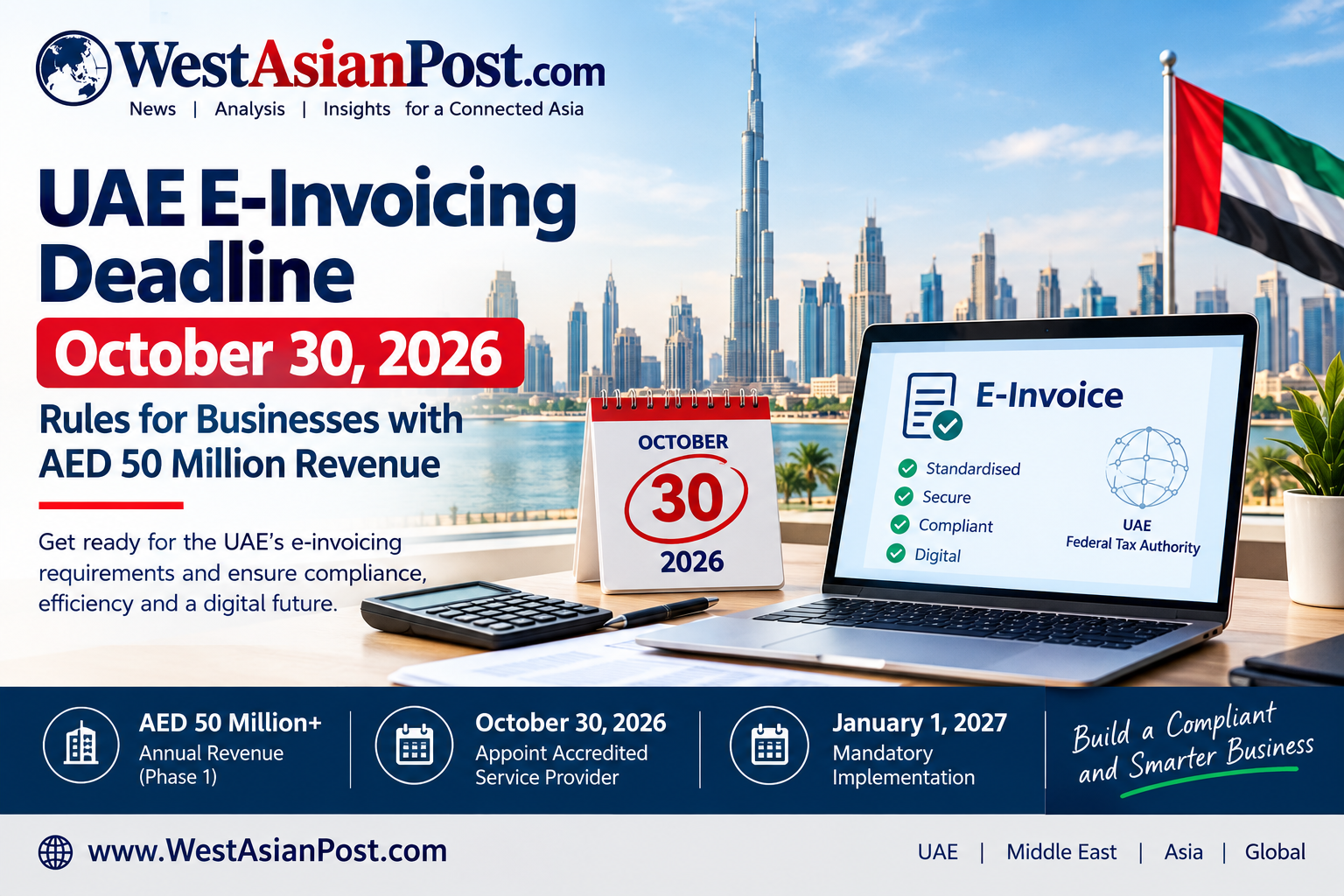
UAE E-Invoicing Deadline October 30, 2026: Rules for Businesses with AED 50 Million Revenue
UAE E-Invoicing 2026: October 30 Deadline for Businesses with Revenue of AED 50 Million or More.
The UAE is preparing businesses for mandatory electronic invoicing, with October 30, 2026, set as the deadline for businesses subject to the first phase with annual revenue of AED 50 million or more to appoint an Accredited Service Provider. Learn about the implementation timetable, compliance requirements, technology considerations, business benefits and practical steps companies should take before the January 1, 2027 go-live date.
The United Arab Emirates is moving towards a digital-first tax and invoicing environment, with electronic invoicing becoming an increasingly important compliance priority for businesses operating in the country. For companies with annual revenue of AED 50 million or more, the reported October 30, 2026 deadline is a significant date to watch as businesses prepare for the UAE’s e-invoicing requirements.
The transition has implications for finance departments, chief financial officers, accountants, tax advisers, enterprise software providers and business owners. Companies that begin preparing early can reduce the risk of implementation delays, improve the accuracy of financial records and make their invoicing processes more efficient.
However, businesses should distinguish between the deadline to appoint an accredited service provider, the deadline to implement the system and the date on which electronic invoicing becomes operational. These can be separate milestones under the UAE framework, and companies should verify which obligation applies to their circumstances.
UAE E-Invoicing 2026: October 30 Deadline for Businesses with AED 50 Million or More in Revenue
The UAE’s e-invoicing transition enters a critical phase as large businesses must appoint accredited service providers by October 30, 2026, ahead of mandatory implementation from January 1, 2027.
The UAE Federal Tax Authority (FTA) has reiterated that businesses subject to the new electronic invoicing system with annual revenue equal to or exceeding AED 50 million must appoint an Accredited Service Provider (ASP) no later than October 30, 2026. These businesses must then implement the e-invoicing system by January 1, 2027. Federal Tax Authority
For businesses operating across the Emirates, the deadline represents an important compliance milestone. Companies must assess their existing invoicing infrastructure, select an appropriate technology partner, prepare their accounting systems and establish processes for exchanging invoices electronically.
The reform is also expected to reshape financial administration by improving transaction visibility, supporting tax compliance and encouraging automation across the UAE’s business ecosystem.
An important distinction: October 30, 2026, is the deadline for appointing an accredited service provider for the first phase. It is not the final date for completing the entire implementation process. The mandatory implementation date for businesses in this category remains January 1, 2027.
1. What Is the UAE E-Invoicing System?
Electronic invoicing, commonly called e-invoicing, is a system through which businesses issue, exchange and report invoice information electronically in a prescribed, structured format.
Unlike conventional invoicing, where companies may exchange PDF documents, scanned invoices, spreadsheets or paper bills, e-invoicing uses machine-readable data that can be validated and processed automatically.
Under the UAE framework, the system is designed to facilitate the exchange of electronic invoices between suppliers and buyers while enabling the relevant tax data to be reported to the Federal Tax Authority through accredited service providers.
The UAE has adopted a model based on the international Peppol framework, using the UAE-specific PINT AE invoice specification.
The Ministry of Finance explains that an ordinary PDF, Word document, image or scanned invoice does not qualify as an e-invoice under the new framework. The invoice must contain structured data that meets the prescribed technical requirements.
How is an electronic invoice different from a PDF invoice?
Consider a company in Dubai supplying industrial equipment to a customer in Abu Dhabi.
Under a conventional process, the supplier might generate a PDF invoice through its accounting software and email it to the customer. The customer would then enter the invoice details into its accounting system, either manually or through a separate process.
Under an e-invoicing arrangement, the invoice data is generated and exchanged electronically through connected systems. The data can be validated and processed automatically, reducing the need for manual entry.
The main differences are:
- Data structure: E-invoices contain information in a prescribed machine-readable format.
- Electronic exchange: Invoices are transmitted through the designated electronic invoicing network.
- Validation: The system supports automated checks on invoice data.
- Tax reporting: Relevant tax data is reported through the prescribed mechanism.
- Automation: Accounting and enterprise resource planning systems can process invoice information with less manual intervention.
The objective is not simply to replace paper with digital documents. It is to establish a standardised electronic invoicing process that improves the reliability and efficiency of business transactions.
2. Who Must Appoint an Accredited Service Provider by October 30, 2026?
The first phase focuses on businesses subject to the e-invoicing framework with annual revenue equal to or exceeding AED 50 million.
According to the Federal Tax Authority’s September 29, 2026 announcement, these businesses must appoint an Accredited Service Provider by October 30, 2026, and implement the system no later than January 1, 2027. Federal Tax Authority
Businesses should not assume that the requirement applies only to companies registered for VAT. The scope of the e-invoicing framework is determined by the applicable legislation, the nature of the transactions and any specific exclusions.
The UAE framework generally covers business-to-business (B2B) and business-to-government (B2G) transactions, subject to the applicable rules and exclusions.
Businesses that should assess their readiness
Companies operating in the following sectors should review their invoicing arrangements and determine whether they fall within the applicable requirements:
- Manufacturing and industrial production
- Wholesale and distribution
- Retail and consumer goods
- Construction and engineering
- Real estate and property services
- Logistics, transport and supply-chain management
- Professional and consulting services
- Healthcare and pharmaceutical distribution
- Information technology and telecommunications
- Import, export and international trading
- Hospitality and other business services
The sector alone does not determine whether an entity must comply in the first phase. The relevant revenue threshold, scope of activities and applicable exclusions must be assessed.
How should revenue be assessed?
Companies should examine their latest financial statements and confirm how revenue is determined under the applicable rules.
The Ministry of Finance’s published implementation information states that the latest financial statements are relevant for determining revenue and that projected revenue for the ongoing financial year is used for newly established businesses. Companies should verify the applicable criteria with their tax advisers or the relevant authorities.
Groups with several legal entities should not automatically assume that the group’s consolidated revenue determines each entity’s treatment. They should assess the relevant legal entities and applicable rules individually, taking professional advice where necessary.
3. UAE E-Invoicing Implementation Timeline: Key Dates for Businesses
The UAE is introducing e-invoicing in phases to give businesses time to select service providers, configure their systems and establish the necessary technical connections.
The current implementation schedule includes the following milestones.
| Business category | Deadline to appoint an Accredited Service Provider | Mandatory implementation date |
|---|---|---|
| Businesses with annual revenue of AED 50 million or more | October 30, 2026 | January 1, 2027 |
| Businesses with annual revenue below AED 50 million | March 31, 2027 | July 1, 2027 |
| Government entities covered by the framework | March 31, 2027 | October 1, 2027 |
These dates reflect the published implementation schedule and the FTA’s September 2026 clarification. The relevant legal decisions and any subsequent amendments should be checked before businesses finalise their compliance plans. Federal Tax Authority
Why the October 30 deadline matters
For businesses in the first phase, appointing an accredited service provider is an important early milestone.
Appointment is not necessarily the same as being fully operational. Businesses must also undertake the technical and administrative steps required to implement the system.
These may include:
- Reviewing current invoicing and accounting processes.
- Selecting an appropriate accredited service provider.
- Agreeing on commercial and technical arrangements.
- Mapping invoice data from existing systems.
- Configuring the required integrations.
- Testing invoice generation and exchange.
- Completing applicable registration and activation procedures.
- Preparing employees for the new workflow.
- Establishing ongoing monitoring and reconciliation procedures.
Leaving these activities until the last few weeks could create avoidable operational pressure, particularly for businesses with multiple branches, large invoice volumes or complex enterprise systems.
4. What Is an Accredited Service Provider?
An Accredited Service Provider is a provider authorised under the UAE’s e-invoicing framework to deliver the relevant electronic invoicing services.
Such providers play an important role in connecting businesses to the electronic invoicing ecosystem.
Depending on the solution and its scope, their services may support invoice creation, validation, electronic transmission, interoperability between suppliers and buyers, and the reporting of relevant tax data.
The service provider also helps establish the technical connection between the business’s invoicing environment and the wider e-invoicing network.
The Ministry of Finance maintains the official e-invoicing portal, which provides access to the applicable guidelines, service-provider information and legislative documents. Businesses should use this official resource to verify a provider’s accreditation status.
How should businesses choose a service provider?
The lowest-priced option may not necessarily be the most suitable.
Businesses should assess the provider’s technical capabilities, experience, support arrangements and compatibility with their existing financial systems.
Important considerations include:
1. Official accreditation
Confirm that the provider is appropriately accredited under the applicable UAE framework.
2. Accounting software compatibility
The solution should integrate effectively with the company’s accounting software, ERP platform or other invoicing systems.
3. Invoice volumes
A business issuing thousands of invoices each month may require a different solution from a small organisation with relatively simple billing processes.
4. Integration capabilities
Assess whether the provider can connect with existing systems without creating unnecessary duplication or manual work.
5. Data security
Review the provider’s data protection arrangements, access controls, backup procedures and incident-response processes.
6. Implementation support
Determine whether the provider offers assistance with data mapping, testing, employee training and troubleshooting.
7. Pricing transparency
Understand implementation charges, recurring fees, transaction-based pricing, additional integration costs and potential future expenses.
8. Scalability
The solution should accommodate future growth, additional entities and higher transaction volumes.
9. Customer support
Clarify support availability, response times, escalation procedures and responsibilities during system failures.
10. Business continuity
Establish how invoices will be handled if a technical issue temporarily interrupts normal operations.
A well-selected service provider can help the business meet its compliance obligations while improving its broader finance and accounting infrastructure.
5. How Does the UAE E-Invoicing Process Work?
The UAE’s e-invoicing model is based on a decentralised system involving the supplier, the supplier’s service provider, the buyer’s service provider, the buyer and the relevant tax-reporting function.
This is commonly described as a five-corner model.
The process can be understood through the following stages.
Step 1: The supplier generates the invoice
The supplier creates the invoice using its accounting software, ERP system or another compatible invoicing application.
The invoice data must meet the applicable technical specifications and mandatory information requirements.
Step 2: The supplier’s service provider validates the data
The supplier sends the invoice data to its Accredited Service Provider.
The provider checks the data and converts it into the prescribed UAE structured format where necessary.
Step 3: The invoice is transmitted electronically
The supplier’s provider transmits the invoice through the electronic invoicing network to the buyer’s service provider.
The system supports interoperability between the two sides of the transaction.
Step 4: The relevant tax data is reported
The supplier’s provider reports the prescribed Tax Data Document to the designated tax-reporting function.
The buyer’s service provider also has reporting responsibilities under the applicable model.
Step 5: The buyer receives the invoice
The buyer’s provider validates and forwards the invoice to the buyer through the agreed electronic arrangements.
Status messages communicate the outcome of the validation and reporting processes.
This approach is intended to standardise invoice exchange and reduce the need for businesses to develop separate electronic connections with every trading partner. The detailed requirements are set out in the Ministry of Finance’s official e-invoicing guidance
6. What Information Should Businesses Prepare for E-Invoicing?
A successful implementation requires more than purchasing new software.
Businesses should review the information captured in their invoices and determine whether it is accurate, complete and compatible with the prescribed data requirements.
The following areas deserve particular attention.
Supplier and customer information
Review customer and supplier master data, including relevant identification details, addresses and tax-related information where applicable.
Incorrect or incomplete records can create validation problems and delays.
Invoice identification
Ensure that invoice numbers, dates, document types and other required identifying information are generated consistently.
Transaction details
Review descriptions of goods and services, quantities, unit prices, discounts and other transaction-level information.
VAT and tax information
Assess whether the systems correctly capture applicable VAT information and other mandatory tax-related data.
Credit notes and adjustments
Businesses should understand how the system handles credit notes, corrections, cancellations and other adjustments under the relevant technical requirements.
Multi-entity and multi-branch operations
Companies with multiple legal entities or branches should determine how invoice data is generated, approved and transmitted across the organisation.
The objective should be to establish consistent processes while respecting the distinct compliance obligations of each entity.
7. Benefits of E-Invoicing for UAE Businesses
Although the transition requires investment and organisational effort, e-invoicing can deliver benefits extending beyond regulatory compliance.
A. Reduced manual data entry
Manual invoice processing consumes employee time and creates opportunities for errors.
Electronic exchange of structured invoice data can reduce repeated data entry and improve consistency between the supplier’s and buyer’s records.
Finance teams may then be able to devote more time to analysis, planning and financial control.
B. Faster invoice processing
Automated validation and electronic transmission can reduce the time spent sending invoices, checking information and resolving routine administrative issues.
The actual improvement depends on the quality of the company’s systems and the readiness of its trading partners.
C. Better working capital management
Delayed invoice processing can contribute to delayed payments, disputes and difficulties forecasting cash flows.
By improving invoice visibility and reducing administrative bottlenecks, e-invoicing may help businesses strengthen receivables management.
However, electronic invoicing does not guarantee faster payment. Payment terms, customer behaviour, credit controls and dispute-resolution processes remain important.
D. Improved financial reporting
Structured invoice information can support more consistent reporting and analysis.
Businesses may be better positioned to monitor sales, purchasing, outstanding receivables and transaction trends.
E. Stronger internal controls
Automated checks can help identify missing information, inconsistent records and certain processing errors.
Combined with appropriate approval controls, audit trails and reconciliation procedures, e-invoicing can strengthen financial governance.
F. Greater operational efficiency
Businesses with high invoice volumes may benefit from reducing paper handling, repetitive administrative tasks and manual reconciliation.
The savings will depend on implementation costs, the existing level of automation and the quality of the final solution.
G. Improved cross-border interoperability
The use of the Peppol framework supports standardised electronic document exchange and can help businesses connect with trading partners in compatible networks.
This may be particularly relevant to companies operating across multiple markets. The Ministry of Finance identifies cross-border invoice exchange as one of the potential benefits of the system.
8. What Are the Main Challenges Businesses Should Anticipate?
Businesses should avoid treating e-invoicing as a simple software installation.
The transition may require changes to processes, technology, data management and employee responsibilities.
Legacy accounting systems
Older accounting applications may not support the required integration without upgrades or additional software.
Companies should assess these limitations early.
Inaccurate master data
Incomplete customer records, inconsistent supplier information and unreliable product descriptions can complicate implementation.
Cleaning up these records before integration can reduce problems later.
Integration with ERP systems
Larger businesses may operate several accounting platforms, procurement systems, billing applications and enterprise resource planning systems.
Ensuring that these systems exchange accurate information can require detailed technical planning.
Employee training
Finance teams, sales personnel, procurement departments and IT staff may need training on revised processes.
Employees should understand not only how to use the system but also how to identify and escalate errors.
Cost management
Implementation expenses may include software configuration, service-provider fees, integration work, data cleansing, employee training and ongoing support.
Businesses should assess the total cost of ownership rather than comparing subscription prices alone.
Business continuity
Companies must establish procedures for handling technical failures, rejected invoices and delayed processing.
The relevant arrangements should comply with the applicable framework rather than relying on informal workarounds.
9. Can E-Invoicing Help Reduce Tax Errors and Improve Compliance?
One of the central objectives of the UAE’s electronic invoicing programme is to improve the quality and transparency of business transaction data.
Structured electronic invoices can make information easier to validate, reconcile and analyse.
The reporting framework also gives the Federal Tax Authority access to the prescribed transaction data through the designated processes.
These capabilities can help improve the detection of discrepancies and support more effective tax administration.
For businesses, better invoice data can improve the reliability of accounting records and assist with preparing VAT returns.
The Ministry of Finance has also identified potential benefits including the automatic pre-population of certain VAT return fields and more efficient refund processing. These benefits depend on the applicable arrangements and the quality of the data submitted.
However, e-invoicing should not be viewed as a substitute for sound tax governance.
Businesses remain responsible for maintaining appropriate records, applying the correct tax treatment, reviewing transactions and meeting their other legal obligations.
Companies should continue to maintain effective internal controls and seek qualified tax advice where necessary.
10. What Happens If a Business Is Not Ready by the Deadline?
Businesses subject to the first phase should treat the October 30, 2026 service-provider appointment deadline as a priority.
The Federal Tax Authority has warned that failure to meet the implementation requirements may result in administrative penalties. Federal Tax Authority
The consequences of non-compliance depend on the applicable legislation and the nature of the breach.
Companies should not assume that appointing a provider automatically fulfils every obligation. They must also complete the necessary implementation, registration, integration and operational steps within the prescribed timeframe.
Recommended immediate actions
Businesses that have not yet started preparations should consider the following sequence:
- Confirm whether the business falls within the first phase. Review the relevant revenue criteria, legal entity structure, transaction types and applicable exclusions.
- Appoint an internal project owner. Assign responsibility to an appropriate executive, finance leader or compliance professional.
- Review existing systems. Document how invoices are currently generated, approved, transmitted and recorded.
- Evaluate accredited providers. Compare technical capabilities, commercial terms, integration options and support services.
- Complete the appointment process. Ensure that the service-provider arrangement is properly documented before the applicable deadline.
- Plan system integration. Establish responsibilities, milestones and testing requirements.
- Review invoice data. Correct inaccurate records and map existing fields to the required format.
- Conduct testing. Test representative transactions and address validation failures before operational implementation.
- Train employees. Explain the new processes to relevant departments.
- Establish ongoing monitoring. Assign responsibility for checking invoice status, resolving errors and maintaining records.
Businesses with complex systems should consider involving their ERP provider, accounting team, tax adviser and service provider in the same implementation plan.
11. What Should CFOs and Finance Directors Do Now?
For chief financial officers and finance directors, the transition presents an opportunity to improve financial operations while addressing regulatory requirements.
The first priority is to ensure that the organisation has a clear understanding of its obligations and a realistic implementation timetable.
A practical CFO-led approach should include five workstreams.
Compliance assessment: Confirm the applicable requirements and identify the responsible legal entities.
Technology assessment: Review accounting systems, invoice-generation processes and integration requirements.
Data governance: Establish standards for customer records, supplier details, invoice fields and reconciliation.
Financial impact: Estimate implementation costs, identify efficiency opportunities and establish an appropriate budget.
Project governance: Assign responsibilities, monitor milestones and report progress to senior management.
The CFO should also ensure that the organisation’s internal audit, tax and information technology teams understand their respective responsibilities.
For larger organisations, e-invoicing may involve several departments and external service providers. A coordinated approach can reduce duplication and help management identify problems before they affect business operations.
12. Implications for Small and Medium-Sized Enterprises
Although the October 30 deadline concerns the first phase, smaller businesses should also begin evaluating their future requirements.
Under the published timetable, businesses with annual revenue below AED 50 million must appoint an Accredited Service Provider by March 31, 2027, and implement the system by July 1, 2027, subject to the applicable scope and exclusions. Federal Tax Authority
SMEs may face different challenges from large corporations.
Smaller companies may have limited IT resources, rely on basic accounting software or outsource their bookkeeping.
They should therefore evaluate solutions that are proportionate to their invoice volumes, operational complexity and budget.
What should smaller businesses consider?
- Whether their current accounting software supports the required functionality.
- Whether an upgrade or integration will be necessary.
- The total cost of adopting an accredited solution.
- The quality and completeness of existing accounting records.
- The level of assistance available from their accountant or software provider.
- The procedures needed to maintain compliant invoices and records.
Starting early can give smaller businesses more time to compare providers and address technical issues without disrupting day-to-day operations.
13. Will E-Invoicing Transform the UAE’s Business Environment?
The introduction of e-invoicing forms part of the UAE’s broader digital transformation and efforts to improve the efficiency of public administration and the business environment.
For companies, the change may encourage greater standardisation of financial processes and accelerate the adoption of integrated accounting technologies.
The potential effects extend across several areas.
Trade and distribution: High-volume invoicing can become more automated, reducing repetitive administrative work.
Manufacturing: More consistent invoice data can support coordination between procurement, sales and finance teams.
Professional services: Digital invoice exchange can simplify administrative workflows involving corporate customers.
Construction and real estate: Businesses may benefit from better invoice tracking across complex supplier and contractor networks, although project-specific billing arrangements may require additional configuration.
International business: Standardised electronic data exchange may help companies operating across multiple jurisdictions connect with compatible systems.
These benefits are not automatic. They depend on implementation quality, system interoperability, reliable data and the willingness of businesses to improve their internal processes.
Nevertheless, the transition creates an opportunity for companies to modernise financial administration rather than merely satisfy a new compliance requirement.
14. Frequently Asked Questions About UAE E-Invoicing
1. What is the deadline for UAE businesses with revenue of AED 50 million or more?
Businesses subject to the first phase with annual revenue equal to or exceeding AED 50 million must appoint an Accredited Service Provider by October 30, 2026.
2. When must these businesses implement e-invoicing?
The mandatory implementation date for businesses covered by the first phase is January 1, 2027.
3. Is a PDF invoice considered an e-invoice?
No. Under the UAE framework, a PDF, scanned document, image or ordinary Word document does not qualify as a structured electronic invoice. The invoice must meet the prescribed technical requirements.
4. What is an Accredited Service Provider?
An Accredited Service Provider is a provider authorised under the UAE framework to deliver the relevant electronic invoicing services and connect businesses to the prescribed electronic invoicing ecosystem.
5. Does the requirement apply to every business in the UAE on October 30, 2026?
No. The October 30 deadline applies to businesses subject to the first phase with annual revenue equal to or exceeding AED 50 million. Other businesses and government entities have different implementation dates under the published timetable.
6. What is the deadline for businesses with revenue below AED 50 million?
Under the published schedule, businesses in this category must appoint an Accredited Service Provider by March 31, 2027, and implement e-invoicing by July 1, 2027, subject to the applicable rules.
7. Does appointing a service provider complete the implementation?
No. Businesses must also complete the relevant registration, integration, testing and implementation steps required under the framework.
8. Can e-invoicing improve cash flow?
It can help improve invoice processing, visibility and reconciliation, potentially supporting better receivables management. However, faster payments are not guaranteed and continue to depend on contractual terms and customer payment behaviour.
9. Where can businesses find official information?
Businesses should consult the UAE Ministry of Finance’s official e-invoicing portal and the Federal Tax Authority’s announcements for the latest guidelines, legislation, deadlines and provider information.
Official resource: UAE Ministry of Finance — E-Invoicing
Federal Tax Authority update: October 2026 e-invoicing deadline announcement
Conclusion: UAE Businesses Should Act Before October 30, 2026
The UAE’s e-invoicing programme represents an important development in corporate tax administration and digital business operations.
For businesses subject to the first phase, October 30, 2026, is the deadline to appoint an Accredited Service Provider. The subsequent implementation deadline of January 1, 2027, leaves a defined period for completing integration, testing and operational preparations.
Businesses should avoid treating the appointment deadline as a routine administrative task. Selecting an appropriate provider, preparing accurate data, integrating accounting systems and training employees all require careful planning.
Companies that approach the transition systematically can reduce implementation risks while potentially improving invoice processing, financial reporting and internal controls.
For SMEs that will enter later phases, early preparation can also provide valuable time to evaluate technology options and establish reliable procedures.
The key message for UAE businesses is clear: confirm your obligations, appoint an appropriate accredited provider, begin implementation planning immediately and monitor official regulatory updates.
The organisations that prepare effectively will be better positioned to meet their compliance responsibilities while making the most of the UAE’s increasingly digital business environment.
Editorial note: This article is for general informational purposes and does not constitute legal, tax or accounting advice. Businesses should confirm their specific obligations against the latest UAE legislation and official guidance.
More Featured Posts:
Why Global Entrepreneurs Are Moving to Dubai: The Ultimate Business Hub of the 21st Century.
How Businesses in the UAE Can Stay Ahead of Compliance Demands in 2026.
Unlock Growth: How to Secure ₹1 Cr – ₹15 Cr Unsecured Funding for Your Business :
How Startups Can Raise Funding in Dubai: A Comprehensive Guide for Founders and Entrepreneurs.
Company Registration in Dubai 2026: Complete Guide to Setup, Costs, Benefits & Compliance.