
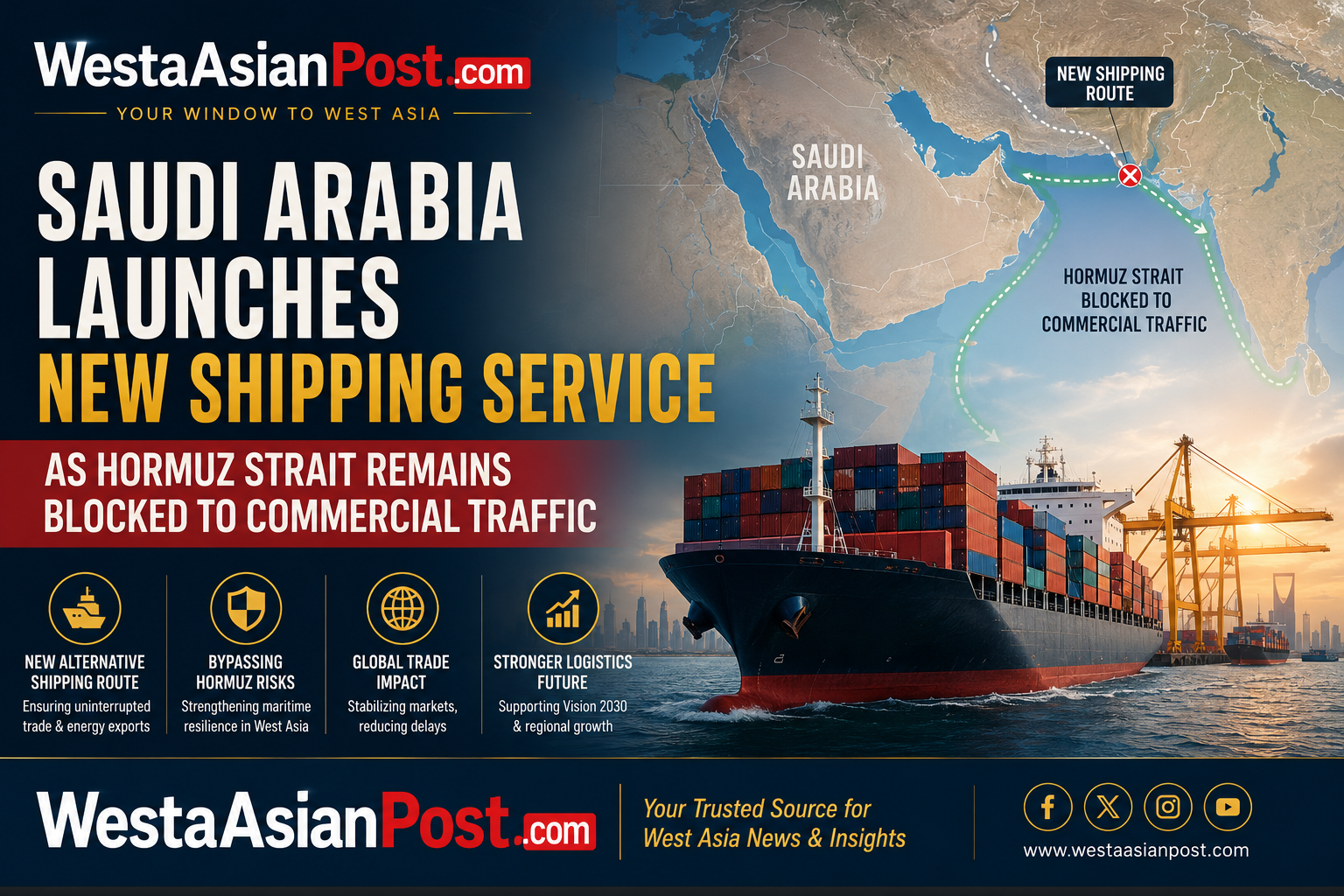
Saudi Arabia Launches New Shipping Service as Hormuz Strait Remains Blocked to Commercial Traffic: Implications for Global Trade and West Asia.
Saudi Arabia launches a new alternative shipping service amid continued disruption in the Strait of Hormuz. Explore the impact on global trade, energy markets, logistics, and West Asian geopolitics in this detailed analysis.
Saudi Arabia has unveiled a new strategic shipping service as commercial maritime traffic through the Strait of Hormuz continues to face severe disruptions. The move comes amid heightened geopolitical tensions in the Gulf region, creating significant concerns for global energy markets, international trade routes, maritime logistics companies, and import-export businesses worldwide.
The Strait of Hormuz remains one of the world’s most strategically critical maritime chokepoints, handling nearly one-fifth of global oil shipments and a substantial volume of LNG exports. Any prolonged interruption in this corridor has far-reaching consequences for energy security, freight costs, shipping schedules, insurance premiums, and economic stability across Asia, Europe, and the Middle East.
Saudi Arabia’s latest initiative reflects a broader regional strategy aimed at reducing dependency on vulnerable maritime routes while ensuring continuity in trade and energy exports.
Understanding the Importance of the Strait of Hormuz
The Strait of Hormuz is a narrow waterway connecting the Persian Gulf to the Gulf of Oman and the Arabian Sea. It serves as the primary export route for crude oil and petroleum products from major Gulf producers including Saudi Arabia, the UAE, Kuwait, Iraq, and Qatar.
Every day, millions of barrels of oil and large quantities of liquefied natural gas pass through this strategic corridor. Any disruption immediately impacts:
- Global crude oil prices
- LNG supplies
- Shipping freight rates
- Insurance costs for vessels
- Commodity prices
- Supply chain stability
The current blockage or restriction of commercial movement has triggered alarm across international markets and prompted urgent contingency planning by governments and shipping operators.
Saudi Arabia’s New Shipping Service: A Strategic Alternative
Saudi Arabia’s newly announced shipping initiative is designed to provide an alternative trade and logistics corridor that bypasses the affected Hormuz route.
The service is expected to:
- Facilitate uninterrupted cargo movement
- Ensure stable energy exports
- Support regional supply chains
- Reduce delays for commercial shipping
- Strengthen maritime resilience in West Asia
Industry analysts believe the Kingdom is leveraging its Red Sea ports and existing pipeline infrastructure to reroute cargo efficiently toward global markets.
The development also highlights Saudi Arabia’s long-term vision of becoming a dominant global logistics hub under its Vision 2030 economic diversification program.
Potential Shipping and Logistics Alternatives
Several alternative logistical pathways are currently under discussion or expansion across the Gulf region:
1. Red Sea Shipping Corridors
Saudi Arabia’s western ports on the Red Sea offer direct access to Europe, Africa, and Mediterranean markets without relying on the Strait of Hormuz.
2. East-West Pipeline Infrastructure
Saudi Arabia already operates pipelines connecting oil fields in the Eastern Province to Red Sea export terminals, reducing dependence on Gulf maritime routes.
3. Regional Multimodal Logistics Networks
Integrated rail, road, and port systems are increasingly being developed to create resilient supply chain ecosystems.
4. Strategic Port Expansion
Ports such as Jeddah Islamic Port and Yanbu are likely to witness increased operational significance during the current crisis.
Impact on Global Oil Markets
The blockage of Hormuz has already created volatility in global energy markets. Investors and commodity traders are closely monitoring developments due to fears of supply shortages.
Rising Crude Oil Prices
Even partial disruptions in Gulf shipping can trigger immediate spikes in crude prices due to market uncertainty.
Increased Shipping Insurance Costs
War-risk premiums for vessels operating near conflict zones have surged sharply.
Supply Chain Delays
Energy-importing nations in Asia, particularly India, China, Japan, and South Korea, face potential logistical disruptions.
LNG Market Pressures
Qatar, one of the world’s largest LNG exporters, heavily relies on Hormuz access. Prolonged disruption could tighten global gas supplies.
Implications for India and Asian Economies
India is among the countries most exposed to developments in the Gulf shipping corridor due to its significant dependence on imported crude oil from West Asia.
Potential consequences include:
- Increased fuel prices
- Higher inflationary pressure
- Elevated freight and logistics costs
- Rupee volatility
- Increased import bills
Indian exporters and importers may also experience delays in cargo movement and increased container shipping expenses.
However, the emergence of alternative shipping routes from Saudi Arabia could provide some degree of market stability and reduce panic in regional trade networks.
Geopolitical Dimensions of the Crisis
The maritime situation also carries major geopolitical implications.
Strategic Competition in West Asia
Control over maritime routes remains central to regional influence and global power dynamics.
Energy Security Concerns
Major economies are now reassessing their energy security strategies and strategic petroleum reserves.
Expansion of Alternative Trade Corridors
Countries are accelerating investments in diversified trade routes to reduce dependence on single chokepoints.
Strengthening Maritime Alliances
International naval cooperation and maritime security operations may intensify to safeguard commercial navigation.
Opportunities Emerging from the Crisis
Despite the risks, the current disruption could create several long-term opportunities.
Saudi Arabia’s Rise as a Logistics Powerhouse
The Kingdom’s proactive response strengthens its ambition to become a leading global logistics and shipping hub.
Infrastructure Investments
Regional governments may accelerate investments in:
- Ports
- Pipelines
- Rail connectivity
- Industrial corridors
- Free trade zones
Supply Chain Diversification
Businesses worldwide are increasingly focusing on diversified sourcing and logistics strategies.
Maritime Technology Adoption
Digital shipping management, AI-based route optimization, and smart logistics solutions could see faster adoption.
What Businesses Should Do Now
Companies involved in international trade, logistics, manufacturing, and energy sectors should proactively prepare for prolonged maritime uncertainty.
Recommended measures include:
- Diversifying shipping routes
- Reviewing supply chain risks
- Increasing inventory buffers
- Renegotiating freight contracts
- Monitoring geopolitical developments
- Exploring alternative sourcing destinations
Import-export firms dealing with West Asia should also closely track customs, shipping schedules, and freight market changes.
The Future of Gulf Maritime Trade
The current crisis may fundamentally reshape maritime trade architecture in West Asia. Governments across the Gulf region are likely to prioritize strategic redundancy in shipping infrastructure and energy export capabilities.
Saudi Arabia’s latest shipping initiative demonstrates how regional powers are adapting rapidly to geopolitical challenges while attempting to preserve global trade continuity.
As tensions continue, the effectiveness of alternative logistics networks will play a critical role in stabilizing energy markets and international commerce.
Conclusion
Saudi Arabia’s launch of a new shipping service amid the continued blockage of the Strait of Hormuz represents a major strategic and economic development for the Gulf region and the global economy.
The initiative underscores the growing importance of resilient logistics infrastructure, diversified trade corridors, and maritime security in an increasingly uncertain geopolitical environment.
For businesses, investors, policymakers, and global shipping operators, the evolving situation in West Asia will remain a key factor influencing trade, energy prices, and economic stability in the months ahead.
As the world watches developments closely, Saudi Arabia’s response could become a defining moment in the future evolution of global maritime trade and regional logistics leadership.
WestAsianPost.com
More Featured Articles:
Why Saudi Arabia Is Opening Its Doors to Global Tourism: Vision, Economy, and a New Cultural Era.
How Startups Can Raise Funding in Dubai: A Comprehensive Guide for Founders and Entrepreneurs.
The Complete Guide to Startup Funding in West Asia (2026 Edition).
UAE’s Rise as a Global Powerhouse: Stability, Innovation, and Strategic Leadership in West Asia.
Suez Crisis 1956: The War That Reshaped the Middle East and Marked the End of European Empire.
Trump’s “Board of Peace”: How Real Estate, Crypto, and Pakistan Are Shaping U.S.–Iran Diplomacy.
Ultimate Guide to Early Stage Startup Funding in MENA (2026): Top Investors & Strategies