

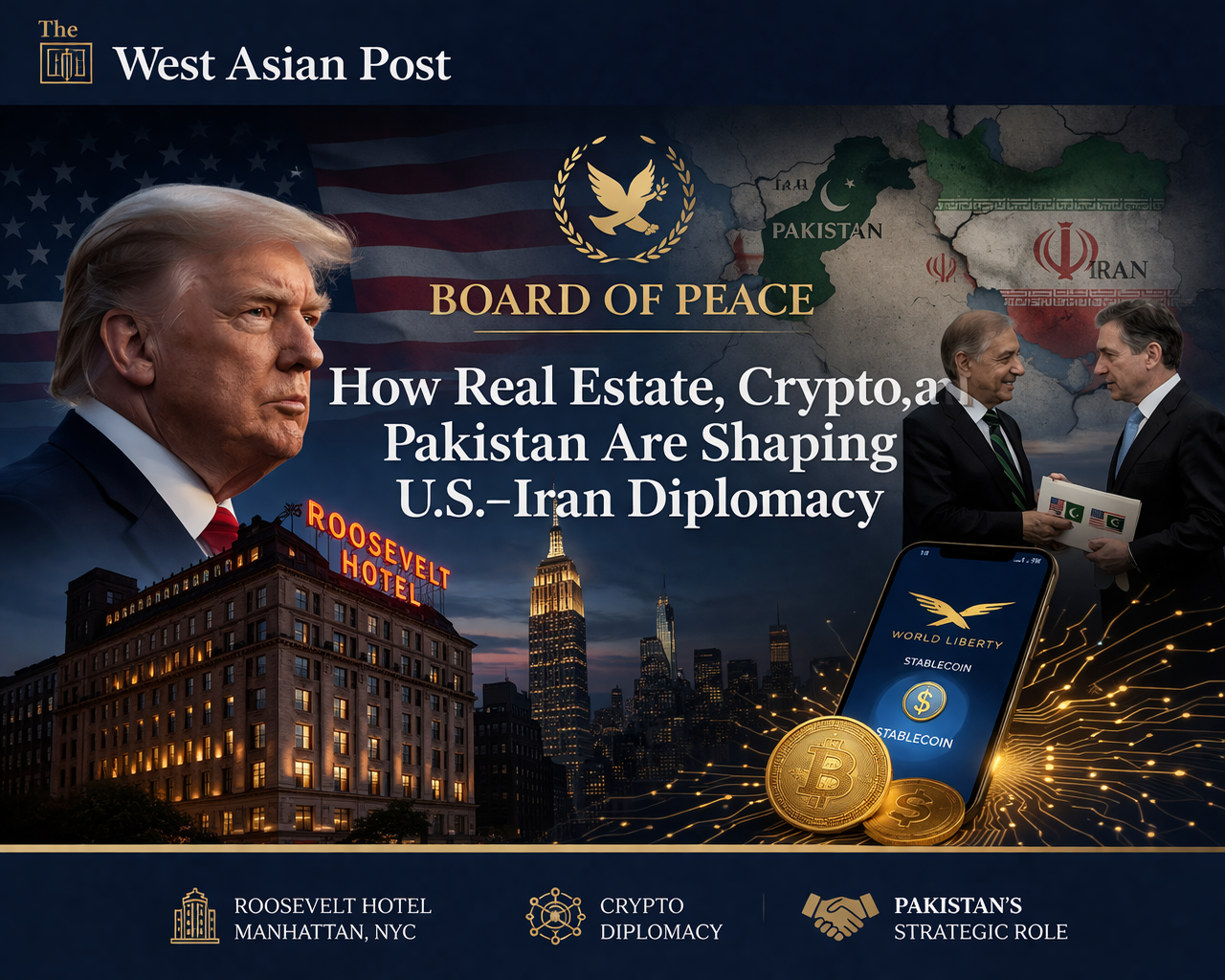
Trump’s “Board of Peace”: How Real Estate, Crypto, and Pakistan Are Shaping U.S.–Iran Diplomacy.
An in-depth analysis of how Donald Trump’s “Board of Peace” initiative intertwines real estate deals, crypto diplomacy, and Pakistan’s strategic ambitions in reshaping U.S.–Iran relations.
The emergence of a new diplomatic framework under Donald Trump—branded as the “Board of Peace”—signals a striking departure from traditional international conflict resolution mechanisms. Marketed as an alternative to institutions like the United Nations, this initiative blends geopolitics with transactional dealmaking, where economic interests and strategic alignments appear inseparable from diplomacy itself.
At the center of this evolving architecture lies an unusual convergence of actors and interests: Pakistan’s renewed engagement with Washington, a high-profile Manhattan real estate project, and the growing role of cryptocurrency in statecraft.
From Peace Talks to Property Deals
The inaugural meeting of the Board of Peace did not produce a ceasefire roadmap for tensions involving Iran. Instead, it spotlighted a redevelopment proposal for the historic Roosevelt Hotel in Midtown Manhattan—an asset owned by Pakistan.
Spearheaded by Special Envoy Steve Witkoff, the proposal outlined a joint U.S.–Pakistan venture to transform the shuttered property. While officials later clarified that the agreement carried no binding obligations, the symbolism was unmistakable: diplomacy, in this framework, begins with deals rather than doctrines.
This blending of foreign policy with commercial negotiation reflects a broader pattern in Trump-era governance, where access and influence are often cultivated through economic engagement rather than institutional channels.
Pakistan’s Strategic Re-entry
For Pakistan, the Board of Peace represents more than a diplomatic opportunity—it is a calculated re-entry into Washington’s inner circle. Over the course of Trump’s second term, Islamabad has pursued a multi-pronged strategy to regain relevance in U.S. foreign policy.
This includes:
- Signing a reported $1.3 billion agreement in critical minerals
- Engaging lobbyists with close ties to Trump’s network
- Partnering with crypto ventures linked to Trump allies to introduce stablecoin infrastructure
These moves have collectively positioned Pakistan as a key intermediary in U.S. outreach to Iran. Acting as a conduit for proposals, Islamabad is now relaying messages, offering to host negotiations, and presenting itself as a neutral facilitator in a highly volatile regional equation.
Crypto Diplomacy and Financial Leverage
A defining feature of this emerging framework is the integration of cryptocurrency into diplomatic strategy. Agreements involving blockchain-based financial systems—particularly stablecoins—are being explored as tools for economic engagement and influence.
This “crypto diplomacy” serves multiple purposes. It provides countries like Pakistan with access to alternative financial channels, potentially bypassing traditional constraints. Simultaneously, it aligns with broader U.S. interests in expanding digital financial ecosystems tied to American firms and allies.
In this context, financial infrastructure becomes a geopolitical instrument, blurring the lines between economic innovation and strategic leverage.
A New Model of Diplomacy
The Board of Peace reflects a deeper shift in how diplomacy is conceptualized. Rather than prioritizing multilateral consensus or normative frameworks, this model emphasizes transactional relationships. Deals—whether in real estate, minerals, or digital finance—form the foundation of political engagement.
Critics argue that such an approach risks sidelining principles like transparency, accountability, and long-term stability. Supporters, however, contend that it introduces pragmatism and speed into a system often criticized for inefficiency.
What is clear is that the traditional boundaries between public policy and private enterprise are becoming increasingly porous.
Implications for U.S.–Iran Relations
For U.S.–Iran dynamics, this evolving structure introduces both opportunity and uncertainty. Pakistan’s role as an intermediary could open new communication channels, particularly in the absence of direct dialogue. However, the reliance on informal networks and transactional incentives may complicate efforts to achieve durable agreements.
Iran, for its part, must navigate a landscape where negotiations are influenced not only by strategic considerations but also by economic partnerships and third-party interests.
Conclusion
The Board of Peace is less an institution than a reflection of a governing philosophy—one that prioritizes deals over doctrines and relationships over rules. By intertwining real estate ventures, cryptocurrency initiatives, and geopolitical maneuvering, it represents a distinctly modern, if controversial, approach to diplomacy.
As Pakistan positions itself at the crossroads of these developments, and as U.S. policy toward Iran continues to evolve, the world may be witnessing the early stages of a new diplomatic paradigm—one where the language of negotiation is increasingly written in contracts, investments, and digital assets rather than treaties alone.
Team: WestAsianPost.com
More Featured Articles:
Epic Bluff or Strategic Gamble? Why Trump’s Iran Campaign May Be Heading Toward Failure.
Company Registration in Dubai 2026: Complete Guide to Setup, Costs, Benefits & Compliance.
Why Saudi Arabia Is Opening Its Doors to Global Tourism: Vision, Economy, and a New Cultural Era.
Venture Capital and Private Equity Funding in India: A Complete Founder’s Guide (2025)
Why Kjøller Is an Important Venture Capital Investor for Startups Globally.

One thought on “Trump’s “Board of Peace”: How Real Estate, Crypto, and Pakistan Are Shaping U.S.–Iran Diplomacy.”