
‘Achilles Shield’ Could Reshape Eastern Mediterranean Security as Cyprus & Israel Warns of Common Threat from Turkey.
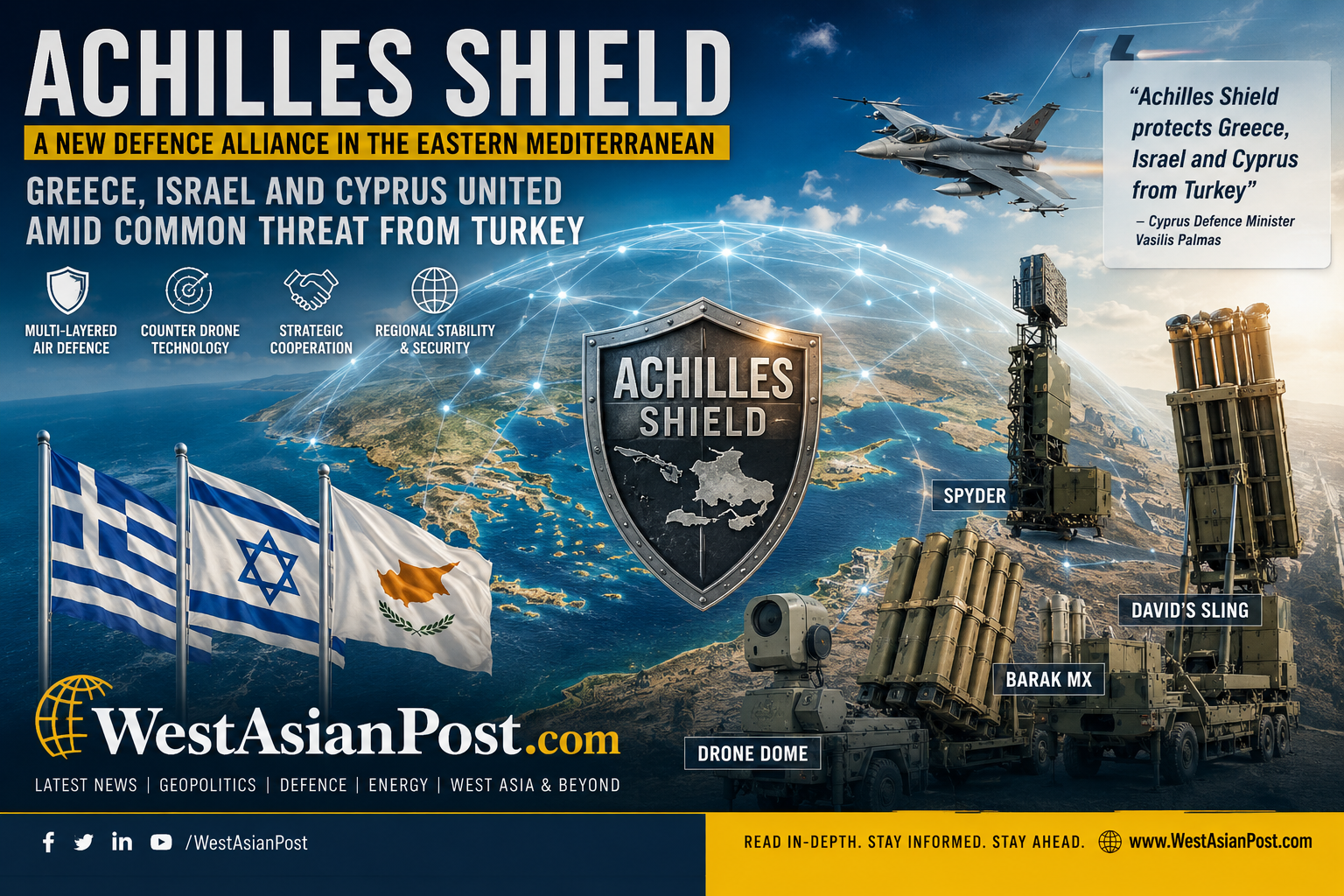
Greece and Israel’s €3 billion “Achilles Shield” air-defence agreement is deepening their strategic partnership, while Cyprus says the system strengthens the security of all three countries amid long-standing tensions with Turkey.
‘Achilles Shield’ Could Reshape Eastern Mediterranean Security as Cyprus Warns of Common Threat from Turkey
A landmark defence agreement between Greece and Israel is rapidly emerging as one of the most consequential security developments in the Eastern Mediterranean, with Cyprus now openly describing the initiative as a protective shield against what it regards as a common security challenge from Turkey.
Cyprus Defence Minister Vasilis Palmas said on Thursday that the newly signed “Achilles Shield” agreement between Greece and Israel has significance extending beyond the two countries, arguing that Greece, Israel and Cyprus face overlapping security concerns involving Turkey.
His comments, reported by Cyprus Mail, come only days after Israel and Greece formally signed a defence agreement worth approximately €3 billion, under which Israel will construct a sophisticated, multi-layered air-defence network for Greece.
The development adds another important dimension to an increasingly close strategic relationship between Greece, Cyprus and Israel, while potentially intensifying the security competition involving Turkey in the Aegean and Eastern Mediterranean.
What is the Achilles Shield?
The Achilles Shield is designed as a comprehensive, multi-layered air and missile defence architecture for Greece.
Unlike a single missile battery designed to counter one category of threat, the system is intended to integrate multiple layers capable of dealing with ballistic missiles, aircraft, cruise-type aerial threats and unmanned aerial vehicles (UAVs).
According to Israel’s Ministry of Defence, the approximately €3 billion agreement includes:
- David’s Sling
- SPYDER
- BARAK MX
- MMR multi-mission radars
- A new national command-and-control system
- Additional counter-drone capabilities
The Israeli ministry described the agreement as the largest defence export deal in the history of Israel-Greece relations and one of the largest defence deals in Israel’s history.
A separate agreement worth approximately €26 million will provide Greece with Israel’s Drone Dome systems to strengthen protection of strategic locations against drone threats.
The system is expected to give Greece a much more integrated approach to air defence, connecting different sensors, interceptors and command systems rather than relying exclusively on individual weapons platforms.
Why Cyprus is watching the deal closely
For Cyprus, the development is particularly significant because the island occupies a strategically important position in the Eastern Mediterranean and has its own long-running security dispute involving Turkey.
Palmas said the three countries face defence-related challenges involving Turkey and argued that their increasingly close military and political cooperation could help them address these risks collectively.
He also pointed to Cyprus’ long-standing division and the security challenges faced by Greece and Israel. According to the minister, cooperation among the three countries is intended to strengthen regional security while protecting their territorial integrity and sovereignty.
It is important, however, to distinguish between the actual scope of the Achilles Shield contract and Cyprus’ interpretation of its wider strategic significance.
The agreement itself is a bilateral Greece-Israel defence programme. Cyprus is not a contracting party to the €3 billion system.
That distinction matters.
The system is being built for Greece, but the political and strategic relationships connecting Athens, Nicosia and Jerusalem mean that its consequences could extend beyond Greek territory.
A three-way strategic relationship
Over the past decade, Greece, Cyprus and Israel have steadily expanded military, energy and diplomatic cooperation.
The relationship has been driven by several common interests:
- Eastern Mediterranean security
- Energy infrastructure
- Maritime security
- Counter-drone and air-defence technology
- Military exercises and training
- Strategic coordination
- Concerns over regional power competition
Israel and Greece have particularly deepened defence cooperation, including joint military exercises and technology cooperation.
Cyprus has also developed significant defence ties with Israel. According to Cyprus Mail, Cyprus already operates the BARAK MX system and has approved the acquisition of four Greek-made Kentavros counter-drone systems.
This means that the Achilles Shield is being introduced into an already expanding network of defence cooperation.
Turkey remains the central strategic factor
Although Israeli and Greek officials have framed the agreement in broader terms involving regional security and evolving military threats, Turkey is an unavoidable factor in understanding Greece’s military modernisation.
Greece and Turkey are both NATO members but have longstanding disputes involving the Aegean Sea, airspace, maritime boundaries, sovereignty issues and the militarisation of certain Greek islands.
The relationship has periodically improved through diplomatic engagement, but major disagreements remain.
The timing of the Achilles Shield agreement is therefore particularly notable.
Only days after the Greece-Israel agreement, Turkish President Recep Tayyip Erdoğan again warned Greece against what Ankara describes as the militarisation of demilitarised Aegean islands.
According to reporting from Cyprus, Erdoğan warned that Turkey would take action to protect what it considers its rights and cautioned Greece against interpreting Turkish restraint as weakness.
This does not mean that the Achilles Shield agreement automatically points towards an impending military confrontation.
Rather, it demonstrates that military deterrence and technological superiority are increasingly becoming central components of the strategic competition in the Eastern Mediterranean.
Israel’s defence technology becomes a major strategic asset
The deal also highlights Israel’s growing importance as a global supplier of sophisticated air-defence technology.
Israel’s systems have gained considerable international attention because of their operational use against missiles, rockets and drones.
The David’s Sling, for example, is designed to intercept medium-range threats, while SPYDER provides another layer of air defence and BARAK MX provides a modular system capable of dealing with several categories of aerial threats.
The Achilles Shield seeks to bring these capabilities together under an integrated architecture.
Israel’s Ministry of Defence has said that the system will draw on operational experience accumulated by the Israeli defence establishment.
For Greece, the attraction is therefore not simply the purchase of individual missiles or radar systems. It is the creation of a networked national air-defence architecture.
Greece’s much larger military modernisation programme
The €3 billion Achilles Shield agreement should also be viewed as part of a much broader Greek defence transformation.
Athens has announced plans for approximately €28 billion in defence spending through 2036, including modernisation of its air force, navy and ground forces.
The programme includes plans for:
- Up to 40 F-35 fighter aircraft
- New frigates
- Modern air-defence systems
- Advanced drones
- Counter-drone capabilities
- Military transport aircraft
- Other next-generation defence technologies
Greece currently spends approximately 3.5% of GDP on defence, a relatively high level among NATO members.
The strategy reflects a recognition in Athens that modern warfare increasingly involves not only conventional aircraft and missiles but also drones, ballistic missiles, electronic warfare, cyber capabilities and other asymmetric technologies.
Why drones have changed the equation
One of the most important features of the Achilles Shield is its emphasis on countering drones.
The proliferation of relatively inexpensive unmanned systems has transformed military planning.
A sophisticated missile defence system can become economically inefficient if expensive interceptors have to be used against inexpensive drones.
That has created demand for layered systems combining:
- Radar detection
- Electronic warfare
- Short-range interceptors
- Directed-energy or specialised counter-drone systems
- Command-and-control networks
- Conventional missile defence
The inclusion of Drone Dome therefore reflects a broader shift in military thinking.
The battlefield is no longer dominated exclusively by expensive fighter aircraft and ballistic missiles. Cheap drones can threaten military bases, infrastructure, naval assets and civilian facilities.
Could Achilles Shield protect Cyprus?
This is perhaps the most politically sensitive question raised by the Cyprus defence minister’s remarks.
At present, the agreement does not establish an Israeli-operated air-defence umbrella formally covering Cyprus.
The €3 billion programme is designed to build Greece’s air-defence architecture.
Nevertheless, Cyprus could benefit indirectly from the strengthening of the wider Greece-Israel strategic relationship.
There are several potential mechanisms.
1. Greater intelligence and surveillance cooperation
Closer defence coordination can improve the sharing of information about aerial and maritime activity.
2. Interoperability
The more closely Greek, Cypriot and Israeli defence systems operate together, the greater the potential for coordinated responses to regional threats.
3. Counter-drone cooperation
Cyprus is already strengthening its counter-drone capabilities, making this an obvious area for further cooperation.
4. Strategic deterrence
A stronger Greek defence capability could alter calculations by any potential adversary considering military action in the region.
However, these are strategic implications rather than guarantees that Achilles Shield directly defends Cyprus.
The Israel-Turkey dimension
The development also comes against the backdrop of increasingly strained relations between Israel and Turkey.
The relationship between Ankara and Jerusalem has deteriorated sharply over recent years, while Israel has simultaneously strengthened its strategic partnerships with Greece and Cyprus.
This creates a complex geopolitical triangle.
Turkey remains an important NATO member and a major regional power. Greece is also a NATO member and has increasingly aligned its defence strategy with Israel and other Western partners.
Israel, meanwhile, has become an increasingly important defence technology supplier to Greece.
The result is a changing strategic map in which military partnerships are increasingly overlapping with energy, maritime and diplomatic interests.
A new security architecture for the Eastern Mediterranean?
The significance of Achilles Shield therefore extends beyond the value of the weapons involved.
It represents another step towards a more integrated security architecture involving Greece, Cyprus and Israel.
The three countries have different strategic priorities and are not part of a formal trilateral military alliance equivalent to NATO.
Yet their growing cooperation is unmistakable.
For Greece, the priority is strengthening deterrence and modernising its armed forces.
For Cyprus, the focus includes the island’s unresolved security situation and protection of its sovereignty.
For Israel, Greece provides a strategically important European and Mediterranean partner.
These interests increasingly intersect.
Deterrence or escalation?
The central question now is whether the Achilles Shield will ultimately contribute to stability through deterrence or encourage a further arms race in the Eastern Mediterranean.
Athens is likely to argue that stronger defensive capabilities reduce the risk of conflict because a potential adversary will be less confident of achieving its military objectives.
Ankara, however, may view the rapid expansion of Greek military capabilities differently—particularly if advanced systems are deployed in strategically sensitive locations.
That creates a classic security dilemma: one country’s defensive investment can be interpreted by another as a potential offensive threat.
For that reason, the diplomatic relationship between Greece and Turkey will remain just as important as the technology being deployed.
What happens next?
The implementation of Achilles Shield will be closely watched across the region.
The Israeli Ministry of Defence says the project involves the creation of a comprehensive defence architecture rather than the simple delivery of individual weapons systems. Greece is also seeking domestic participation in the programme and technology and expertise transfers that could strengthen its own defence industry.
As the system moves towards deployment, several issues will attract attention:
- Where individual components will be deployed
- How Greece integrates existing and new systems
- The degree of Greek industrial participation
- Cooperation between Greek and Israeli defence industries
- Whether Cyprus expands its own Israeli defence purchases
- Turkey’s response to Greece’s military modernisation
- Whether Athens and Ankara continue diplomatic engagement
- How the European Union responds to increasing security competition in the Eastern Mediterranean
The bigger picture
The Achilles Shield is more than a €3 billion arms agreement.
It is a symbol of the rapid transformation of Eastern Mediterranean security.
Greece is investing heavily in advanced air and missile defence. Israel is expanding its role as a major defence technology partner. Cyprus is increasingly aligning itself with Athens and Jerusalem on strategic issues.
And Turkey remains an influential military and geopolitical power whose relationship with Greece, Cyprus and Israel will significantly shape the region’s future.
Cyprus Defence Minister Vasilis Palmas’ description of the system as a shield benefiting Greece, Israel and Cyprus captures the political significance of this emerging alignment.
But the reality is more nuanced: Achilles Shield is formally a Greek-Israeli defence programme, while its wider impact could be felt across the Eastern Mediterranean.
Whether it becomes primarily a tool of deterrence or another catalyst for regional military competition will depend not only on the capabilities of the system, but also on diplomacy between Athens and Ankara and the evolving strategic relationship among Greece, Cyprus and Israel.
For the Eastern Mediterranean, the message is clear: air defence is no longer merely a military procurement issue—it is becoming a central element of regional geopolitics.
WestAsianPost.com | Geopolitics • Defence • Energy • West Asia & Eastern Mediterranean
Editorial note: This article distinguishes between confirmed elements of the Greece-Israel agreement and the broader strategic interpretation offered by Cyprus officials. The assertion that Achilles Shield protects Cyprus is the assessment of Cyprus Defence Minister Vasilis Palmas, not a statement that Cyprus is formally covered by the €3 billion bilateral defence contract.
More Featured Articles.
Why Global Entrepreneurs Are Moving to Dubai: The Ultimate Business Hub of the 21st Century.
How Businesses in the UAE Can Stay Ahead of Compliance Demands in 2026.
CFO Services for Startups: Why Virtual CFOs Are Transforming Business Scalability in India
Launch Your Own Skincare, Haircare & Personal Care Brand Through White-Label Manufacturing.
Why Kjøller Is an Important Venture Capital Investor for Startups Globally.
Dubai vs Singapore: Which City Will Become the Next Global Financial Hub?
Company Registration in Dubai 2026: Complete Guide to Setup, Costs, Benefits & Compliance.