
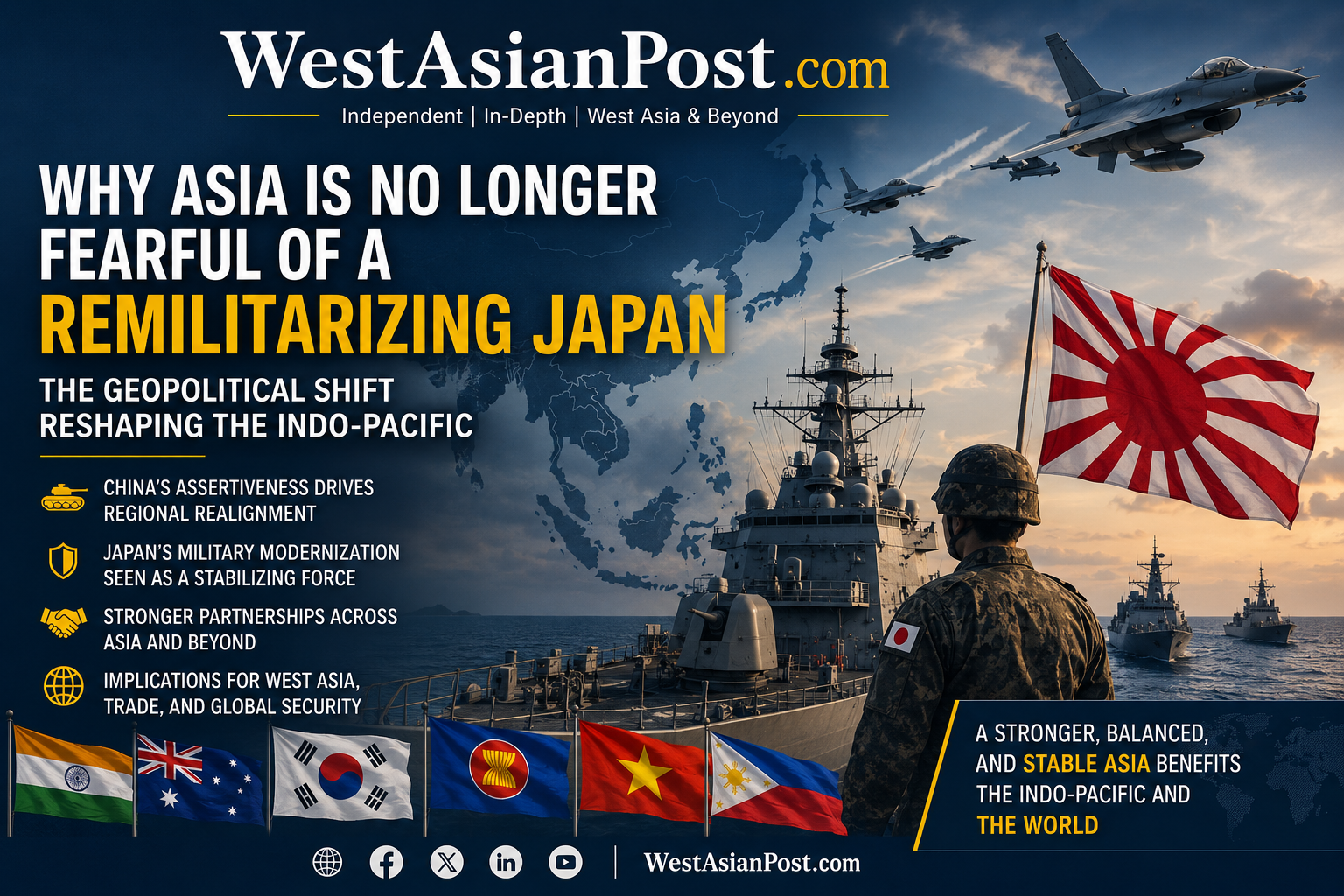
Why Asia Is No Longer Fearful of a Remilitarizing Japan: The Geopolitical Shift Reshaping the Indo-Pacific
Asia’s Shifting Security Landscape: Why Many Nations Are Growing More Comfortable with a Stronger Japan.
As China expands its military and strategic influence across Asia, many countries are increasingly viewing Japan’s military modernization as a stabilizing force rather than a threat. Explore the geopolitical shifts reshaping the Indo-Pacific and West Asia.
For decades after World War II, the prospect of Japan rebuilding significant military capabilities was viewed with suspicion across Asia. Memories of Japanese imperial expansion, wartime occupation, and military aggression remained deeply embedded in the collective consciousness of countries throughout East and Southeast Asia.
However, the geopolitical realities of the 21st century are changing those perceptions. While concerns remain in certain quarters, an increasing number of Asian nations now see Japan’s military modernization not as a threat but as a necessary counterbalance in an increasingly uncertain regional security environment dominated by China’s growing military power.
This shift represents one of the most significant strategic transformations in Asia since the end of the Cold War.
Japan’s Post-War Military Restraint
Following its defeat in 1945, Japan adopted a pacifist constitution under which Article 9 renounced war as a sovereign right and prohibited the maintenance of offensive military forces.
For decades, Japan relied heavily on the United States for security while maintaining only the Self-Defense Forces (SDF), which were designed primarily for homeland protection.
Japan’s defense spending remained modest by global standards, and successive governments carefully avoided actions that could be interpreted as a return to militarism.
This arrangement helped Japan rebuild its economy and emerge as one of the world’s largest economic powers while reassuring neighboring countries that it would not repeat its wartime past.
China’s Rise Has Changed Regional Calculations
The strategic environment began changing dramatically with China’s rapid economic and military rise.
Over the past two decades, Beijing has:
- Expanded its naval capabilities at an unprecedented pace.
- Increased military activities around Taiwan.
- Asserted territorial claims in the South China Sea.
- Enhanced military presence in the East China Sea.
- Developed advanced missile and cyber warfare capabilities.
- Increased strategic influence across Asia through economic and diplomatic initiatives.
Many Asian governments increasingly view China’s growing military assertiveness as a more immediate concern than Japan’s military normalization.
As a result, countries that once worried about Japanese military expansion are now more focused on maintaining a balance of power in the region.
Japan’s Military Transformation
Japan has gradually undertaken the most significant military modernization program in its post-war history.
Recent developments include:
Higher Defense Spending
Japan has committed to substantially increasing defense expenditure, moving toward levels comparable to NATO standards.
Counterstrike Capabilities
Tokyo has approved the acquisition of long-range missile systems capable of striking enemy launch sites if Japan comes under attack.
Advanced Military Technology
Japan is investing heavily in:
- Hypersonic weapons
- Missile defense systems
- Cybersecurity capabilities
- Space-based defense assets
- Artificial intelligence applications for military operations
Enhanced Naval and Air Power
The Japan Maritime Self-Defense Force is increasingly recognized as one of the world’s most capable naval forces.
Japan is also upgrading helicopter carriers to operate advanced fighter aircraft, significantly enhancing its regional power projection capabilities.
How Asian Nations View Japan Today
Southeast Asia
Countries such as Vietnam, the Philippines, and Indonesia have strengthened security cooperation with Japan.
These nations value:
- Japanese maritime security assistance.
- Coast guard training programs.
- Defense technology cooperation.
- Infrastructure investments that provide alternatives to Chinese financing.
For many Southeast Asian states, Japan is viewed as a responsible stakeholder that supports regional stability.
South Korea
Relations between Japan and South Korea remain complicated due to historical grievances.
However, growing concerns over North Korea’s missile program and China’s regional ambitions have encouraged closer security coordination among Seoul, Tokyo, and Washington.
India
India has become one of Japan’s closest strategic partners.
The two countries cooperate extensively on:
- Maritime security.
- Defense technology.
- Infrastructure development.
- Indo-Pacific strategic initiatives.
Both countries share concerns regarding freedom of navigation and regional security.
Australia
Australia and Japan have developed one of the Indo-Pacific’s strongest security partnerships.
Joint military exercises, intelligence sharing, and defense agreements reflect growing trust between the two democracies.
Why China Remains Concerned
Beijing continues to criticize Japan’s military expansion and frequently warns against what it describes as a revival of militarism.
Chinese policymakers argue that Japan’s military modernization could destabilize the region and undermine post-war security arrangements.
However, many observers note that China’s own military growth has been a major factor driving Japan’s defense transformation.
The security competition between Asia’s two largest economies is increasingly shaping the future strategic architecture of the Indo-Pacific.
Implications for West Asia
Although geographically distant, developments in East Asia carry significant implications for West Asia.
Key impacts include:
Energy Security
Japan remains heavily dependent on Middle Eastern energy supplies. A stronger Japanese military presence could contribute to securing vital sea lanes connecting West Asia to East Asia.
Trade Routes
The Indo-Pacific hosts some of the world’s busiest maritime corridors. Stability in these waters directly affects Gulf exporters and Asian importers.
Strategic Partnerships
Several Gulf nations are expanding economic and technological cooperation with Japan, viewing Tokyo as a reliable long-term partner.
Multipolar World Order
Japan’s growing strategic role contributes to an emerging multipolar global system in which regional powers increasingly shape security outcomes.
Challenges and Risks Ahead
Despite growing acceptance of Japan’s military normalization, challenges remain.
Historical memories continue to influence public opinion in parts of Asia.
Potential risks include:
- Escalating tensions between China and Japan.
- Arms competition in the Indo-Pacific.
- Increased military activity around Taiwan.
- Regional security dilemmas involving multiple major powers.
Managing these risks will require careful diplomacy and confidence-building measures.
The Emerging Consensus
The most remarkable aspect of Asia’s evolving security landscape is not simply Japan’s military modernization but the changing perceptions surrounding it.
For many countries across Asia, the central strategic concern is no longer whether Japan will become too strong. Instead, it is whether sufficient regional balance exists to preserve peace and stability amid intensifying great-power competition.
As China continues to expand its influence and military capabilities, Japan’s enhanced defense posture is increasingly viewed as part of the solution rather than part of the problem.
The result is a profound geopolitical shift that is redefining alliances, partnerships, and security calculations across the Indo-Pacific—and one that will continue to influence global politics, including the strategic interests of West Asia, for years to come.
Focus Keyword
Japan Military Modernization
Secondary Keywords
- China Japan Relations
- Indo-Pacific Security
- Asian Geopolitics
- Japan Defense Policy
- Regional Security Balance
- West Asia Strategic Affairs
- China Military Expansion
- Maritime Security in Asia
- Quad Alliance
- Asia Pacific Defense Trends
Published by WestAsianPost.com – Tracking the geopolitical developments shaping Asia, the Middle East, and the emerging global order.
More Featured Posts
The Complete Guide to Startup Funding in West Asia (2026 Edition).
UAE’s Rise as a Global Powerhouse: Stability, Innovation, and Strategic Leadership in West Asia.
India’s Strategic Depth in West Asia: Why Pakistan’s Iran Diplomacy Narrative Doesn’t Hold.