
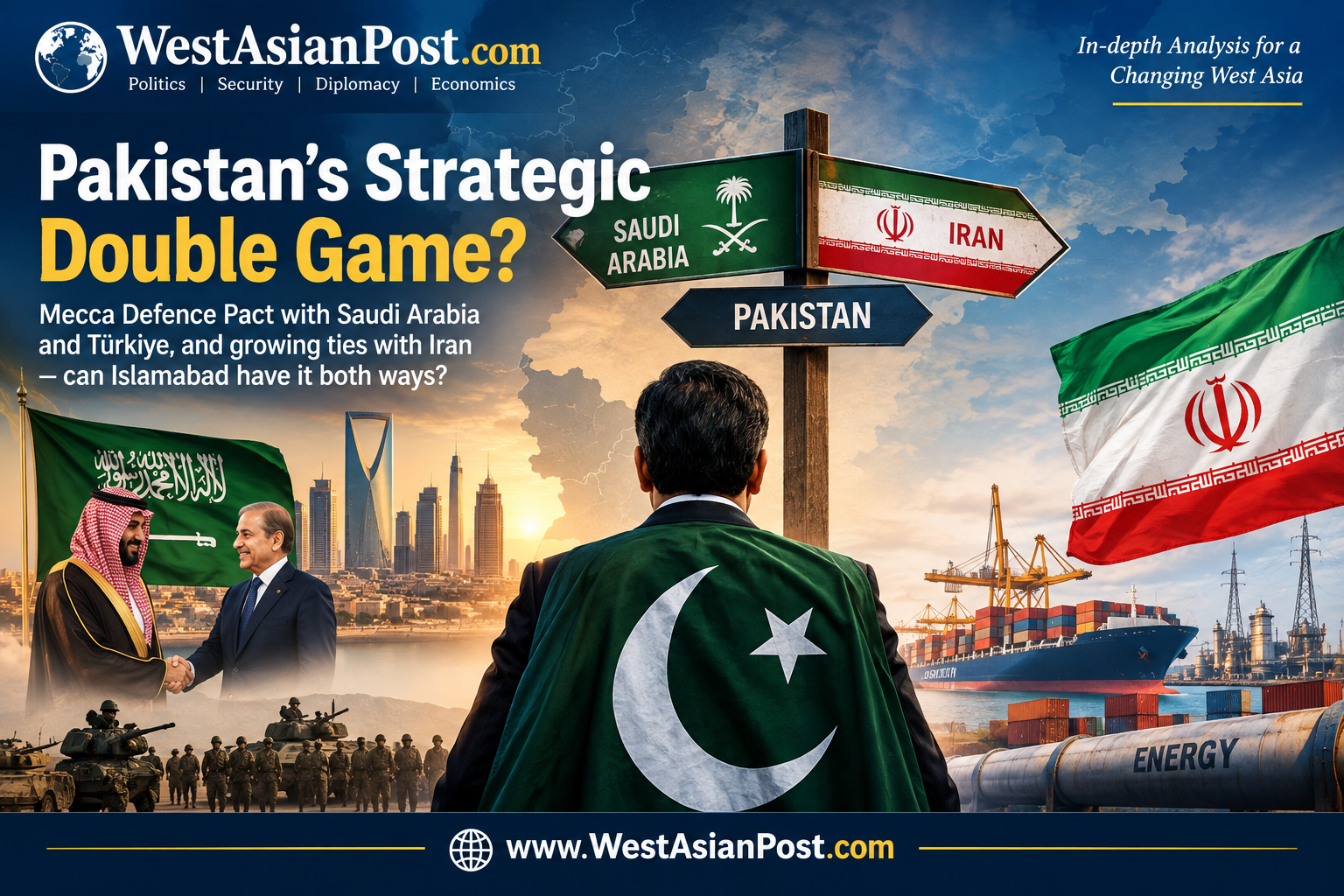
Pakistan’s Double Game: The Mecca Defence Pact With Saudi Arabia and Growing Trade With Iran Raise Serious Questions
The Mecca Defence Pact: Pakistan Wants Saudi Arabia’s Finance While Expanding Ties With Iran – A Dangerous Game of Strategic Double-Dealing.
An exclusive analytical article for WestAsianPost.com
Pakistan’s defence commitments to Saudi Arabia under the Mecca Agreement sit uneasily alongside its expanding economic ties with Iran. Is Islamabad pursuing strategic ambiguity at its allies’ expense? or is it trying to loot everyone?
Introduction: An Ally With One Foot in Each Camp
In international relations, countries often attempt to balance competing interests. Maintaining diplomatic relations with rival powers is not inherently dishonest, nor is economic cooperation with one country automatically incompatible with a defence agreement with another.
However, when a country enters into a collective defence arrangement while simultaneously expanding economic relations with a state whose regional interests conflict with those of its security partner, legitimate questions arise about its strategic priorities, reliability and long-term intentions.
Pakistan’s emerging relationship with Saudi Arabia and Iran presents precisely this dilemma.
On one side stands Saudi Arabia, an important financial supporter of Pakistan and a strategic partner that has entered into the Mecca Joint Defence Agreement with Pakistan and Türkiye. The agreement, signed in August 2026, provides for collective defence, with the parties committing to regard an armed attack on one as an attack on all.
On the other side is Iran, with which Pakistan continues to pursue trade, border connectivity and energy cooperation.
According to the October 17 report by Republic World, Pakistan is expanding its economic engagement with Iran, including work towards a reported $10 billion bilateral trade target, even as its defence commitments to Saudi Arabia raise questions about its position in an increasingly polarised regional security environment.
The central question is straightforward: Can Pakistan credibly promise collective defence to Saudi Arabia while preserving economic and diplomatic flexibility with Iran, particularly when tensions involving Iran-aligned groups threaten Saudi security?
Islamabad may argue that it is protecting its national interests. But the arrangement also creates a serious credibility problem.
For Saudi Arabia, the concern is whether Pakistan’s commitments will translate into dependable action when the kingdom needs support. For Pakistan, the danger is that an attempt to maintain relations with everyone could ultimately weaken its credibility with everyone.
Editorial note: The article distinguishes established agreement provisions and reported developments from political interpretation. Continued trade with Iran does not, by itself, establish a breach of Pakistan’s defence commitments.
1. What Exactly Is the Mecca Defence Agreement?
The Mecca Joint Defence Agreement brings together three countries with different strategic capabilities and priorities:
- Saudi Arabia: A major Gulf power with substantial financial resources, significant defence spending and an important role in regional energy security.
- Pakistan: A nuclear-armed state with a large military, established defence cooperation with Saudi Arabia and longstanding political and economic ties across the Muslim world.
- Türkiye: A major regional military power with a substantial defence industry, drone capabilities and membership in NATO.
The agreement was signed in August 2026. Its central principle is collective defence: an armed attack on one member is to be treated as an attack on all.
The three governments subsequently began developing the institutional and operational arrangements needed to implement their commitments.
On October 5, 2026, an official joint statement announced that the parties would move towards practical implementation, including arrangements for providing agreed military forces and capabilities to Saudi Arabia. The statement also referred to rapid deployment and the need to act in accordance with each country’s national legislation. Ministry of Foreign Affairs
On paper, this represents a significant development in regional security cooperation.
But a defence agreement is only as credible as its implementation.
Its real value depends on several questions:
- What circumstances trigger collective defence?
- What military assistance must each member provide?
- How quickly can forces and equipment be deployed?
- How will the members coordinate their military operations?
- What happens if a member’s economic or diplomatic interests conflict with the alliance’s security objectives?
These are not minor technical details. They determine whether the agreement becomes a meaningful deterrent or remains largely a political declaration.
The complete operational details and obligations are essential to assessing its strength. Without clarity about the limits of the commitments, it would be premature to describe the agreement as equivalent to NATO’s collective-defence system.
Nevertheless, Pakistan has accepted a responsibility that carries consequences beyond diplomatic statements.
A country cannot expect the political benefits of a security alliance indefinitely without demonstrating that its commitments have practical substance.
2. Pakistan’s Iran Policy: Economic Pragmatism or Strategic Contradiction?
Pakistan’s relations with Iran have their own logic.
The two countries share a border, have communities and commercial interests that extend across it, and face common challenges involving border security, smuggling and regional instability.
Iran can also be relevant to Pakistan’s energy requirements and the development of trade routes.
Consequently, maintaining relations with Tehran is not inherently incompatible with Pakistan’s partnership with Riyadh.
The problem emerges when economic engagement intersects with military and strategic commitments.
The October 17 Republic World report describes several elements of Pakistan-Iran economic engagement, including the opening of another official border crossing, continued trade discussions and a reported target of $10 billion in bilateral trade. It also points to Iranian electricity imports as part of the economic relationship.
These developments illustrate Islamabad’s desire to preserve and expand its relationship with Tehran.
Yet Saudi Arabia and Iran have long competed for regional influence, and tensions involving Iran-aligned armed groups have created direct security concerns for the kingdom.
This places Pakistan in a difficult position.
If Islamabad wants to be a dependable defence partner of Saudi Arabia, it must demonstrate that its economic engagement with Iran will not compromise its ability to meet its security obligations.
If it wants to remain a credible interlocutor with Tehran, it must avoid giving the impression that its defence partnership with Saudi Arabia is a commitment to unconditional participation in every confrontation involving Iran and its regional partners.
Both objectives may be possible, but only through transparent diplomacy and clearly defined limits.
The danger is that Pakistan may be attempting to enjoy the benefits of both relationships without adequately addressing their potential contradictions.
The critical question
If a serious regional crisis forces Saudi Arabia to seek military assistance from Pakistan, what will Islamabad prioritise?
Will it act according to its defence commitments, seek to mediate, restrict its assistance to defensive measures or attempt to avoid taking a clear position?
The answers will determine the credibility of the Mecca agreement.
Until Pakistan demonstrates how it intends to reconcile these competing obligations, its strategy will remain vulnerable to the charge of opportunism.
3. Saudi Arabia’s Support for Pakistan Raises Questions About Reciprocity
Saudi Arabia and Pakistan have a longstanding relationship encompassing defence cooperation, investment, financial assistance, energy interests and diplomatic engagement.
The relationship is not merely ideological. It has substantial strategic and economic dimensions.
For Pakistan, Saudi support can be particularly important during periods of financial pressure.
For Saudi Arabia, Pakistan offers access to a large military establishment, defence expertise and a strategically located partner with relationships across South Asia, Central Asia and the wider Muslim world.
Both countries therefore have legitimate reasons to maintain close ties.
However, a partnership built partly on financial support also creates expectations of reciprocity.
If Saudi Arabia provides economic assistance and enters into a formal defence arrangement with Pakistan, Riyadh will naturally want clarity about the military and political support it can expect in return.
That does not mean Saudi assistance purchases Pakistan’s foreign policy. Nor does it mean Pakistan must sever its relations with Iran.
Rather, the question concerns the credibility of commitments voluntarily undertaken by both parties.
If Pakistan accepts the advantages of a Saudi security partnership but remains unwilling to clarify how it would respond during a serious confrontation, Riyadh has reason to question the practical value of the arrangement.
The problem is particularly acute when security concerns are immediate rather than hypothetical.
In October 2026, regional reporting described the activation of the agreement’s collective-defence arrangements in response to attacks on Saudi targets by Iran-aligned Houthi forces in Yemen.
Reuters reported on October 7 that Türkiye was providing primarily defensive and technical assistance to Saudi Arabia, including support involving equipment, intelligence and air-defence capabilities. Türkiye’s parliamentary ratification process remained an important consideration for the extent of its participation. Reuters
These developments illustrate why the agreement’s actual implementation matters more than the ceremony surrounding its signing.
They also raise a legitimate question about the division of responsibilities among the three partners.
What precisely is Pakistan prepared to contribute, and under what conditions?
A credible answer would serve both Saudi Arabia and Pakistan better than vague assurances of solidarity.
4. Is Pakistan Trying to Have It Both Ways?
Pakistan’s apparent balancing act deserves critical scrutiny.
Its relationship with Saudi Arabia offers economic, diplomatic and security advantages. Its relationship with Iran offers opportunities for border trade, energy cooperation and regional engagement.
Islamabad has incentives to preserve both.
But the pursuit of multiple relationships becomes problematic when a government makes commitments that could pull it in opposing directions.
There are at least three possible interpretations of Pakistan’s approach.
Interpretation One: Strategic Pragmatism
Pakistan may believe that maintaining relations with both countries protects its national interests.
Economic cooperation with Iran could help border communities and support energy requirements, while the defence agreement provides a framework for cooperation with Saudi Arabia.
Under this interpretation, Islamabad is not playing a double game. It is trying to prevent regional rivalries from forcing it into an unnecessarily restrictive foreign policy.
This is a legitimate argument.
Countries are not generally required to terminate economic relationships simply because they have defence agreements with another state.
Interpretation Two: Strategic Ambiguity
A second possibility is that Pakistan deliberately avoids clarifying the limits of its commitments.
By promising solidarity to Saudi Arabia while maintaining engagement with Iran, Islamabad may hope to preserve flexibility until the nature of a future crisis becomes clear.
This approach can provide short-term diplomatic advantages.
However, ambiguity also creates uncertainty among partners.
Saudi Arabia may question whether Pakistan’s commitments are dependable, while Iran may wonder whether Islamabad’s defence agreement could eventually place Pakistan on the opposing side of a regional confrontation.
Strategic ambiguity is useful only when it is carefully managed.
When it creates uncertainty about fundamental security obligations, it can weaken trust rather than preserve it.
Interpretation Three: An Attempt to Obtain Benefits Without Accepting Full Responsibility
The most critical interpretation is that Pakistan wants the advantages of a security partnership with Saudi Arabia while retaining maximum freedom to pursue economic and political interests that may conflict with Riyadh’s security objectives.
If that is the case, the strategy could prove self-defeating.
A defence agreement cannot function effectively if one member expects the others to provide security while reserving the right to avoid meaningful obligations whenever the political costs become uncomfortable.
This does not establish that Pakistan has acted in bad faith. The public information available is insufficient to prove such an intention.
Nevertheless, it identifies the central risk facing the agreement.
Pakistan must demonstrate that its balancing strategy is a coherent foreign policy rather than an attempt to secure benefits from competing sides without clearly defining its responsibilities to either.
5. Iran’s Regional Role Makes the Contradiction More Serious
The Pakistan-Iran relationship cannot be assessed solely through trade figures.
Iran’s regional influence, its relationships with armed groups and its rivalry with other Middle Eastern powers shape the strategic environment in which the Mecca agreement operates.
The Houthis in Yemen are among the most important actors in this context. They are aligned with Iran, although the precise nature and extent of Iranian influence over their decisions varies by issue.
Attacks attributed to the Houthis have created serious security concerns for Saudi Arabia, particularly when Saudi territory, civilian infrastructure or important economic facilities are threatened.
In such circumstances, a collective-defence agreement is expected to provide more than diplomatic sympathy.
It should establish a credible framework for responding to threats.
Pakistan’s continued engagement with Iran therefore presents a question of policy coordination: how will Islamabad distinguish legitimate economic cooperation with Tehran from circumstances in which regional developments require it to support Saudi Arabia’s defence?
The distinction is essential.
Pakistan need not treat every Iranian policy as hostile to Saudi Arabia, and it should not automatically be expected to regard every regional dispute as a reason for confrontation with Iran.
But neither should its economic relationship with Tehran become an excuse for avoiding clearly defined commitments to Riyadh.
A functioning defence partnership requires the members to identify these boundaries before a crisis escalates.
Waiting until an emergency occurs would leave each government uncertain about the others’ intentions.
6. Is the Mecca Agreement More Symbolic Than Strategic?
The agreement’s ultimate value will depend on what its members actually do.
The signing of a treaty can signal political unity, strengthen deterrence and encourage cooperation between military establishments.
But the existence of a treaty does not automatically produce an effective military alliance.
Several challenges deserve attention.
A. Unclear operational obligations
The public needs a clear understanding of the circumstances in which each member must provide assistance and the forms that assistance may take.
A commitment to collective defence is not necessarily an automatic promise to deploy ground troops in every conflict.
Support could involve air defence, intelligence, logistics, equipment, maritime security or other capabilities, depending on the agreement’s provisions and the circumstances.
Without clarity, political expectations may exceed what the treaty actually requires.
B. Different national interests
Saudi Arabia, Pakistan and Türkiye do not have identical relationships with Iran, the United States or other regional powers.
Nor do they necessarily share the same assessment of every conflict.
A durable alliance must accommodate legitimate differences without allowing those differences to undermine its central purpose.
C. Military coordination
Effective collective defence requires compatible systems, intelligence-sharing arrangements, command structures, logistical support and procedures for joint decision-making.
These capabilities cannot be created merely through diplomatic declarations.
D. Domestic political and legal constraints
Each member must act within its own constitutional and legal framework.
Political leaders must also consider public opinion, economic consequences and the possibility that involvement in a regional conflict could generate domestic instability.
These constraints do not make collective defence impossible. They make careful planning indispensable.
E. Credibility under pressure
Ultimately, the agreement will be judged by the actions of its members when the costs of cooperation become significant.
Will the countries provide the agreed assistance? Will they coordinate effectively? Will they honour their commitments even when doing so creates diplomatic or economic difficulties?
These are the tests that will determine whether the Mecca agreement becomes a meaningful security framework.
For now, it is more accurate to judge the arrangement by its implementation than to assume either that it is destined to succeed or that it is already worthless.
Nevertheless, if its members cannot reconcile their competing regional interests, the agreement risks becoming a political symbol whose practical value falls short of its promises.
7. Pakistan Risks Losing Credibility With Both Saudi Arabia and Iran
The most serious danger for Pakistan may not be an immediate rupture with either country. It may be the gradual erosion of confidence in its foreign policy.
Consider the possible outcomes.
If Pakistan places its defence commitments to Saudi Arabia above other considerations during a regional crisis, Iran may view Islamabad’s military cooperation as hostile, potentially damaging trade, border security and diplomatic relations.
If Pakistan limits its support for Saudi Arabia to protect its relationship with Iran, Riyadh may question whether the defence agreement provides the security assurances it expects.
If Islamabad attempts to remain neutral without adequately communicating its position, both countries may conclude that Pakistan’s commitments are conditional on political convenience.
This is the fundamental problem with trying to maintain strategic ambiguity indefinitely.
A country can be a trading partner of one state and a defence partner of another. But when their interests collide, it must have a credible policy for managing the conflict.
Otherwise, the strategy of maintaining multiple partnerships can become a liability.
Pakistan’s geography makes this especially important.
Its western border with Iran, its strategic relationship with Saudi Arabia and its wider regional ambitions mean that a deterioration in either relationship could have consequences beyond diplomacy.
The economic benefits of preserving ties with Tehran must therefore be weighed against the potential costs of undermining confidence in the Saudi partnership.
Likewise, the advantages of security cooperation with Riyadh must be assessed against the risk of being drawn into conflicts that Pakistan would prefer to avoid.
This is not an argument for Pakistan to choose permanent hostility towards Iran.
It is an argument for clarity, consistency and accountability.
8. What Should Saudi Arabia Demand From Pakistan?
Saudi Arabia has a legitimate interest in ensuring that the Mecca agreement provides practical security benefits.
It should therefore seek clear answers to several questions.
First, what are Pakistan’s actual obligations?
The parties should establish a shared understanding of the military, logistical and intelligence assistance required under different scenarios.
Second, what restrictions apply to that assistance?
Pakistan’s economic relationship with Iran should not automatically invalidate its defence commitments. Equally, the parties should not leave unresolved the possibility that a crisis involving Iran-aligned groups could create competing expectations.
Third, how will the members coordinate during an emergency?
A credible arrangement requires defined communication channels, decision-making procedures and practical military coordination.
Fourth, how will the alliance distinguish defensive cooperation from participation in a wider regional war?
A defence agreement should protect members against aggression without automatically transforming every regional disagreement into a larger military confrontation.
Fifth, how will the members maintain transparency?
Saudi Arabia should not have to rely solely on public declarations of solidarity. Pakistan, in turn, should have a clear understanding of the commitments it has accepted.
These questions would strengthen the alliance by reducing the risk of misunderstanding.
Saudi Arabia should also recognise that a durable partnership cannot be built solely on financial leverage.
A relationship based on mutual interests, clearly defined obligations and confidence in each other’s intentions is more sustainable than one in which each side continually questions the other’s motives.
9. What Should Pakistan Do to Avoid the Appearance of Double-Dealing?
Pakistan should recognise that maintaining relations with both Riyadh and Tehran is not necessarily a weakness.
Indeed, if managed effectively, Islamabad could use its relationships to encourage dialogue, reduce regional tensions and prevent economic disputes from becoming military confrontations.
But it must take several steps.
First, clarify its commitments to Saudi Arabia.
Pakistan should explain, within the framework of the agreement, what assistance it is prepared to provide and under what circumstances.
Second, explain the limits of its Iran policy.
Economic cooperation should be pursued transparently, with due consideration for applicable international obligations and the security implications of regional developments.
Third, avoid contradictory public messaging.
Statements made to Saudi officials should be consistent with Pakistan’s broader diplomatic position. Likewise, its engagement with Iran should not create the impression that Islamabad is concealing material differences over regional security.
Fourth, pursue de-escalation.
Pakistan could seek to use its relations with both countries to encourage restraint, particularly where attacks on civilian populations and economic infrastructure threaten to widen conflicts.
Fifth, prepare for difficult decisions.
Diplomatic balancing is most effective when governments have considered the consequences of different scenarios in advance.
Pakistan cannot guarantee that its interests will always align perfectly with those of Saudi Arabia or Iran. It can, however, reduce uncertainty by establishing clear principles for managing those differences.
If Islamabad fails to do so, its policy risks appearing opportunistic even when its intentions are more complicated.
10. The Larger Lesson for West Asia
The controversy surrounding Pakistan’s relationships with Saudi Arabia and Iran reflects a wider challenge in West Asian geopolitics.
Regional governments increasingly seek overlapping partnerships rather than exclusive alliances.
Economic interdependence, energy security, defence cooperation and diplomatic engagement frequently cross political divides.
Such relationships can contribute to stability by giving governments incentives to avoid conflict.
But overlapping partnerships also create vulnerabilities when states make security commitments without adequately considering how those commitments interact with their other relationships.
The Mecca agreement illustrates both possibilities.
If Pakistan, Saudi Arabia and Türkiye develop credible mechanisms for collective defence while maintaining diplomatic channels with Iran, the arrangement could strengthen deterrence without necessarily making regional confrontation inevitable.
If, however, the agreement becomes an instrument of political signalling without sufficiently clear obligations, it could increase expectations without providing corresponding security.
Pakistan’s approach to Iran will be an important test.
Its trade relationship with Tehran is not, by itself, evidence of betrayal. The more important question is whether Islamabad can maintain that relationship while honouring the commitments it has voluntarily undertaken towards Riyadh.
Similarly, Saudi Arabia must distinguish between legitimate Pakistani economic interests and any actual failure to fulfil agreed defence obligations.
A sustainable regional security architecture cannot be built on assumptions, slogans or demands for unconditional loyalty. It requires clearly defined responsibilities and a shared understanding of what each partner is prepared to do.
Conclusion: The Mecca Agreement Must Deliver More Than Diplomatic Optics
Pakistan’s simultaneous pursuit of closer economic ties with Iran and a collective-defence partnership with Saudi Arabia presents a serious strategic challenge.
Islamabad may see this as a sensible attempt to preserve its freedom of action in a complicated region.
But from Saudi Arabia’s perspective, the arrangement raises an unavoidable question: What is the practical value of a defence commitment if the partner making that commitment has not clearly explained how it will act when its other relationships pull it in a different direction?
That question deserves an answer.
The Mecca agreement should not be dismissed simply because Pakistan trades with Iran. Countries can maintain economic relationships across political divides, and diplomacy often depends on precisely that flexibility.
However, neither should the agreement be celebrated as a decisive strategic achievement merely because its signatories have issued declarations of solidarity.
Its value will depend on the clarity of its obligations, the reliability of its members and their willingness to implement their commitments when circumstances become difficult.
For Pakistan, the stakes are particularly high.
If it successfully reconciles its relationships with Riyadh and Tehran, it could strengthen its position as a regional diplomatic actor while preserving important economic opportunities.
If it fails, it risks being seen as a country that seeks the benefits of competing partnerships without adequately addressing the responsibilities that accompany them.
For Saudi Arabia, the lesson is equally important: defence agreements must be supported by credible implementation, not merely political symbolism.
The real test of the Mecca agreement is not whether Pakistan can maintain relations with both Saudi Arabia and Iran. It is whether Pakistan can be trusted to honour its commitments when maintaining those relationships becomes difficult.
Until that question receives a convincing answer, doubts about the agreement’s practical effectiveness will remain.
And if the parties cannot translate their declarations into clear, credible and consistent action, the Mecca agreement risks becoming an expensive exercise in diplomatic optics rather than the dependable security arrangement its supporters promise.
About WestAsianPost.com
WestAsianPost.com examines the politics, security, diplomacy, economics and strategic rivalries shaping West Asia and its relationships with South Asia and the wider world.
Suggested social media caption:
Pakistan’s Strategic Double Game?
Pakistan has entered a collective-defence agreement with Saudi Arabia and Türkiye while continuing to expand its economic engagement with Iran.
Is Islamabad pursuing sensible strategic balancing or risking its credibility with both sides?
Our latest analysis examines the contradictions, the risks and the difficult questions facing the Mecca Defence Agreement.
WestAsianPost.com.
More Featured Articles.
India’s Strategic Depth in West Asia: Why Pakistan’s Iran Diplomacy Narrative Doesn’t Hold.
Trump’s “Board of Peace”: How Real Estate, Crypto, and Pakistan Are Shaping U.S.–Iran Diplomacy.
Dubai vs Singapore: Which City Will Become the Next Global Financial Hub?
Why Global Entrepreneurs Are Moving to Dubai: The Ultimate Business Hub of the 21st Century.
How Startups Can Raise Funding in Dubai: A Comprehensive Guide for Founders and Entrepreneurs.
Company Registration in Dubai 2026: Complete Guide to Setup, Costs, Benefits & Compliance.